
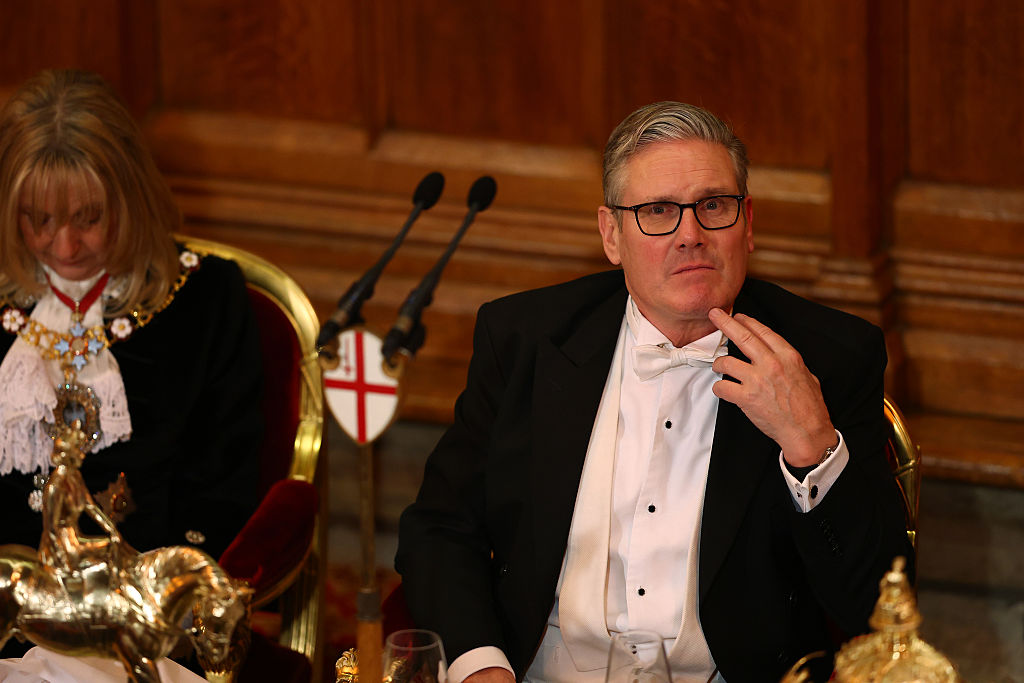
Prior to entering No. 10, Keir Starmer had little experience of foreign affairs. Yet in office, the subject has consumed a disproportionate amount of time, with a sixth of his premiership being spent abroad. So last night’s Lady Mayor’s Banquet speech at the Guildhall offered the Prime Minister a chance to set out his thinking. A year after his previous address, many of Starmer’s themes remained the same, as he summarised his own philosophy as ‘internationalism is patriotism.’
Yet reading Starmer’s speech, it is striking how little he seems to have been influenced by the events of the past year
Europe – so crucial to Starmer’s worldview – naturally was a staple throughout. He bemoaned how ‘Brexit broke the consensus’ that ‘Britain should be outward looking’ – a tradition ‘as British as fish and chips or the Guildhall itself.’ He compared Brexiteers to critics of the European Convention on Human Rights: ‘The same wild promises being made to the country, by the same people – walk away, and all our problems will be solved.’
But the main thrust of Starmer’s speech concerned China, which received 17 mentions in his 2,700-word speech. With the Prime Minister set to visit Beijing next month, he wants to portray his approach as neither starry-eyed Sinophilia nor hawkish isolationism. ‘Neither golden age, nor ice age’ was his summary – a jibe at David Cameron and Boris Johnson, respectively. ‘For years we have blown hot and cold’, he said. ‘We reject that binary choice.’
Instead, Starmer suggested that ‘strong purposeful engagement’ with China was possible. ‘Protecting our security is non-negotiable’, he said. ‘But by taking tough steps to keep us secure, we enable ourselves to cooperate in other areas.’ He rattled off some examples: climate change, global health, AI. In a room full of City bankers, Starmer did not miss the chance to talk up the prospect of increased trade with Beijing, declaring ‘our task is to help British businesses win their share of that opportunity.’
Yet reading Starmer’s speech, it is striking how little he seems to have been influenced by the events of the past year. There was no sign in his address that the collapse of British Steel, the failure of the Chinese spy trial, the threats over the Tower Hamlets super-embassy or the security minister’s spy warnings had made much of an impression on Starmer’s thinking – other than an obligatory reference to how China ‘poses real national security threats to the United Kingdom.’
Ahead of his trip next month, it is far from clear that his triangulation on China will yield results. In January, Rachel Reeves made her own trip to China. She received a paltry £600 million for her troubles – compared to £6.4 billion obtained on a similar trip recently to the Gulf. Can Starmer do better than that?
Comments