The Spectator brings you the latest insight, news and research from the front line. Sign up here to receive this briefing daily by email, and stay abreast of developments both at home and abroad:
News and analysis
- Covid-19 related deaths as of 17 April in England and Wales were 35% higher than the government’s hospital death figure. Details below.
- The Scottish government has recommended that people cover their faces with cloth garments when in public spaces. Dr John Lee weighs up the benefits of masks on Coffee House.
- A minute’s silence for key workers who have died during the Covid-19 outbreak was held this morning at 11 a.m.
- The families of NHS staff who have died of coronavirus will be given £60,000.
- Hospitals will restart non-Covid-19 services from today on a hospital-to-hospital basis.
- Whitehall officials failed to stock up on any gowns, visors, swabs or body bags as part of routine pandemic preparations.
- GPs nationwide have been placed on high alert after a rise in the number of children suffering from a rare and deadly inflammatory disease that could be linked to coronavirus.
- A group of researchers has said a vaccine for Covid-19 could be available this year. An Oxford University team plans to get efficacy results by September.
How many coronavirus deaths will Britain end up with?
The daily figure released by the government refers only to hospital deaths. Every Tuesday at 9.30 a.m. the ONS publishes all UK deaths (with a two-week time lag). They suggest that a third of Covid-19-related deaths take place outside of hospital: 21,284 mentions of Covid-19 on death certificates up to 17 April, vs 13,917 reported by government at that point. The FT is extrapolating this to produce a daily ‘nowcast’ for total deaths for Covid-19 which stands at about 44,000. But much can be lost in this fog of data: how many deaths with Covid-19 on the death certificate are primarily due to Covid-19? Neil Ferguson, No. 10’s epidemiological adviser, has suggested it could be as few as a third. And how many Covid-19 deaths are going under-reported? It’s just too early to say.
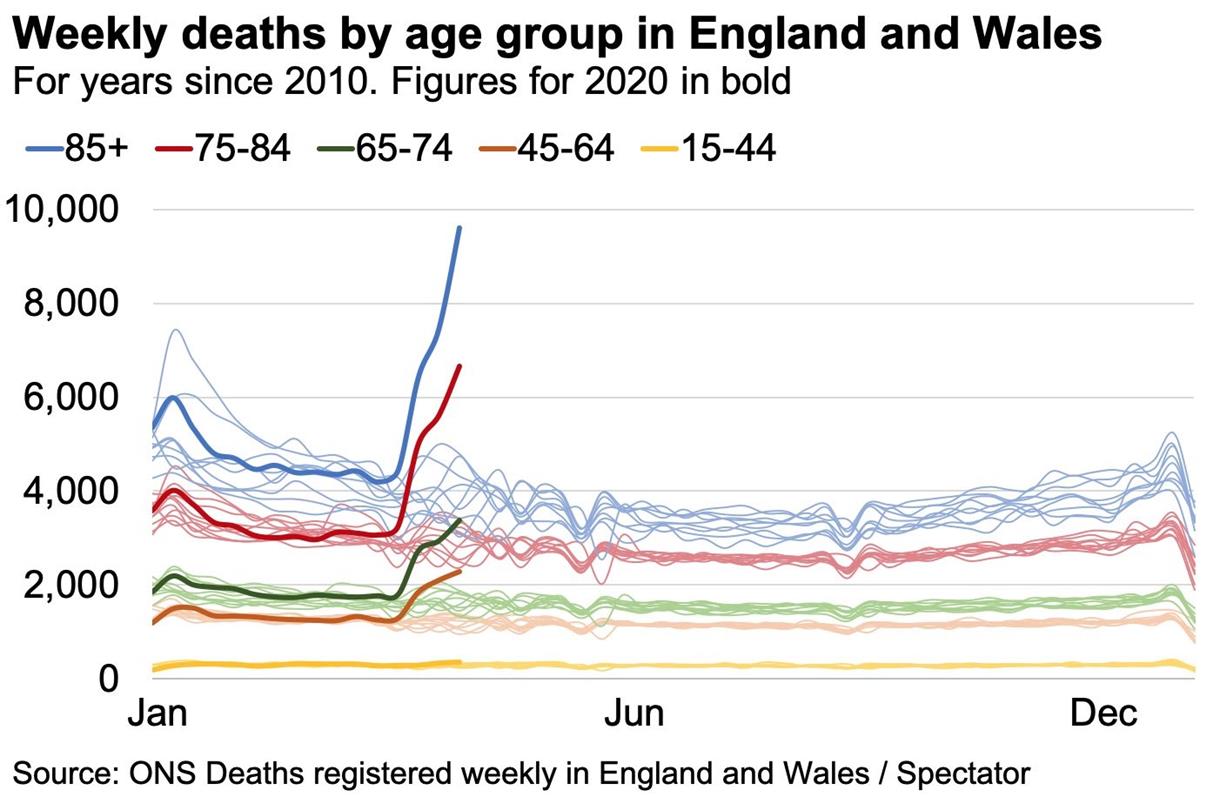
At The Spectator, we’re also keeping an eye on ‘excess deaths’ not caused by Covid-19, which now stand at 7,958 from 21 March until 17 April. When hospital admissions for emergency procedures, even heart complaints, are cut in half it raises the prospect of people dying who, pre-lockdown, might otherwise have sought care. So while today’s data shows ONS weekly deaths standing at the highest level since records began in 1993, this will be a result of direct and indirect deaths: from the virus, and from the disruption caused by lockdown and the plunging use of the non-Covid-19 health service.
For example, let’s look at care homes where ONS data showed a surge in deaths. But most of the growth in excess deaths is not due to Covid-19.
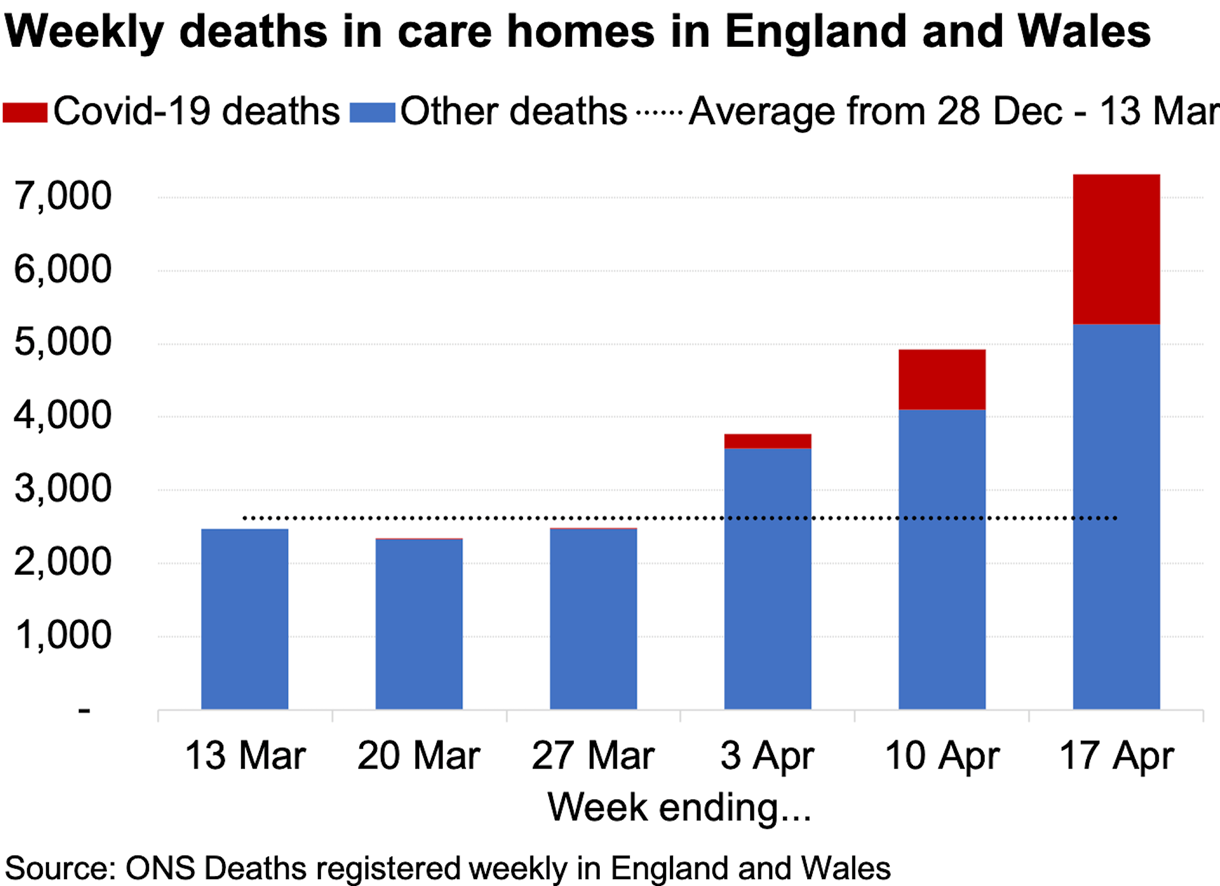
It’s something that needs more attention. Thousands of hospital patients were transferred to care homes as the NHS cleared the decks to prepare for an influx. This is a worry because care homes are far less able to cope with serious health complaints. When Germany’s Covid-19 infection rate (referred to as ‘the R’) hit 0.7, the health service was moved on to a more normal footing to better care for non-Covid-19 complaints. As Fraser Nelson disclosed last week, ministers have been told that ‘the R’ could be as low as 0.5 in the UK and 40 per cent of hospital beds and two-thirds of intensive care ventilator units lie empty. Sweden’s press conference (which has just taken place) gives daily info on how many empty beds there are. This information is not shared in the UK. Perhaps it should be, to inform a discussion about why there are four times as many empty hospital beds than usual for this time of year – and what’s happening to patients who would otherwise be cared for in those beds.
In words
The problem for cancer is going to be bottlenecks. The whole of April’s new patients are going to meet May’s new patients… and all those people are going to need chemotherapy, radiotherapy, other management downstream – and that’s where logistic problems will come. We’ve got to get going again to avoid a catastrophe in a year or two’s time when patients will suffer poor outcomes from their cancer because of delays.
– Professor Karol Sikora, a cancer specialist and dean of the University of Buckingham’s school of medicine, speaking to BBC Breakfast.
I can’t imagine why.
– Donald Trump’s response to hotline calls about disinfectant rising in the US. The President mused about injecting disinfectant in treating Covid-19 in a press conference last week.
Global news
- The Trump administration is investigating China’s handling of the outbreak. Donald Trump has said that China could have stopped the spread of Covid-19.
- New Zealand’s PM has claimed victory against coronavirus, as up to half a million New Zealanders head back to work and outdoor activities are resumed.
- Afghanistan has pardoned more than 12,000 prisoners in an attempt to curb the spread of Covid-19.
- Meanwhile Mexico has emptied its migrant detention centres to prevent outbreaks.
- More than 2.4 million Australians have downloaded the government’s Covid-19 tracing app.
- Officials in South Korea say North Korean dictator Kim Jong-un may be in hiding to avoid contracting Covid-19.
- Tokyo 2020 President Yoshiro Mori has said the Olympic Games – now postponed to 2021 – will be cancelled if the pandemic isn’t under control by next year.
- Argentina has banned all commercial flights until September.
- Repair work has restarted on France’s Notre Dame cathedral after the pandemic delayed reconstruction.
- Africa seems to have avoided the worst impacts of coronavirus so far, with experts cautiously optimistic.
Datawatch
Research
Different approaches, different outcomes
Was lockdown necessary to avoid a rising Covid-19 death toll? All eyes have been on Sweden, which deliberately did not follow the rest of Europe’s lockdown measures, and opted for a ‘herd immunity’ strategy instead, which has involved shielding the elderly and vulnerable and practising social distancing while keeping restaurants, pubs and gyms open, with the public largely able to go about their business as usual. But new analysis from Buzzfeed shows that while day-to-day life has remained largely unchanged, average weekly death tolls have not. In the three weeks to 19 April, Sweden experienced a 34.5 per cent rise in fatalities compared with previous years, while its neighbour Denmark – which implemented an early and strict lockdown – saw an increase of 6.5 per cent. Even accounting for differences in population size, early evidence from the Swedish Covid-19 model suggests that maintaining liberty has come with a major cost.
Coronomics
- A fifth of the workforce across Germany, France, the UK, Italy and Spain has been furloughed.
- The UK job retention scheme, which pays furloughed workers’ wages, will be rolled back gradually, Rishi Sunak says.
- Tesco will double its capacity for online deliveries in just one month.
- Film piracy in the UK has risen by 43% in a month.
- HSBC’s first-quarter profits have fallen by 48% to $3.2 billion. The bank’s new CEO Noel Quinn has blamed ‘the economic impact of the Covid-19 pandemic’.
- Up to 30,000 North Sea oil workers could lose their jobs after the crash in oil prices.
- Airbus have furloughed 6,000 staff in Europe. Its CEO has warned the Covid-19 outbreak could threaten the company’s existence.
- Greggs has begun to reopen some of its shops.
Our latest podcast
More from The Spectator
Is Harbin China’s new Wuhan? – Cindy Yu
Why Germany is reluctant to bail out Italy – Constantin Eckner
A cure for Covid may arrive faster than a vaccine – Matt Ridley
Is Britain’s coronavirus response bogged down in bureaucracy? – Professor Angus Dalgleish
Watch: Michael Gove interrupted by cat during key Brexit meeting – Steerpike




Comments