
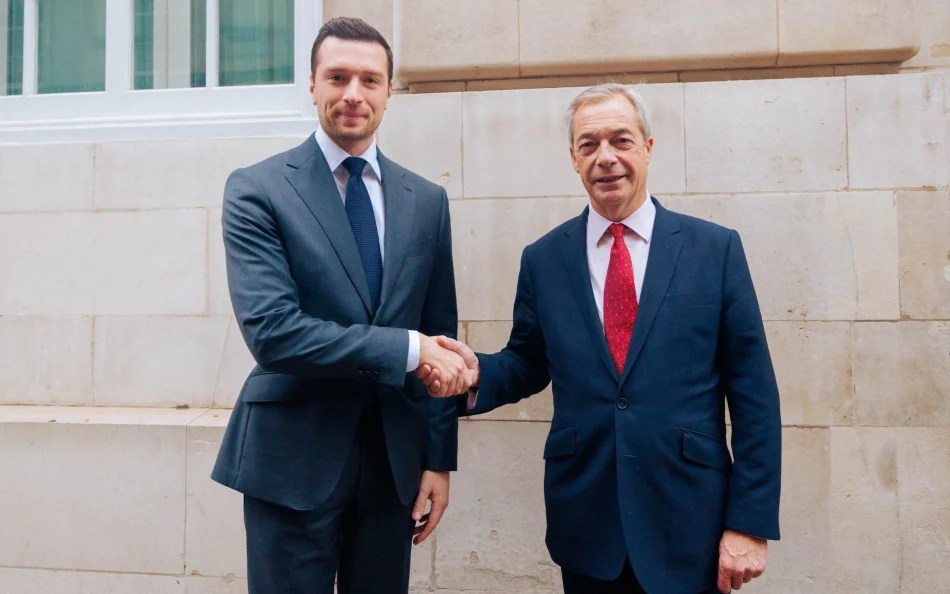
What will European politics look like in 2029? Nigel Farage is hoping that it resembles something like the pictures he posed for in London today, shaking hands and flashing smiles with Jordan Bardella, the president of France’s National Rally (RN). Both men are part of a pan-continental trend of radical parties challenging their established rivals to gain power in the years ahead. For Bardella, the crunch year is 2027, when President Macron’s term in the Élysée is up. Polls show Bardella is the RN frontrunner, with Reform keen to learn the lessons of best practice.
The two men had never met before but they shared a convivial lunch at 5 Hertford Street – with Farage’s partner Laure Ferrari serving as a translator. Farage, 61, is something of a lodestar for Bardella, 30, whose political career began when the Reform leader was already a well-established figure on the European scene. There are clearly shared goals between the two men, with Bardella remarking that ‘We must prepare our political movements to exercise power and that it is possible we will do so at the same time.’ It certainly fits with the ethos espoused by some figures in Donald Trump’s ‘MAGA’ movement, who believe that there ought to be common cause between the respective leaders of Europe’s radical right.
But what happens when Bardella and Farage’s interests do not align? Small boats is the most obvious area where they could be potential conflict – for the simple reason that Paris will never care as much about people leaving its territory as London will about people entering. So at lunch today, Farage decided to raise the issue with his guest, reasoning that Bardella ought to be told from the outset what any future Reform government would do. ‘Nigel made it clear’, says one attendee, ‘that we will leave the European Convention on Human Rights, and we will deporting those that come. But, ultimately, if it comes to it, we will tow the boats back to France.’
Bardella appears to have taken this straight-talking remarkably well. En route home, he gave an interview with the Telegraph in which he backed joint Franco-British patrols and pledged to allow UK Border Force to carry out ‘pushbacks’ in the Channel. This is a tactic that successive British governments have explored but been unable to deploy because France has refused to accept returned vessels. Bardella argues that such a practice ought to be allowed by British vessels as it is already used by European authorities to deter boats off the African coast: ‘I can’t defend the notion of pushbacks and then refuse to allow Great Britain to do the same.’
For Reform, such comments will be seized upon as proof that Farage’s personal standing carries significant weight with his European counterparts – some of whom have grown up watching him on YouTube. Even if Bardella fails in his bid for the Élysée, today’s meeting offers another example of the ‘shadow diplomacy’ which Reform likes to practice. Big sit downs with leading foreign figures is all part of their bid to portray Farage in a prime ministerial light. After a bumpy few weeks for the party, Lord Offord’s defection and the Bardella meeting are reminders that they do have a few tricks in the box when it comes to setting the news agenda.


Comments