
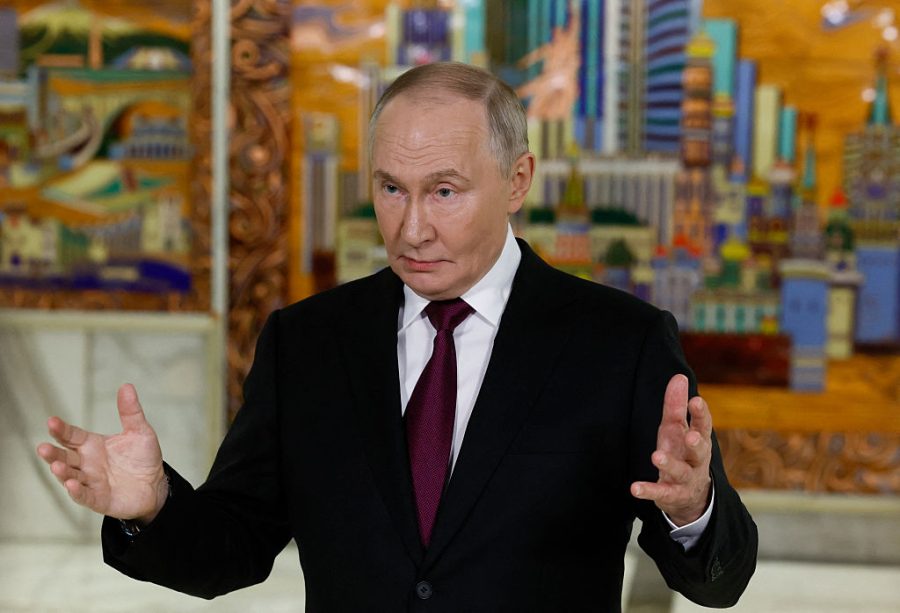
The Kremlin pulled out all the stops for the visit of Donald Trump’s son-in-law Jared Kushner and special envoy Steve Witkoff to Moscow today. Accompanied by Putin’s envoy Kirill Dmitriev, Witkoff and Kushner strolled through crowds on Red Square with minimal security after lunching at a fancy restaurant on Petrovka street. Not coincidentally, Chinese foreign minister Wang Yi was also in town for a meeting with Russian Security Council head Sergei Shoigu, where Russia affirmed its support for Beijing’s One China policy.
It was a sophisticated piece of great power signalling intended to send a multi-part message to Donald Trump. First and foremost, the Kremlin was showing off its new solidarity with China – the DragonBear alliance ready to step up as the world’s next dominant superpower. Second, it was demonstrating that Russia regards Ukraine as a mere detail in a much larger geopolitical realignment where three great powers carve up the world between them and Europe is relegated to a yapping irrelevance. Third, by walking Witkoff through the streets of Moscow – including a stroll past the TsUM department store with its window displays piled with luxury, sanctions-busting Western goods – the Kremlin was showing off the Russian capital’s obvious wealth, stability and security. This is a city that hasn’t noticed there’s a war on, went the Kremlin’s not-so-subliminal message. It’s a city where top officials can stroll through crowds with no fear of being accosted by angry citizens.
Putin has good reason to believe that his opponents and rivals are in worse shape than he is
Even as he talks about a peace plan for Ukraine, Vladimir Putin believes that the world is going his way. Yes, his economy has been battered by huge war expenses and sanctions – and is about to be battered a whole lot more by Ukrainian attacks on shadow fleet tankers at sea, on oil terminals and refineries. But all in all, Putin has good reason to believe that his opponents and rivals from Washington to Brussels to Kyiv are in worse shape than he is. And that belief is the wellspring of his stubborn insistence on sticking to his maximalist war aims. Even as European leaders and Volodimir Zelensky whittle down the White House’s 28-point peace plan – dubbed the ’28PPP’ – the Kremlin seems to be going in the opposite direction, insisting that the 28PPP does not go far enough in Russia’s favour.
The very fact that Washington is so eager to talk peace is seen by the Kremlin as a sign of weakness, argues former Russian diplomat Boris Bondarev, the most senior Russian official to defect to the West in protest at the 2022 invasion. ‘The emergence of such a US initiative signals, in Putin’s view, that Washington is capitulating … not because it has suffered losses but because it is tired, frightened and eager to avoid involvement,’ wrote Bondarev in a recent essay. From Russia’s point of view, Trump is ‘declaring the impotence of a superpower incapable of defending its own interests’. Worse, Trump ‘does not understand that once a state pledges support to an ally, it cannot abandon that promise so ostentatiously,’ says the former diplomat.
The Trump administration has already indicated it is willing to recognise both the Donbas and Crimea as Russian. More significantly, even prominent pro-Ukraine Senator Lindsey Graham has made it clear that the US will never contemplate Ukraine in Nato – something that has long been obvious but which former US Secretary of State Antony Blinken refused, fatefully, to put on paper on the eve of the war. With Kyiv’s most powerful one-time ally already conceding these fundamental points at the very beginning of talks, why would Putin not be tempted to push for even more?
On the front lines in Ukraine, Russia is positioning itself for further advances on the ground. The grim and protracted battle for control of the Donbas town of Pokrovsk – which Putin announced had fallen this week – have distracted attention from much larger Russian advances in the south around Zaporizhzhia. Russian forces occupied some 502 square kilometres of territory in November, mostly in this sector, four times more than in September. The Kremlin’s troops are now just 20 kilometres from the provincial capital of Zaporizhzhia – the third largest city on the eastern bank of the Dnipro river after Kharkiv and Donetsk – and are moving to surround Hulaipole. Moscow’s ruthless and systematic air war against Ukraine’s energy grid is moving towards its grim goal of plunging whole regions into winter darkness.
In Kyiv the political mood is febrile. Last week Volodymyr Zelensky was forced to fire his closest adviser and right-hand man Andriy Yermak after anticorruption police investigating an ugly $100 million (£76 million) embezzlement scheme of defence construction funds raided his home. The war profiteering scandal has already claimed several of Zelensky’s top ministers and friends. This week Ukrainian MPs blocked the start of parliamentary proceedings with chants of ‘government out!’
According to Zelensky’s former spokesperson Iullia Mendel, ‘Ukraine’s parliament is paralysed … The country’s long-simmering political crisis has now reached its boiling point.’ Political analyst Volodymyr Petrov, a longstanding friend and mouthpiece of Zelensky’s, claimed in a television interview on Tuesday that found Zelensky ‘tired of us … I feel like he’s decided to send us all to hell … he’s tired of explaining to all of us why the fuck we need this war.’ He also predicted, without producing evidence, that ‘by 15 December we will sign a ceasefire and Zelensky will leave’.
Zelensky himself has been touring European capitals to drum up diplomatic and financial support, exchanging hugs on the steps of Paris’ Elysee Palace with his stalwart supporter – and critics say, fellow lame-duck – French President Emmanuel Macron. Characteristically upbeat, Macron claimed that a new round of European sanctions against shadow fleet tankers that carry some 40 per cent of Russia’s oil will soon bring Russia to its knees. ‘I truly believe that in the coming weeks, the pressure on Russia’s economy and its ability to finance the war will change dramatically,’ said Macron.
Yet even as he spoke, the European Central Bank effectively killed off Europe’s plan to raise a €140 billion (£123 billion) ‘reparations loan’ backed by frozen Russian assets on the grounds that the loan would violate EU treaties. ‘This shows the hard limits of ‘donor-onomics’,’ says former head of Ukraine’s Central Bank Kirilo Shevchenko. ‘Europe wants to support Ukraine at scale, but no major institution wants to underwrite the legal and political risks tied to Russia’s immobilised assets.’ The proximate result of that decision is that Kyiv is fast running out of options to finance a continued war.
Even former Ukrainian foreign minister Dmytro Kuleba, a long-time stalwart of talks with Ukraine’s allies for the first three years of the war, admits that ‘the time has come to acknowledge a deep and painful truth” that ‘Ukraine is facing a tactical defeat … as soon as we recognise that and face it, we can start rebuilding our future’.
With military disaster and political crisis stalking Kyiv, an economic squeeze rendering Europe strategically impotent and a US administration in a hurry to do a peace deal at almost any price, it’s small wonder that Putin believes that time and destiny is on his side. Yet at the same time, as Kuleba pointed out, Ukraine remains independent and free, for all Putin’s attempts to crush it. And as long as that remains true what Putin has achieved is not victory but a very bloody annexation of the Donbas, leaving the remaining 80 per cent of Ukraine beyond his command.

Comments