Fredericksburg, Virginia
Ask an American to name the author of the line ‘Sleep, that knits up the ravelled sleeve of care’, and he will promptly reply ‘Shakespeare’. It’s pure guesswork but we always credit the Bard with anything that sounds like a literary quotation, so he inadvertently gets it right. But if you recite the rest of the passage and ask what it means you will draw a blank. The American mind will not spark until it hears ‘Macbeth hath murdered sleep’, which sets off a cascading display of audience-identification fireworks, and visions of a new American production in which Macbeth is renamed Big Thane and cast as the hero of the play.
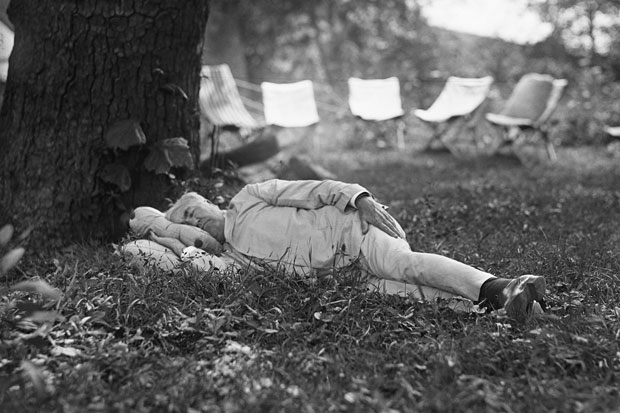
Americans are so afraid of sleep that we see nothing wrong in murdering it. Sleep takes time away from our pursuit of the American Dream of success and hence must be eliminated. We came to this conclusion through our worship of the most successful American who ever lived, the inventor Thomas Edison. We had always been pragmatic about working hard to get ahead, but the example Edison set moved us into the realm of mysticism. He owned a thousand patents! How did he do it, how did he find the time? There were only 24 hours in a day — when did he sleep? As the moving pictures, phonographs, electricity and incandescent light bulbs poured one after another from his laboratory, the rumour arose that he was some sort of medical miracle who needed no sleep at all. Appreciating the publicity value, he let his assistants drop stories about his practice of catching 40 winks in his lab while stretched out on a table or a shelf, fully clothed and indifferent to ‘sore labour’s bath’. It caught the American imagination, and the catnap, Edison’s greatest invention, was born. It is with us still and is the root of our subconscious belief that getting enough sleep is inimical to success, if not a prediction of outright failure. Our war on sleep is hard to miss. TV interviewers ask today’s hard-driving inventors like Bill Gates how long they sleep, as they asked Steve Jobs before he died young. When the guest leaves, the interviewers bat the question around with each other, boasting about ‘pulling all-nighters’ in college or claiming ‘I’m OK with five’, revelling in a festival of one-downsmanship about how few hours they can ‘get by on’. If the standard recommendation of eight hours a night gets mentioned, it is treated with genial contempt and the insistence that ‘everybody’s different’. The commercial break comes while somebody is in the midst of saying ‘I can’t sleep eight hours at a stretch.’ They won’t let it go. They are like sentries in an ancient army, assigned to stand watch and knowing they will be impaled if they doze off. Genderwise, to use our favourite adverbial form, men stand to gain the most from the Macbething of America. Maybe women are being punished for inventing the sexual euphemism ‘sleep with’, but their biggest stumbling block on the road to Having It All is not education or ability but sleep. Sleep is a career move in the wrong direction because nothing must be allowed to interfere with feminism’s ironclad myth that a woman with young children is no sleepier than anybody else. She is really up against it if she has a new baby, the very symbol of sleep, who makes everyone think hypnotic thoughts of cradles rocking… rocking… rocking. The wisdom of the ages having been repealed, it is foolhardy to point out that new mothers used to solve this problem by napping while the baby napped (‘great Nature’s second course’) because you might be slapped with a discrimination lawsuit for saying that women need more sleep than men. It would not be the first time we combined discrimination against women with discrimination against sleep. Used together in yesteryear’s popular entertainment, they meant ‘bad wife’, like the messy housekeeper who slept until noon portrayed by Shirley Booth in Come Back, Little Sheba, or two-timing hussy Jean Harlow in Dinner at Eight, who also stayed in bed until noon. Somewhere along the way we dropped the wives and made ‘sleeping till noon’ a workplace execration against slobs and cheaters, as well as a pot of ashes to dump on our own heads when we need to do penance for knocking off work early and going to bed. Discussing the Macbething of America is an iffy, sometimes perilous business. It’s like saying ‘rope’ in the hangman’s house. Never tell anybody, ‘You look sleepy.’ He will think you are after his job. Never tell anybody ‘Don’t lose any sleep over it’ because then he will know you are. Never say ‘Try to get some sleep’ because no matter how kindly and well-intentioned you try to sound, it will come across as threatening. Even the familiar adage counselling prudence will be taken the wrong way, so never say ‘Sleep on it.’ You will only end up like the father of the teenaged nymphomaniac who tried to arouse her latent fastidiousness by making her read The Princess and the PeaWe believe that getting enough sleep is inimical to success, if not a prediction of outright failure



Comments