Massachusetts
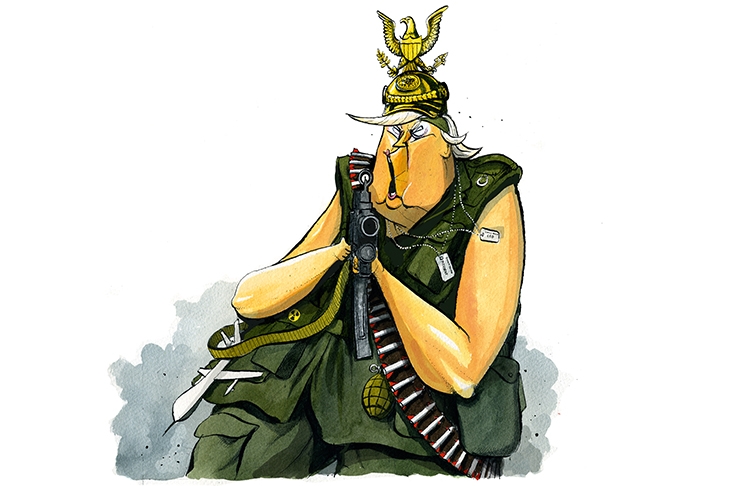
All politicians wear masks. Donald Trump’s favourite is that of Maximum Leader. It was on display during this past week. ‘If China is not going to solve North Korea, we will,’ he said at the weekend, ahead of his meeting with Xi Jinping — a throwaway comment that could end up causing mayhem in the Far East. Next, his reaction to news of a chemical bombing in Syria. Trump blamed the atrocity on his predecessor’s ‘weakness and irresolution’, suggesting that he is keen to show the world what strength and resolve look like. The President, it seems, is not too dissimilar to the nightmare his political enemies warned us about: a nuclear-armed hothead itching to show the world how tough he is.
Since Trump’s election, talk of fascism on the rise in America is omnipresent — 241 years after declaring independence, the United States finds itself compared to the Weimar Republic, which lasted barely a decade. Serious observers liken Donald Trump to Adolf Hitler, with others casting his strategist Steve Bannon or press spokesman Sean Spicer (take your pick) as Joseph Goebbels. Mein Kampf (presumably in English translation) is said to serve as Trump’s ‘playbook’. Trumpism, we are told, is repackaged Nazism.Andrew J. Bacevich is joined by General Sir Richard Barrons and Heather Williams to discuss Trump’s wars: As with so many earlier bouts of American political paranoia — recall that Franklin Roosevelt, Harry Truman, and Dwight D. Eisenhower were each denounced as tools of international communism — this one has its comic aspects. Yet silliness aside, comparisons between Trump and Hitler are unhelpful. Rather than furthering our understanding of the Trump presidency, they impede it. What we confront is troubling enough. Still, there remains something irresistible about dredging up bits of the past to explain the present, especially when colourful personalities are involved. So let me propose an alternative to those who see Trump as Hitler sans the moustache (although retaining the bad haircut). Stick with Germany, its villainous past making it an agreeable foil for us Anglo-Saxons. Rather than focusing on the Third Reich, however, consider the Second. That’s right: Donald Trump as Kaiser Wilhelm II. Almost precisely 100 years after the USA intervened in the Great War, few Americans can differentiate between Hohenzollerns and Habsburgs. Unless it concerns Alexander Hamilton or Abraham Lincoln, we don’t do much history predating 7 December 1941. But for British readers, citing a German emperor as a figure worthy of note might not seem far-fetched. That Wilhelm was the last monarch to rule Germany was in no small measure due to his own folly. When he assumed the throne in 1888, Germany had already emerged as a great power and proud possessor of the world’s mightiest army. As Kaiser, Wilhelm was determined to make Germany greater still, his stated ambitions not differing materially from Donald Trump’s vow to ‘Make America Great Again’. The Kaiser was given to bluster, which concealed his own fears and insecurities. In his role as supreme war lord, he loved playing soldier, sitting astride some magnificent mount as grenadiers, uhlans, cuirassiers, and infantry regiments without number paraded by in review. He coveted colonies and wanted a navy that would stand comparison with that of his British cousin. He was impatient and ambitious. Yet Wilhelm knew nothing of statecraft. A gambler and an opportunist, he lacked prudence. ‘He knew how to make the gestures, to utter the word, to strike the attitudes in the imperial style,’ Churchill wrote in profiling the Kaiser. ‘He could stamp and snort’ but he possessed neither character nor consistency nor foresight. His modus operandi was to raise a ruckus and to see what might happen. Impulse took precedence over calculation. In the long run-up to the war of 1914-1918, the Kaiser’s penchant for recklessness was on full display. On multiple occasions, he instigated crises that brought Europe to the brink of war over issues that no European leader viewed worth fighting for. Take the Agadir Crisis of 1911. Annoyed that France was asserting primary influence in Morocco without properly accounting for German interests there, the Kaiser opted for a show of force. Dispatching the gunboat Panther
In all likelihood, Trump himself does not know what he intends. He’s operating on instinct

Comments