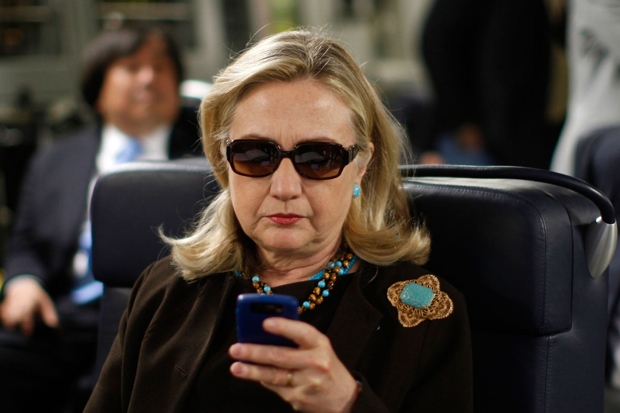
Here’s a sentence I never thought I would write: I feel sorry for Hillary Clinton. Following months of scandal over her email shenanigans (in a nutshell: she’s been using a private email address rather than her government one) she’s just had to hand her email server to the FBI. And anyone who has so much as a smidgen of the DNA that makes up the empathy gene must surely be thinking to him or herself: ‘Oof. Poor Hillary.’
Imagine having to pass every email you’d ever written — whether in jest, anger or horniness — to the powers-that-be, knowing they could be pored over in public. I know what I’ll have to do if this ever happens to me: spend a day phoning everyone I’ve ever met to apologise for that thing I said about them, before making plans to move to Mexico to live out the rest of my days in a hut made of shame. IT whizzkids will say: Duh, nothing online is truly private. And no doubt that’s true. But the vast majority of us nonetheless treat email as if it were a no-go zone beyond the long snouts of nosey parkers. And we do so for a very understandable reason: because everyone needs a space in which they can speak frankly; have thought experiments that won’t be exposed; take intellectual risks without risking ridicule. This is the real problem with the hounding of Hillary over her emails: it speaks to the starving of politicians of precisely that kind of space. Under today’s cult of transparency, where politicians are judged less for what they say than for how clean-cut and see-through they are, for how faithfully they register every drink-with-a-hack or lunch-with-a-fatcat, the ability of politicians to speak purely privately is diminished. And, not surprisingly, this means some are seeking out less-watched arenas in which they might say what they really think. Yes, Hillary broke the rules (the Federal Records Act says officials’ private emails must be stored on government servers). But I understand why. She wanted a zone in which she could let rip. And she isn’t the only one. Our very own Michael Gove got in trouble in 2011 when he and his closest education advisers were found to be using gmail accounts to gab about education policy, apparently in order to dodge the possibility that their chats would be exposed under a Freedom of Information request. One of Gove’s exposed emails simply said ‘AAAAAARGGGGGHHHH!!!!!’, in response to a judicial review of his decision to cancel the Building Schools for the Future programme. ‘AAAAAARGGGGGHHHH!!!!!’ — don’t we all sometimes feel the urge to speak so viscerally? The Independent accused Gove and his team of ‘cloak-and-dagger activity’. Come on. All they were doing was speaking completely off-record, in a franker way than can be done in a committee room or a press conference. The treatment of even the sending of private emails as ‘cloak-and-dagger’ shows how mad the cult of transparency has become. It’s the tyranny of transparency that forced Gove, Clinton and no doubt others to create dark, unseeable zones for political chatter. In an era when every lunch must be registered, when leakers love to tell-all about what some suit said to another suit at the watercooler, when whistleblowing is all the rage, privacy and frankness have become tantamount to crimes. And that’s really bad. Politicians, like the rest of us, need to be able to think out loud before they actually speak out loud. That’s the only way they can make policy: through risky, daring discussions, before serving up the final product for us, the public, to judge. When we rob politicians of such a thoughtzone, we harm democracy: politicians will be discouraged from ever stating their true thoughts, lest someone expose them, and the backroom meetings in which ideas ought to be aired and hammered out will become frozen, unadventurous places. The ironic end result of the cult of transparency: less honesty and less substance in politics. Brendan O’Neill
Make politics more 'transparent' and politicians will become less honest




Comments