
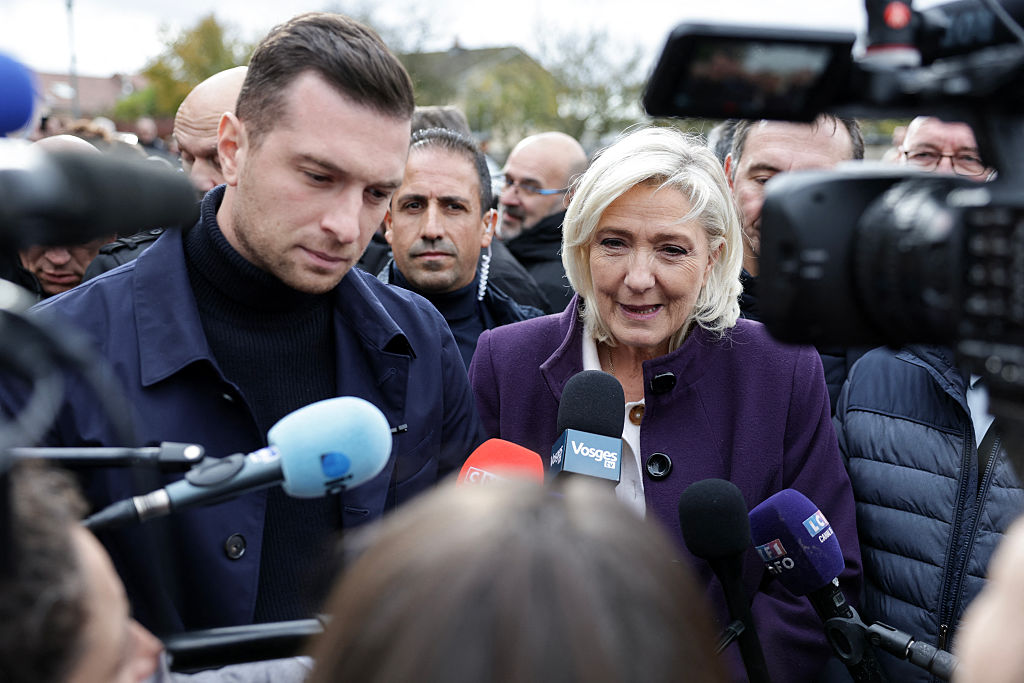
Jordan Bardella has been physically attacked twice over the past five days. Flour was thrown over him at an agricultural fair in Burgundy, then this weekend an egg was crushed on his head at a book signing in Moissac in the Tarn-et-Garonne. He walked away unharmed, but the incidents could easily have been more serious. They come at a moment when Bardella leads the polls to become France’s next president, with Marine Le Pen increasingly sidelined after she was barred from running by the courts. Right-wing officials and politicians are facing a steady rise in insults, threats and physical aggression.
France is edging towards a hierarchy of victims in which the acceptability of violence depends on the political alignment of the target
The National Rally is directly targeted by this violence. During last year’s campaign in Saint-Étienne, Hervé Breuil, a National Rally candidate, was assaulted by masked extremists and taken to hospital with a suspected stroke. And in April in Albi, ten hooded militants set upon Clément Cabrolier, the son of a National Rally councillor, beating him in the street until he managed to take refuge in a hotel.
A climate has taken hold in which assaults of National Rally politicians are increasingly treated not as political violence but as a form of resistance. Each new attack is condemned by the left – and then followed by the insinuation that the victim somehow brought it upon himself. The idea has settled on the left that the National Rally lies outside the democratic norm and can therefore be handled outside it, a shift with consequences that reach far beyond a few handfuls of flour.
A journalist on the left-leaning BFMTV commented after this weekend’s attack that while she condemned what happened, Bardella remained a target of political violence due to what she described as his violent and Islamophobic arguments. It was a familiar formula: the effect is not to excuse the assault outright, but to place it in a moral hierarchy where the real offence is the politics of the victim rather than the act committed against him.

The journalist’s comments were seized upon by the National Rally as another attempt to normalise intimidation. The party has filed a complaint with the media regulator, arguing that this style of commentary creates a permissive atmosphere in which attacks are framed as reactions rather than the attacks that they are. There’s a current of opinion that regards the National Rally not as a democratic adversary, but as a threat to be confronted by exceptional means.
This logic is not uniquely French. It mirrors a pattern long established in the US, where so-called progressive commentators have perfected the art of treating conservative speech as a form of violence while recasting actual violence against conservatives as a regrettable but somehow understandable response. Charlie Kirk was accused of creating a climate in which extremism flourished. MPs and candidates in the UK also report a rise in threats, harassment and street-level aggression.
National Rally politicians in France have been told that their positions on immigration, security or Islam amount to provocation. By the time an egg or a fist lands, the attacker is framed not as an aggressor but as someone pushed to the end of their tether by the rhetoric of the far right. It’s a convenient fiction that allows France’s establishment to maintain its claim to non-violence while tolerating a steady escalation of intimidation against its political opponents.
This posture has been encouraged by a wider ecosystem of activists and political figures who suggest that the National Rally is a force so dangerous that ordinary democratic norms do not apply. La France Insoumise has been particularly energetic in this respect, denouncing the National Rally as a fascist threat with a frequency that borders on ritual. They suggest that the National Rally doesn’t simply hold objectionable views, it represents an existential menace to the Republic itself. Left wing MPs refuse to acknowledge National Rally colleagues, let alone shake their hands. Once that idea takes hold, the boundary between confrontation and intimidation begins to blur. The dehumanisation process begins.
France is edging towards a hierarchy of victims in which the acceptability of violence depends on the political alignment of the target. The attacks in recent days on Bardella may seem trivial compared with the assaults suffered by some of his candidates, yet they mark the point at which a normalised hostility towards one party produces a steady stream of minor humiliations and occasional blows. The left insists that it’s defending democracy against the ‘far right’, yet its approach will undoubtedly lead to more serious attacks.
Presenting violence against the National Rally as a form of civic virtue is a dangerous step. It grants moral cover to intimidation and ensures that each boundary crossed becomes the starting point for the next one. Once violence is recast as virtue, the slide towards more serious attacks is not a risk but an expectation. Bardella’s two attackers were amateurs. The climate that encouraged them will produce worse.




Comments