
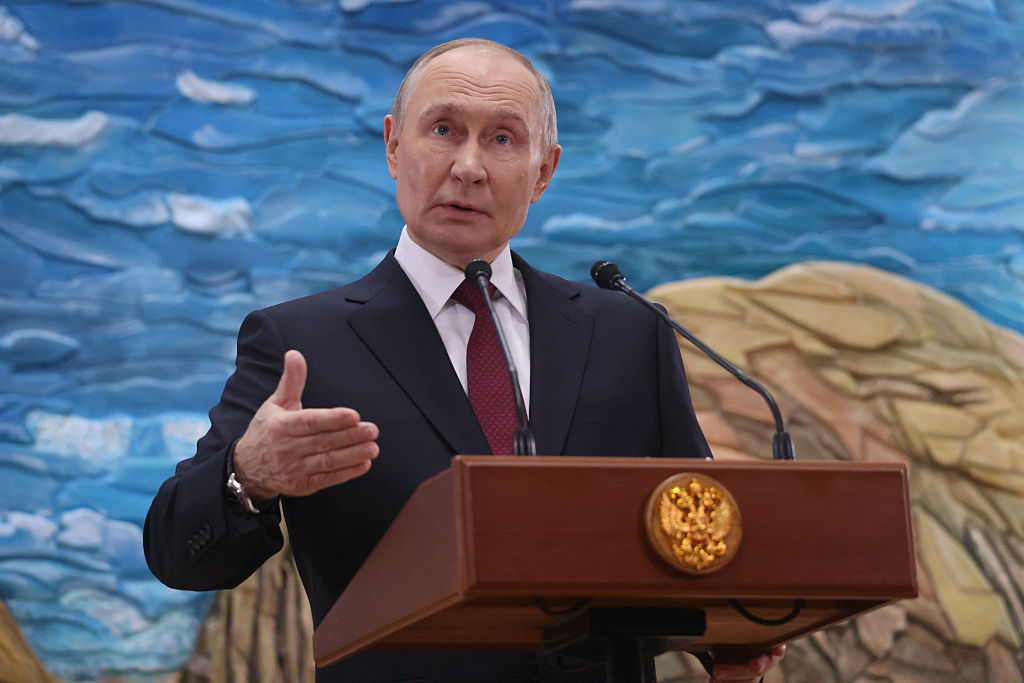
Steve Witkoff’s sixth visit of the year to Moscow seems to have ended again with very little to show for it. The US special envoy was in the Russian capital, accompanied by Jared Kushner, Donald Trump’s son-in-law, to meet President Vladimir Putin and present the latest version of a peace plan to end the war in Ukraine. Little is currently known about the contents of the peace plan itself.
Witkoff and Kushner spent five-hours with Putin in the Kremlin. Speaking after the meeting, Russian presidential aide Yuri Ushakov called the summit ‘very useful, constructive and substantive’ but said that ‘a compromise hasn’t been found yet’. Asked whether peace was closer or further away after the talks, Ushakov’s answer was an unpromising ‘definitely not further’.
As has become par for the course in Trump’s diplomatic handling of the conflict, no Ukrainian representatives were present at the meeting – nor were any of Kyiv’s European allies. Speaking bullishly earlier in the day, despite the mild cold that left him with a husky voice and cough, Putin claimed that Ukraine’s European allies had ‘sidelined themselves’ from the negotiations because they were unhappy with the direction the conflict is taking.
Accusing the continent of lacking a ‘peaceful agenda’, Putin warmed to his theme, adding that Europe was intent on sabotaging Trump’s plan for peace. The Kremlin has steadily been pushing this narrative since the summer: that Ukraine and its allies, and not Russia, are the true obstacles to peace. If that wasn’t clear enough, in answer to a follow-up question on the ever-rising tensions with Nato, he added: ‘We are not planning to go to war with Europe, I’ve already said this a hundred times. But if Europe wants to and starts, we are ready right now.’’

The ‘sabotage’ Putin was likely referring to was the backlash to Witkoff’s original 28-point peace plan, after it emerged it had been jointly authored with Russia’s sovereign fund chief Kirill Dmitriev last month. The Americans had to go back to the drawing board, meeting with a Ukrainian delegation to scrap, rewrite and tweak points on the plan. Unsurprisingly, proposals to drastically cut the size of Ukraine’s army, hand over the Donbas region to Russia and ban Kyiv from ever joining Nato were red lines the administration of Volodymyr Zelensky was unwilling to agree to. Talks between Witkoff and Ukrainian national security chief Rustem Umerov continued right up until Monday in Florida, just hours before Witkoff set off for Moscow. Neither side was able to confirm whether those points of contention were resolved.
With the White House erratically swinging between supporting and publicly shooting down Ukraine’s calls for a just peace, there is every chance that after last night whatever was settled between Witkoff and Umerov will not last. More than any of Trump’s team, Witkoff appears to be particularly susceptible to the Kremlin’s siren song of chummy future Russo-American collaboration. As the co-author of the original 28-point-plan which many of Ukraine’s allies rightly saw as conceding to Putin’s maximalist demands, few in Europe trust Witkoff to keep Ukraine’s interests at heart.
Yesterday was the first time Witkoff has met with Putin since leaked phone calls revealed he had been coaxing Ushakov – also present at yesterday’s summit – on how to prep the Russian president for a phone call with Trump. Moreover, a report last week also revealed the details of a plan supposedly being drawn up by Witkoff, Kushner and Dmitriev to grant the US privileged access to Russian central bank assets – currently still frozen in Europe – after the war in Ukraine comes to an end.
Speaking to the press after the talks finished, Ushakov was reluctant to give too much away. ‘Some American proposals [for a peace settlement] appear more or less acceptable, but they need to be discussed. Some of the formulations we were offered are unacceptable. Therefore, the work will continue,’ he said.
Earlier yesterday, Kremlin spokesperson Dmitry Peskov declared that Russia did not intend to do negotiations through a ‘megaphone’. As with the deliberate aura of mystery that Moscow cultivated around the Alaskan tête-à-tête between Trump and Putin in August, this could suggest a tactic to hide the fact that the Kremlin is potentially considering rejecting the terms brought by Trump’s representatives. Any hint to the Americans that Russia, and not Ukraine (as the Kremlin would have Trump believe), is the true hurdle to a peace deal would bring the ruse crashing down.
Shortly after their meeting in the Kremlin drew to a close, Witkoff and Kushner departed for Europe – reportedly Brussels – where they will meet with Zelensky today to brief him on yesterday’s developments. It is safe to assume that only after Zelensky has been briefed by Witkoff and Kushner will Ukraine’s European allies find out how the plan for peace has evolved.
Nevertheless, it is clear that even the White House sees yesterday’s talks as just one more of many meetings over Ukraine’s future to come. Having abruptly set a deadline last month for striking a peace deal by 27 November, Trump gave the clearest indication yet over the weekend that he had dialled back the time pressure: ‘I don’t have a deadline’ for the war being over, he said. When that moment is likely to come – and at what cost to Ukraine – will become clearer in the hours and days ahead.


Comments