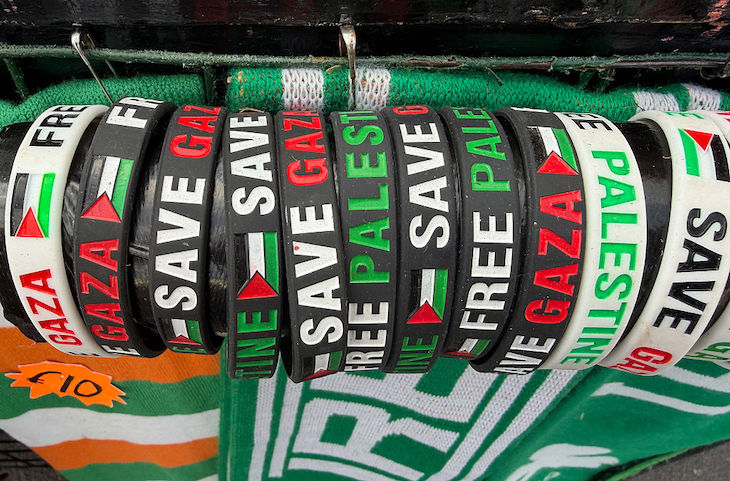
Dublin’s councillors have seen sense – for now. They were due to vote today on a proposal to rename the city’s Herzog Park. Chaim Herzog – the Belfast-born, Dublin-raised, British officer who helped liberate Bergen-Belsen, and became the sixth president of Israel – was set to be be airbrushed away in a ritual of performative righteousness. Some even proposed ‘Free Palestine Park’, a slogan as empty as it is vicious, as its new name. But late last night, Dublin City Council boss Richard Shakespeare said he was proposing to withdraw the report that could have led to the renaming of Herzog Park, on a point of legislative technicality. He apologised for ‘administrative oversight’. This will offer little reassurance to Dublin’s worried Jews.
This is not about a park. It is about whether Ireland still believes its Jewish citizens belong
The motion to erase Herzog’s name, which began last December with a Labour councillor, was turbo-charged by Sinn Féin and People Before Profit, and was steaming towards a vote today. Those who wanted the park’s name changed spoke blandly of Herzog’s ‘connections to Israel’. But they were quieter on the bravery of a man who, in 1945, walked through the gates of hell at Bergen-Belsen and vowed the world would never again be silent. There was nothing much said either about his father, Yitzhak HaLevi Herzog, Ireland’s first Chief Rabbi, who swapped mathematical puzzles with Éamon de Valera and embodied the quiet integration of Jews into the new Free State. They were quiet, too, on the present Israeli president, Chaim’s son Isaac, who called the proposal ‘shameful’.
Even the Taoiseach, Micheál Martin, and Ireland’s Foreign Minister begged the Dublin councillors to drop it. An international outcry appears to have forced them to finally see sense. But make no mistake: anti-Israel fervour has become the new communion wafer of parts of the Irish left. This is not an isolated spasm. It is the latest symptom of a very old disease.
In Fairview Park, a bronze statue of Seán Russell still stands, arm raised in fascist salute. Russell, IRA chief of staff, travelled to Berlin in 1940 to beg weapons from the Reich; he died aboard a German U-boat returning to Ireland to wage war on Britain. Dublin keeps his statue pristine. The man who freed captives from Belsen must make way for a Nazi collaborator’s memory because, decades later, his son wore an Israeli uniform. The hypocrisy is almost artistic.
Ireland’s wartime record offers further dark comedy. Eamon De Valera, the former president of Ireland, offered his condolences to the German legation on Adolf Hitler’s death – an act of punctilious neutrality that horrified the Allies. Yet de Valera also sheltered Jewish refugees, and Israel thanked him in 1966 by planting the De Valera Forest near Nazareth. Complexity, apparently, is a privilege reserved for Irish nationalists alone.
Post-war, the country gave quiet refuge to Nazi war criminals: Otto Skorzeny bought a farm in Kildare; the Breton SS officer Celestin Lainé lived out his days in Galway. Their welcome was never rescinded.
Since October 7, 2023, antisemitic incidents in Ireland have soared. Synagogues daubed, Jewish schoolchildren taunted, bricks through windows. Last week, Sinn Féin hosted the punk band Bob Vylan, whose frontman led a Glastonbury mob in chants calling for death to Israel’s military. The same country that recognised Palestine in 2024 – a gesture applauded by Hamas – now contemplates erasing the name of an Irish Jew who fought fascism.
Dublin already boycotts Israeli academics and leads Europe in anti-Israel UN resolutions. The Israeli embassy in Dublin has been closed by Israel over the extreme anti-Israel policies of the Irish government. Israeli officials now call it, without fear of contradiction, the antisemitic capital of Europe.
This is not about a park. It is about whether Ireland still believes its Jewish citizens belong.
If Herzog’s name does eventually fall, something larger falls with it; the claim that the Republic is an inclusive nation, rather than a monocultural tribe in progressive clothing. A country that erases the memory of the man who liberated Belsen while polishing the statue of the man who courted Hitler has chosen which side of history it wishes to stand on.
And history, whatever the councillors imagine, is not easily fooled.


Comments