
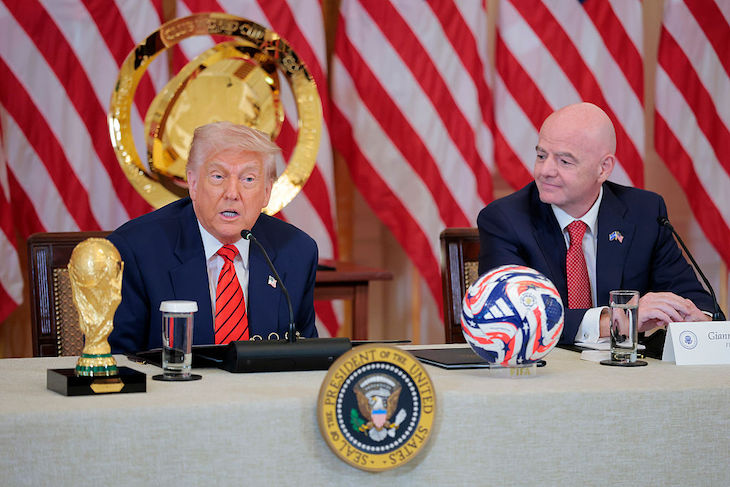
Today’s World Cup draw in Washington, presided over by Fifa president Gianni Infantino with best buddie president Donald Trump at his side, is intended to whet appetites, set pulses racing and, most importantly, get fingers twitching on booking sites for tickets, flights, and hotels for next summer’s North American extravaganza.
The World Cup 2026 is poised to be not just the biggest ever, but the biggest rip-off ever
For those giddily contemplating the trip to North America next summer – not least we Scottish fans who have been denied a place at the party for so long – a cold, hard reality is about to bite. For the World Cup 2026 is poised to be not just the biggest ever, but the biggest rip-off ever. I’ve seen some of the ticket prices and short of The Spectator sending me on an all-expenses paid trip, I will not be dusting off my kilt (last seen in St. Etienne in 1998) and joining the Tartan Army stateside. Fifa’s official resale platform is advertising seats for the final from between $8,000 (about £6,000) for the cheapest and $57,000 (about £43,200) for a category one seat.
As the bard says, ‘I’ll example you with thievery’: there are likely to be hefty mark-ups for games against the hosts, of which there are three, which could mean at least $1,000 (£700) to watch Canada (Canada!). Fancy nabbing a ticket for final? Dream on. As for the ‘affordable’ tickets’, don’t make me laugh. These are going to be so few in number that they barely show up in graphic depictions of stadium seating plans.
Things may get even worse. Oasis style ‘dynamic pricing’ means the cost of a ticket to the most sought-after games could go up still further, becoming absurdly, unimaginably expensive. And the secondary market offers no hope of a reprieve: Fifa has muscled in here too, opening its own ‘resale portal’.
Fifa’s ingenuity is staggering. There is talk of ‘follow your team to the final’ packages where tickets for a putative eight-match run will be offered, to be paid for in full. If your team is eliminated in the quarter finals, the cost of the now void semi-final and final tickets will be returned. But fans will have to wait to get their money back and Fifa will charge $10 (£7.50) for each refunded ticket.
To add grievous insult to cruciate ligament level injury, even association club members who have done their duty on thankless and expensive overseas trips to unappealing destinations may be out of luck. The ‘allocation’ to qualifying nations could be as low as eight per cent. According to the Scotland Co-efficient Substack, this figure may not be of the entire stadium, just of the ‘purchasable inventory’ (meaning capacity minus VIP, media, etc) a significantly lower figure.
After the inevitable deductions for players, sponsors and officialdom that could leave a country like Scotland receiving between 4,700 and fewer than 2,000 tickets per game depending on the stadium. It’s woefully inadequate. There are 38,000 members in the Scottish Football Association’s loyalty scheme and it has been estimated that 200,000 Scots attended the Euros, in Germany two years’ ago. Millions of real football fans will be stuck at home, watching on TV.
Who will go then? For the prestige games, where the prices are coronary-inducing, it surely won’t so much be Roy Keane’s ‘prawn sandwich mob’ as the beluga caviar set. The average football fan will be definitively excluded or at best relegated to short trips to the States. The least attractive games, dead rubbers featuring teams (Curacao? Qatar?) that never stood much of a chance in the first place, are their only real option for tickets.
But whether Infantino and his merry men get away with all this will depend on how much fans, even those like the Scots desperate for a taste of the action, can tolerate. There is an ‘art of the deal’ whiff about all this. After all, ‘dynamic’ prices can go down as well as up, and listing tickets for tens of thousands of dollars on the portal doesn’t guarantee anyone will pay that much. The first fixture of this World Cup then may well be FOMO (fear of missing out) vs FOBRO (fear of being ripped off). Who wins may decide the future pricing policies of events such as these long into the future.

Comments