
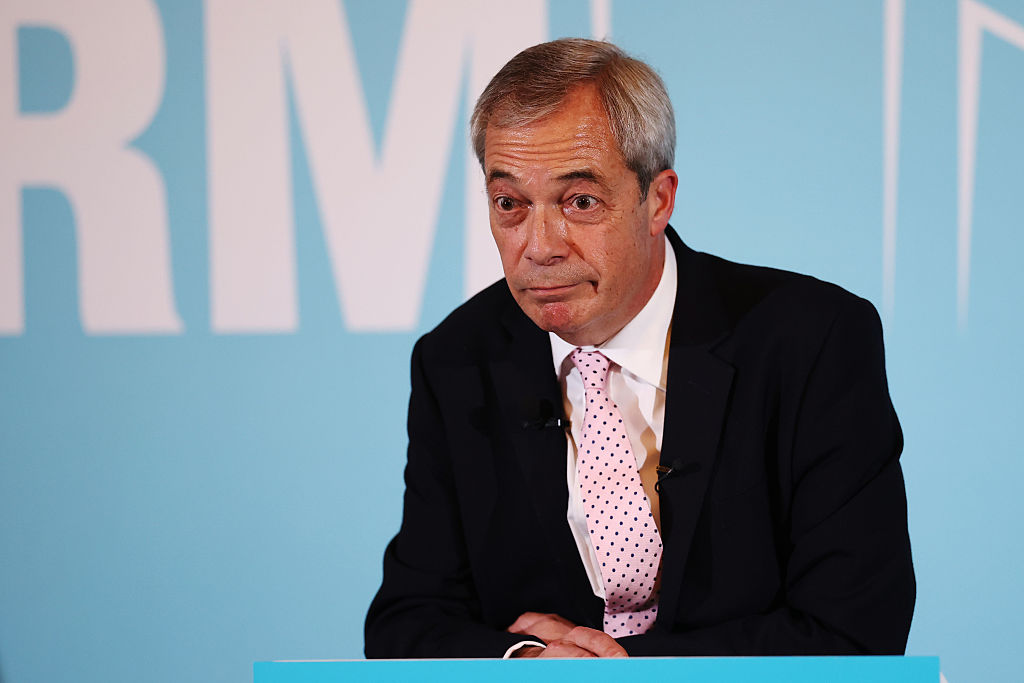
The week ends as it began, with Keir Starmer outlining plans to curb child poverty, news that Rachel Reeves won’t face a formal investigation into whether she misled the markets over her Budget, ministers growing bolder about opposing Brexit and questions about the future of the war in Ukraine. For me the most interesting question of the week is whether we can credibly ask for the first time: has Reform peaked?
Public anger at both Labour and the Tories remains palpable and Farage remains overwhelmingly the greatest beneficiary of the protest vote
I interviewed Nigel Farage earlier this week for the Christmas double issue of the magazine so keep your eyes peeled for that. Reform’s leader knows that if he is to win the next election it will be a rollercoaster ride. But polls published earlier this week showed two developments which may prove to be significant.
Reform has dropped a couple of points from its peak with several pollsters. The Conservatives have recovered a little ground and Kemi Badenoch’s personal approval rating has climbed to -15. She is still less popular than Farage (on -11) but it is now quite close. Reaching the heady heights of minus 15 seems like an odd thing for Tories to hang their hats on, but when you consider that Starmer’s own rating is -47 with the same pollster, More in Common, while Reeves is on -70 with at least one polling company, this is measurable progress for Badenoch, who put in another decent performance at the despatch box at Prime Minister’s Questions on Wednesday.
At a drinks do the same evening, two members of the shadow cabinet remarked independently to me of Badenoch: ‘She is really enjoying herself now.’ Voters tend to prefer leaders who look like they are up for it – Thatcher, Blair, Cameron, Johnson – rather than those who seem tortured by office – Major, May, Sunak and Starmer.

At a private dinner with movers and shakers from SW1 and the City, the audience was asked whether on balance the Tories should stick with Badenoch. A sea of hands went up, not one said she should be removed. The result would have been very different three months ago.
I wrote in the magazine this week that Labour’s Budget, regrettable as much of it was, might make electoral sense for Starmer since there are plenty of votes to be gained if the government pivots to a more left-wing offering on the economy.
The polling by More in Common also provides a compelling explanation for the slight easing in Reform’s support, which is nothing at all to do with the coverage of claims that Farage made racist comments when he was a teenage schoolboy.
‘Reform do best when its issues are in focus (migration, crime, lack of faith in politics) and less so when it’s the economy,’ explains Luke Tryl of More in Common. ‘Reform voters are over six times as likely to say they vote Reform because of immigration than their economic polices. Add to that Reform voters are far less cohesive on economic issues than they are on issues like migration/sense of British decline – their Labour switchers are far more in favour of redistribution than their Tory ones.’
The economy is tenth on the list of reasons why Reform voters back Farage, cited by just 10 per cent of their voters. That’s behind Europe and Brexit, woke policies, crime, Farage himself and the sense that other parties don’t listen to ‘people like me’. Top of the list is immigration with 62 per cent.
In short, it would be in the interests of both Labour and the Tories to spend the next three years advocating tax and spend on the one hand and welfare cuts and fiscal prudence on the other.
So has Reform peaked? Probably not. Public anger at both Labour and the Tories remains palpable and Farage remains overwhelmingly the greatest beneficiary of the protest vote. But it does suggest that the issue which is usually the most prominent at election time could cap Reform’s support.
This is not the beginning of the end for Reform – but it does feel like the end of the beginning of their remarkable story.
Subscribe to Evening Blend here, for in-depth political analysis from our team in Westminster, delivered at 6 p.m. every weekday




Comments