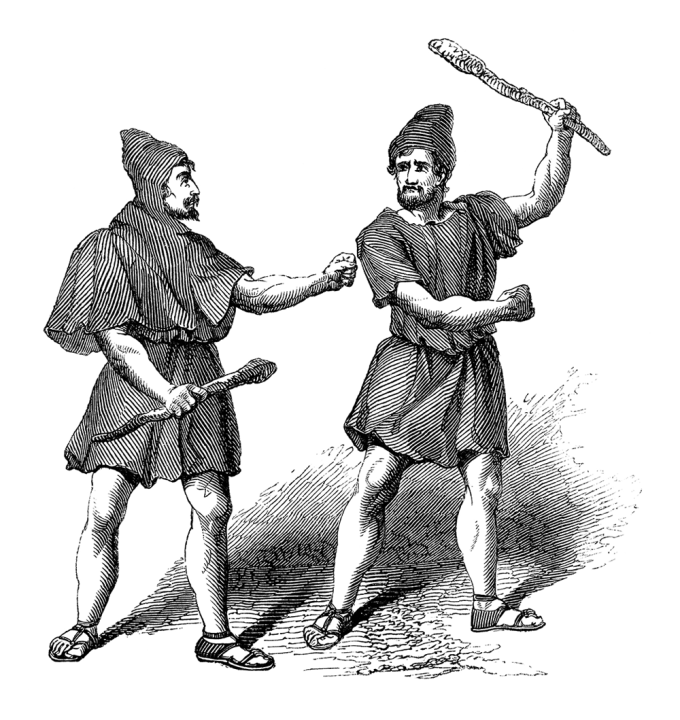


For otherwise healthy plebs in the Roman world, survival depended on the four ‘Fs’: farming (your sole source of food and money), fighting, family and friends. Everything else that made life worth living meant having some degree of control over your life, which could be summed up in the fifth ‘F’, freedom, or political equality. But the elite had little time for such goodwill towards men. For the plebs, there’s the rub.
In the 40s bc, the historian Livy began writing a history of Rome from its foundation in 753 BC. It was first ruled by a series of seven kings (none actually Roman!) who were finally thrown out as tyrants in 509 BC. During that period the plebs, summoned from their farms as necessary, were in almost constant conflict with surrounding tribes over possession of land, and Rome ended up about twice the size of local rivals (c. 350 square miles and a population of 40,000) and with a formidable plebeian (but not standing) army.

It was at this point that Livy describes Rome’s overnight (rather unlikely) transformation into a republic. To summarise: the whole population was given a rank. At the top of the tree were the ‘patricians’, men of high authority and extremely wealthy (they owned vast land holdings), of whom 300 had been appointed as advisers to the kings. Ranked with them came the equites, ‘cavalrymen’, also very wealthy (horses were the equivalent of Ferraris). Everyone else was a pleb, from those fairly wealthy and probably moving in the same social circles as the top group, all the way down to the poorest of the poor. Slaves, perhaps 10 per cent of the population, had no status.
Those rankings defined Romans’ role in the army, the tax they might pay and their place in the new political assemblies. Officials – consuls, praetors, etc with a one-year term of office – were then appointed, mostly from the new law-making Senate of 600 patricians. Here was the rub. What real power could the plebs exert in such a set-up? They had a say, via the assemblies, but the Senate made the laws. True, the plebs could in theory vote them down, but that required communal agreement, not easy when most were peasant farmers.
In 494 BC the crunch came over the long-standing issue of plebeian debt and interest which, if not paid, could lead to prison and even slavery. Rome was thronged with protesting plebs who had lost everything fighting for Rome, when news came that the Volsci tribe were on the march. The call went out for the army to assemble. En masse, the plebs decided to strike: let the Senate do the fighting! Panic ensued, the Senate backed down, the Volsci were repulsed and the army rewarded with booty.
Crisis over? Far from it. One Sicinius raised the stakes dramatically: all fighting men should abandon the city, camp out on the Sacred Mount three miles away, and stay there until the problem was resolved. The Senate caved in, and it was agreed that the plebs should appoint two inviolable plebeian tribunes, above the law – no patricians allowed – able to veto all legislation and protect the plebs against the power of the consuls.
That was the crucial first step that would, in time, after many more such initiatives, lead to the decisions of the plebeian assemblies having exactly the same force as those of the Senate, would enable Rome to unite the whole of Italy, defeat Carthage, grow an empire and lay the basis for our understanding of what is meant by a republic: Latin res publica, ‘the property/business of the populus’, not of the elite.
Those republican principles lie behind modern democracy, i.e. that we the people possess the right, under the law, to run our own affairs; to outsource that running to freely elected office holders with a mandate to serve our interests and not theirs; and to vote them in and out of office.
We in the West are extraordinarily fortunate to live in societies whose government is organised around principles so simple, but fundamental to human freedom and happiness.
Alas, the Roman plebs were not so lucky. Civil war ushered in Augustus, the first emperor. Freedom, farewell.
Peter Jones’s Plebs Romana: People, Power and Politics in Ancient Rome is out now.




Comments