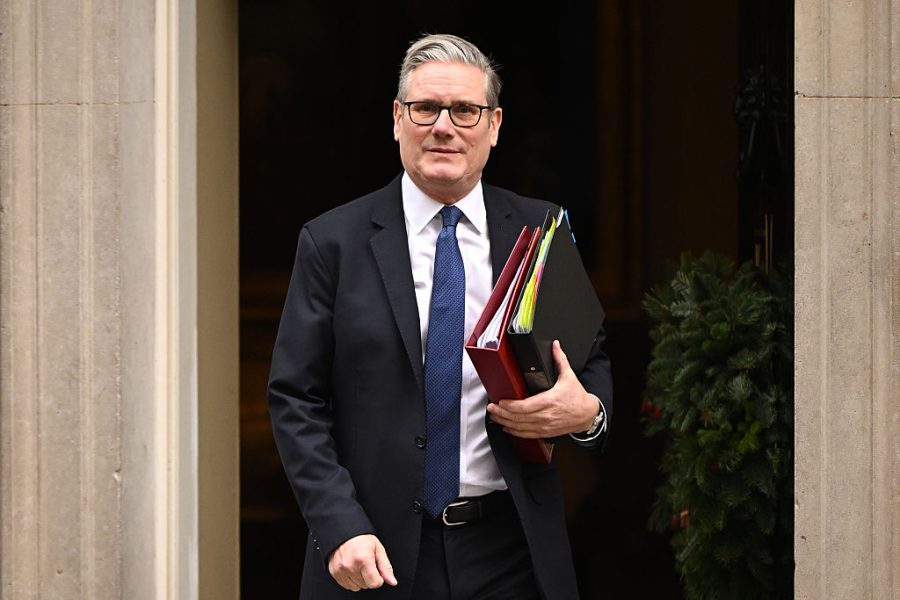
Ahead of a Council of Europe summit in Strasbourg today to discuss the future scope of the European Convention on Human Rights (ECHR), Keir Starmer has called for ‘practical action’ to fix the asylum system and deal with irregular migration. In a joint letter with the Danish prime minister, Mette Frederiksen, Starmer argued that ‘modernisation’ of the ECHR is essential and that the Convention system needs to ‘evolve to reflect the challenges of the 21st century’.
The two leaders acknowledged that responsible progressive governments need to ‘control our borders’ in order to ‘protect our democracies’. This is a tacit admission that Labour is concerned that Conservative and Reform UK proposals to exit the ECHR in order to meet the challenge of migration are cutting through with voters.
Today’s summit, which will debate how the ECHR interprets questions around migration, appears motivated as much to combat the rise of populist right-wing parties as to achieve principled reform. But either way, it highlights the fact that left-wing parties have finally begun to accept that voters have legitimate concerns about migration.
Will this deliver the changes that Starmer is looking for?
The meeting in Strasbourg follows an open letter from the leaders of nine Council of Europe States (including Denmark, Italy, Belgium and Poland). This questioned whether the European Court of Human Rights has, in some cases, ‘extended the scope of the Convention too far’ compared to its drafters’ original intentions, ‘thus shifting the balance between the interests which should be protected.’ Starmer has now added his voice to those calling for change.
I have long argued that rather than leaving the ECHR, the UK should press for reform. If the ECHR is to be a living instrument, it must reflect the concerns of European citizens and not simply well-meaning NGOs and human rights lawyers. However, while today’s meeting in Strasbourg, which will be attended by Justice Secretary David Lammy and Attorney General Lord Hermer KC, presents an opportunity, it is also potentially a high-risk strategy.

According to the legal commentator Joshua Rozenberg, the aim of the summit is to draft a political declaration which could then be agreed at a meeting in Moldova (which currently holds the presidency of the Council of Europe) in six months’ time. While it is possible to amend the ECHR, such amendments can take many years. The last time this occurred, following the 2012 Brighton Declaration promoted by then Lord Chancellor Ken Clarke, it took more than nine years for the new measures to be brought into force.
The question then arises: how much account will the Strasbourg court take of a political declaration in the interim and will this deliver the changes that Starmer is looking for? The two main issues of concern are the interpretation of Articles 3 (prohibition of torture and degrading treatment) and 8 (family life).
The former is what is known as an absolute right and therefore reform would have to be agreed by the Council of Europe. Any changes are likely to be focused on the interpretation of ‘degrading treatment’. Home Secretary Shabana Mahmood claimed last month that it has been impossible to deport foreign national prisoners ‘because the prisons in their home country have cells that are deemed too small, or even mental health provision that is not as good as our own’. More substantial changes to Article 3 appear unlikely and will likely face significant political opposition.
Changes to the approach to Article 8 of the ECHR are likely to begin at home in Britain with new laws overhauling the asylum system which have already been announced by Mahmood. Interference with Article 8 rights can be justified provided that measures are proportionate.
Effective implementation of these domestic policies is likely to have more impact than any reform of the Convention by the Council of Europe (Rozenberg notes that judgments by the Strasbourg court against the UK are exceedingly rare, with only 13 cases relating to deportation or extradition since 1980). However, it is important to note that our domestic courts are also likely to take into account determinations by the Strasbourg court in respect of the other 45 Council of Europe states.
Shadow Attorney General David Wolfson KC has previously highlighted cases against other states, such as Italy, which have expanded the concept of what is known as the ‘non-refoulement principle’ (prohibiting states from forcibly returning any person to a territory where they face persecution, torture or ill-treatment) well beyond what was envisaged by the 1951 Refugee Convention, the treaty that originally articulated the principle. He concluded that ‘ECHR membership places significant practical limits on the UK’s ability to maintain control of its borders.’
In that context, a political declaration which, for example, unambiguously recognised a need to prioritise the deportation of foreign nationals who had committed a serious criminal offence might be seen as a clear win for the government.
The government will hope to gain plaudits for its attempts to modernise the ECHR. And yet the real risk here is that not only is it likely that changes will come slowly, but also that any reforms might be seen as tinkering at the margins. One only has to look back at David Cameron’s attempts to modify the UK’s relations with the European Union before Brexit to see what a political car crash a botched attempt at modernisation might cause.
Thus far, 27 Council of Europe states – just over half – have clearly pressed for change; it is far from clear that there will be unanimous support for reform. It may well prove impossible to get a united position on the transformation of the Strasbourg court’s approach to the interpretation of the ECHR in immigration and asylum cases. In that case, the real winners may be Nigel Farage and Kemi Badenoch, who will argue that the only way to resolve the matter is to exit the Convention.

Comments