It’s tricky for writers to gather up pieces of old work and collect them in significant literary form. It’s risky for former politicians to publish outdated commentaries, with no agenda other than to show politics on the ground and as a record of their efforts and prejudices. Most hazardous of all is titling a book in such a way that it eschews the established geographical and psychological identity of the region it describes. These are the challenges Rory Stewart sets for himself in Middleland.
The book consists of the granary-floor sweepings of journalistic pieces published in the Cumberland and Westmorland Herald while Stewart served as MP for Penrith and the Border. The constituency no longer exists, having been split between three neighbouring territories after the 2023 periodic review. It was located in the very north of England, taking in the Eden Valley, Appleby-in-Westmorland, Wigton, Brampton and a span of the Scotland-England border. To be literal, it’s about halfway down (or up) the island of Great Britain. Stewart’s preferred name for the area is something of a conundrum. It recalls Cumbria’s former independent kingdom, while also operating as unionist toponymic engineering regarding Scottish independence, which Stewart strongly opposes. ‘Middleland’ also suggests a position between local and national governmental systems and between polarised states – the axis of modern politics.
Consisting of farmland, uplands, market towns and historic villages, Penrith and the Border was the largest and arguably safest Conservative seat in the UK, having only ever elected Tories. In 2010, its long-serving MP David McLean stood down and was succeeded by Stewart, who remained until his exit from the party. It wouldn’t have been a bad position to parachute into if you were an ambitious young politician with your finger in the wind.
Arranged thematically, the book contains potted histories of Cumbria, including its Celtic, Roman, Saxon and Norse heritage; anecdotes about what a rural MP gets up to; and a general miscellany about the need to vote, Christmas, travels in Libya and Stewart’s father, etc. There are addendums explaining that on certain issues, such as wind power, Stewart has changed his opinion, but on the whole the writing is what it was.
The articles reveal a politician who is knowledgeable, ignorant, dedicated to and frustrated by the political mechanisms with which he has chosen to work. Keen these days to present himself as a maverick outsider – another challenge for a man who was educated at Eton and Oxford, has tutored princes and followed institutional pathways – Stewart nevertheless, during his residency in Cumbria, adopts the terms, ‘we’, ‘our’ and ‘us’, in solidarity with his constituents. While useful, such an alliance feels precipitate and unearned, and had his subsequent bid for the London mayoralty been successful, the Ich bin ein declarative might simply have transferred to the next demographic.
Because of their original word limit, the pieces often appear corseted, abrupt and undercooked, unable fully to address their content or find nuance. At best, they read like busy, extracurricular dispatches, pridefully rallying and wide-ranging; at worst, like off-cuts, quilting together nostalgic observations and notions of people and place. Frequently, they seem like appeals and appeasements to the newspaper-reading voters Stewart was addressing while in office. An editorial decision has been made to preserve the candour and rawness of reportage, as well as the pandering, but at the expense of deeper reflection.
It’s clear that on some levels Stewart appreciated the complex, ambivalent nature of these ‘debatable lands’, though not ecologically, given his antipathy towards conservation – rewilding is a ‘fantasy’, and in one supercilious chapter he mocks an expert yet unnamed RSPB worker. (In the same chapter, Stewart mistakes bog myrtle for rosemary.) Nor with any sense of égalité, given his proclivity to weight stories towards his interactions with male constituents. A section disparaging the women who keep asking him about Kate Middleton’s wedding dress after he attended her marriage truly rankles; he is, after all, a royalist too.
He celebrates international settlers in the region over the centuries, and notes that Cumbrians are often widely travelled, alongside suggestions of their insularity, and comments that Penrith has the highest percentage of Viking DNA in the UK (a fact with no footnote). The memorial rights of the ancient and the dead often seem greater than the future needs of inhabitants or the dynamism of incomers with new ideas.
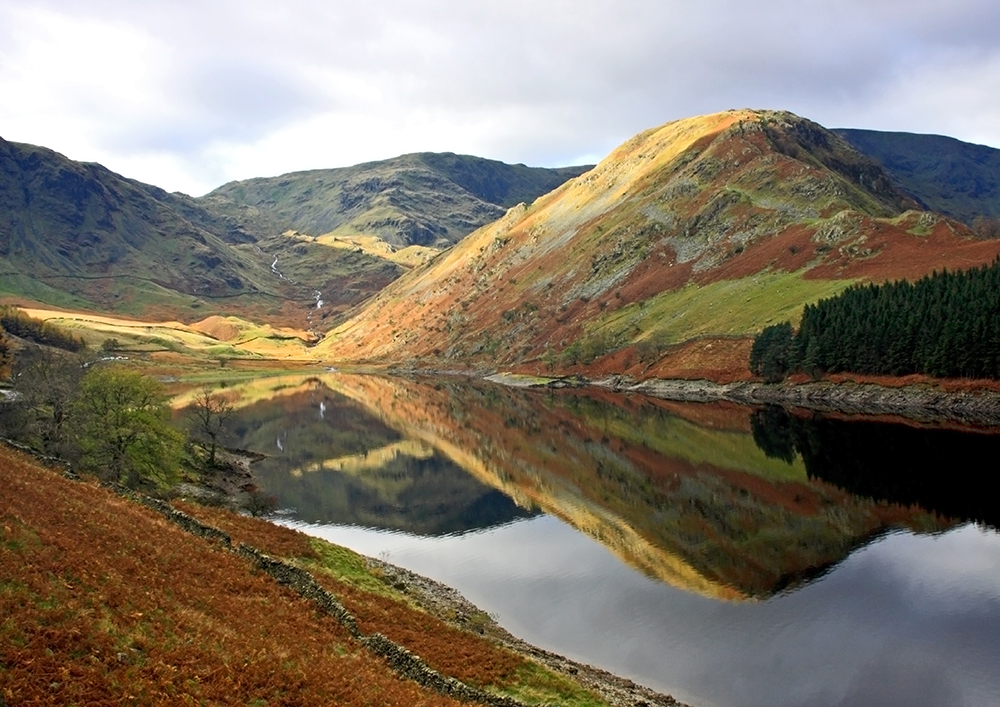
Stewart especially admires industries that cultivated the landscape, including the monasteries responsible for cutting drains to make pasture and burning peat, and farming, which has created ‘the colour of the hillsides’ he loves and believes tourism must rely on. He describes the Lake District as a ‘wilderness’. This is caveated later, because by any scientific measure of wilderness – native woodland, the state of sites of special scientific interest, missing species, the ratio of sheep stock to humans – it isn’t. The ‘improbable’ beauty he finds there is not really unexpected, but predictably romantically described. Indeed, some passages read like Wordsworthian rhapsodies, with ‘lonely fells’ and ‘dignified stone walls’. Evidently Stewart prefers the idea of traditional cultural landscapes to the real, depleted uplands and polluted lakes.
It’s also clear that he worked diligently trying to fathom the mixed needs of a constituency that did not fit neatly into David Cameron’s Big Society philosophy. He made long yomps through every village, witnessing the struggles of farmers (keenly educating one farmer, local to Hadrian’s Wall, about its vallum) and recognising the adaptability of Cumbria’s micro-industries and the gulf between Westminster and these remote, dispersed citizens. The pieces touch on territorial problems, such as broadband availability, affordable housing, agricultural subsidies and the loss of pubs and schools, with some solutions forthcoming. But the greater economic context – wealth inequality in the county, land ownership, austerity’s impact on the infrastructure and the damage to communities of second-home buying – is unexplored.
Essentially, the book is an amplified version of an MP’s diary. Stewart gets the job; he learns the job while on the job; he describes the job and its pitfalls. If the reason for publication after the fact is to give insight into politics on the ground, then Middleland does serve to illuminate the various civic, legal, committee and parliamentary shenanigans that an MP faces, and our imperfect governmental apparatus. It catalogues the particular issues and conflicts of the north-west. And it inadvertently reveals the limiting and dysfunctional illusion that parts of the region operate under and are perceived as being – a ‘perfect republic of shepherds’, or, in Stewart’s words, ‘the imaginative soul of Britain’. Mostly what the book tells us is that Rory Stewart spent some time in Cumbria on his career journey and probably did the best he could, before moving on to the next prospect.



Comments