On Advent Sunday, our grandson Christian became a Christian. He was baptised, sleeping, in the font of our parish church. On the whiteboard in the maternity ward, the newborn’s name beneath his was Mohamed. As is usual (and, in my view, preferable) nowadays, he was christened in the middle of the communion rather than separately. As is less usual, the rite was that of the Book of Common Prayer, ‘The Ministration of Publick Baptism of Infants’. It is tougher than the modern version. The godparents, in the name of the child, had to ‘renounce the devil and all his works, the vain pomp and glory of the world, with all covetous desires of the same, and the carnal desires of the flesh’, but managed with perfect equanimity to drink champagne afterwards. My suggestion of the hymn ‘Christian, dost thou see them’ (including the line ‘Christian, up and smite them’) was rejected, but Bunyan’s original version of ‘To be a pilgrim’ was sung, including the ‘hobgoblin’. It was a happy occasion. If Christian’s pilgrimage through a dark world proves difficult, that will be nothing new, and he will be in good company.
If present trends continue, however, that company will be more select than in the past. In 1956, when I was baptised – as was John Constable 180 years earlier – in East Bergholt parish church, more than half of all live births in Britain received the same sacrament. Christian will be part of about 10 per cent. Will he find himself one of a tiny ‘righteous remnant’ or on a rising tide? Oddly enough, something about the way the world is going makes me take a small bet on the latter.
As a child, I was disgusted by the thought of Australians eating Christmas lunch on the beach. It seemed irreligious and unpleasant to be hot in winter. So I have no desire, unlike so many of Sir Keir Starmer’s subjects, to emigrate to Dubai. But I do see why one might want to go there, beyond the welcome absence of income tax. The underrated factor which makes life there tolerable is air-conditioning. It is only in this century that it has become universal in the Gulf states and much quieter, more efficient and probably healthier than in the 20th. A whole world of comfort, entertainment and convenience has been built upon this one simple invention. In the days when Britain dominated that region, Montesquieu’s dictum that ‘Climate’s law is the first of all empires’ applied. Now it doesn’t. So Dubai becomes more attractive than Dudley, and countries whose climate enervated most of their populations most of the time now burst with energy, wealth and neo-imperial ambitions directed towards foggy islands such as ours.
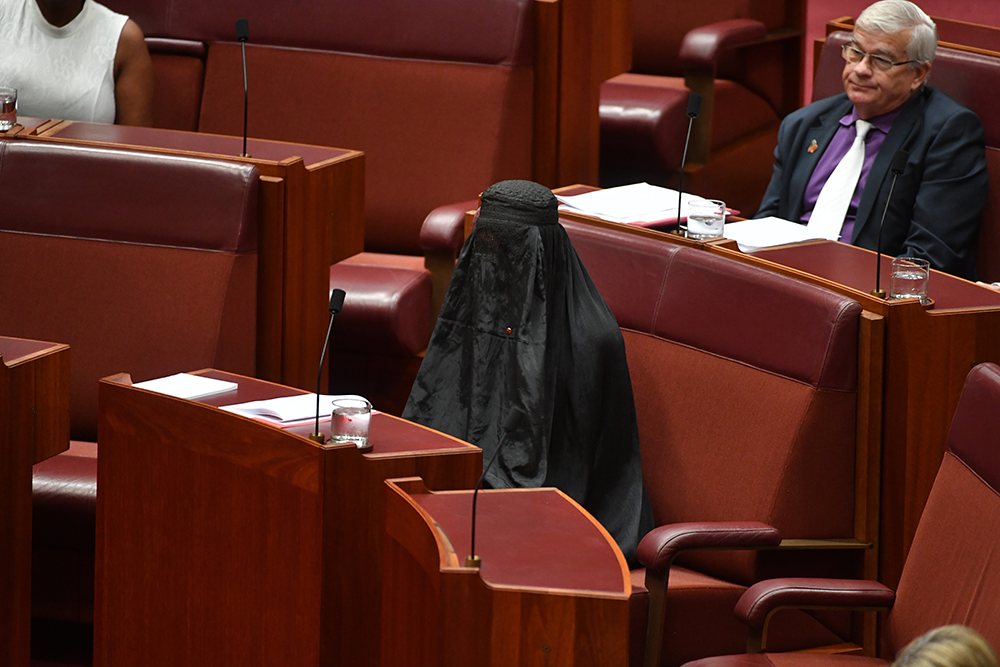
There was widespread disgust when Pauline Hanson of the One Nation party decided to wear a burka in the Australian senate. One can understand why; but consider her feelings. She says the burka is ‘oppressive’ to women, ‘non-religious’ (i.e. not demanded in Islam) and could risk national security. These are not wicked opinions. Having failed in her attempt to get the garment banned, she demonstrated her point visually. I must admit I feel tempted to do the same thing in the House of Lords. I have checked, and there are no dress rules in the Upper House. The only convention which might prevent me wearing a burka is the wise one that forbids the use of props in speeches, but I need not speak to make my entrance. Why – apart from natural cowardice – will I not go ahead? I think because the House of Lords – so far as I know, uniquely – has no rules of order. It takes seriously the equality implied by the word ‘peers’. Convention puts us all on our best behaviour. If I were to sweep in, burka-ed up, the charming doorkeepers would have to check that my security lanyard corresponded with the face hidden under the garment. I would not wish to embarrass them thus. Nor would I intend my attire to reflect satirically upon the bishops, who have swished around in full-length dresses for many centuries. I know if I started it, other stunts would follow – a trans protest, perhaps, or 100 Scottish peers in kilts. Conventions must be obeyed precisely because they are binding in honour, not law. I shall leave burka-wearing to some brave Member of the House of Commons.
The half-an-hour Six O’Clock News on Radio 4, with its Big Ben bongs, is considered the channel’s gold-standard news programme. Recently, however, it has switched tenses in its opening headlines, adopting the historic present as in, say, ‘Rachel Reeves wows her audience’. There is nothing in principle wrong with this device: it is used all the time in newspapers and online. In the case of radio, however, it diminishes authority. After all, the programme has a fixed time, so the BBC knows, unlike with a newspaper, exactly when most of the audience will pick it up. The historic present makes the programme less newsy, less serious and adds, in the self-consciously snappy phrases deployed, a bit of unwanted ‘attitude’.
Quite recently, I took delivery of a new car, a hybrid. In protest at the creeping imposition of electric vehicles and because we live in the country, where chargers are scarce, we never use the electric facility. Now, thanks to Ms Reeves, we shall be charged 1.5p per mile, regardless of the proportion of the drive which is electrically powered. The consultation document states: ‘The government recognises that plug-in hybrid electric vehicles driving habits vary and that some motorists will drive more or less than 50 per cent in electric mode. However, alternative options would require motorists to report their exact mileage driven in petrol vs electric mode, which is not considered a practical or proportionate approach.’ So I shall be double-subsidising electric vehicles, once through my taxes and now through an impost on my non-usage. We still pay petrol fuel duty too, of course.

Comments