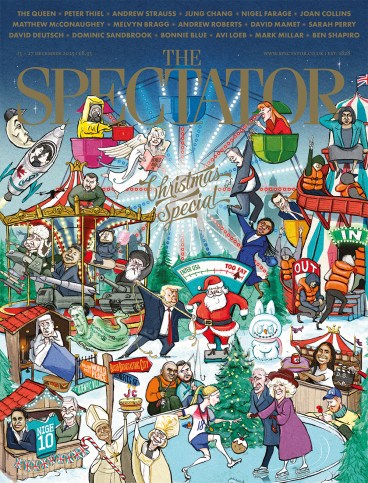
A Christmas Carol is pretty well unavoidable around now, with Little Women trailing somewhat behind. There’s no shortage of alternative literary Christmases among the classics, however, often less sweetly heartwarming and more invigoratingly grumpy. Nigel Molesworth, it will be remembered, foiled all attempts to inflict A Christmas Carol on him. ‘It is just that there is something about the Xmas Carol which makes paters and grown-ups read with grate XPRESION, and this is very embarassing [sic] for all.’ For the Molesworths among us, there are plenty of alternatives to be had.
Sometimes these are depictions of Christmas where no Christmas should be occurring. Arnold Bennett’s sublime The Old Wives’ Tale follows up the miserable, harmonium-playing Christmases of his heroine Sophia’s youth with an unforgettable Christmas lunch in her Paris exile. It is 1870; the city is under siege, and ‘a butcher in the Faubourg Saint-Honoré has bought the three elephants of the Jardin des Plantes for 27,000 francs’. Sophia is not eating elephant; a restaurant has produced a lunch for her of exquisite French perfection, roast duck, ‘a quite little salad’, champagne, a perfect brie. Even the table is rapturously specified – ‘a salt-cellar, out of which one ground rock-salt by turning a handle, a pepper-castor, two knife-rests, and two common tumblers’. Irresistible.
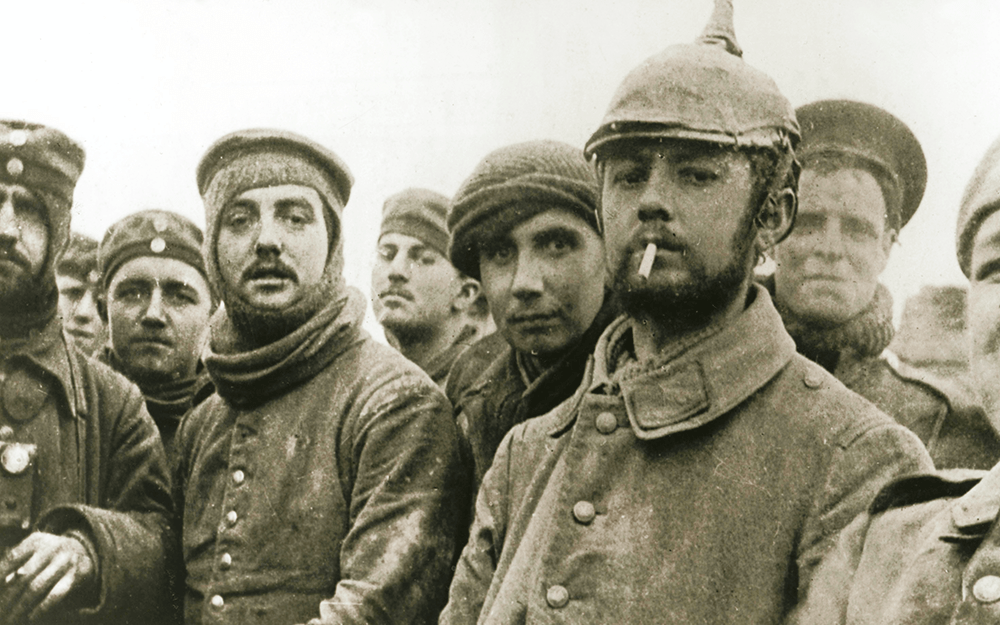
Christmas is celebrated in still more unlikely places. Henry Williamson’s long novel sequence A Chronicle of Ancient Sunlight has never been admired by more than a tiny cult, but at its best provides some exceptional witness accounts to history. One is the remarkable description in the 12th volume, The Phoenix Generation, of one of Hitler’s rallies (Williamson was a rarity among imaginative writers in signing up to British fascism in the 1930s). The most compelling comes in the fifth volume, A Fox Under My Cloak, which opens with a brilliant hallucinatory account of the 1914 Christmas truce in the trenches, as the hero cycles off into no man’s land, not quite sure if he is going to be shot as he would have been the day before, and meeting some jovial Saxons smoking meerschaum pipes. ‘Another Saxon came forward to explain in English. “Prachtig Kerl means Good Chap… what you would call a Proper Toff in Piccadilly.”’
Often novelists – who if they are worth their salt relish a gathering of ill-assorted and borderline hostile individuals – have created wonderfully awful Christmases of hapless hosts and trapped, helpless guests. One of the best is Alice Thomas Ellis’s The Birds of the Air, in which a suburban grandmother finds herself hosting her two daughters, one grieving her dead son, the other reeling from discovering her husband’s adultery. A girl determined to work her charms meets a guest whom nobody has met before, an American called Mauss, who is soon discovered to be a dedicated paedophile. The Christmas message is memorably skewered. ‘“I am a poorer man today,” he announced, “because there are poor people on the street. But – love is stronger than hate even on the streets of Belfast.” In a pig’s arse, thought Mary.’
Novelists, if they are worth their salt, relish a gathering of ill-assorted and borderline hostile individuals
One literary Christmas to be treasured is in Kingsley Amis’s Ending Up. Five more-or-less malevolent, foolish or insane ancients share a house; a Christmas truce is ineffectively declared with some ill-intentioned presents and food – ‘intramural gifts included a bathroom sponge, a set of saucepans, a cushion in a lop-sided cover, a photograph-frame wrought by some vanished hand and with no photograph in it, an embroidered knitting bag’. The grown-up grandchildren resignedly visit, concentrating on ‘gripping Adela by the upper arms to forestall any attempt at a hug… she would have done more if Adela had not smelt so old’.
Mostly, novelists avoid talking about the True Meaning of Christmas. Not every Victorian novelist writes about the festive season – that wonderful novelist Robert Surtees almost always passes over Christmas, writing about Sponge’s ‘disgust’ at all the ‘baccy, brandy and billiards’ and nobly suggesting that ‘the reader’s [feelings] perhaps being the same, we will skip Christmas and pass on to New Year’s Day’. Others can’t resist it – there are not many novels by the prolific Anglican Charlotte Yonge without a heartwarming Christmas Day scene. They were still just about current enough in the 1930s for Ivy Compton-Burnett to write a ruthlessly funny parody in A House and Its Head. An evangelist, Beatrice Fellowes, wanders in a demented way through the village, forcing her entrance to houses to bring ‘the message that Christmas gives’, and being met mostly with direct or lightly concealed insult. ‘“You can wish for us nothing we do not wish for you,” said his wife in her hearty manner. “Well, we will receive and accept the message together,” said Beatrice, doing what she could with the position.’
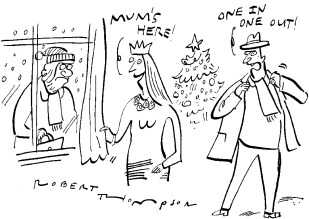
For me, the best of all literary Christmases may be a showstopper in Anthony Trollope’s Orley Farm. With wonderful perversity, the four-chapter Christmas episode in this serially published novel wasn’t released in December, but at the end of the summer. Christmases in four different households are wonderfully portrayed – an abandoned and complaining wife, a messy and joyously overspilling house party, a suburban festival of greedy and drunken commercial travellers.
The fourth is the best; a woman miser, Mrs Mason, indulges herself obscenely in private, but always deprives her family and her guests, who get served half-gnawed chicken legs for lunch. ‘Christmas-day was always a time of very great trial.’ Her husband attempts to put on a good show by ordering the sirloin himself, ‘knowing that it would be useless to trust to orders conveyed through his wife’. The beef arrives at the table and Mrs Mason has won; the best of the beef has, some time before, been cut off and eaten by Mrs Mason, alone in her room. To seal the festivities, she triumphs by palming off a set of gigantic, hideous, defective iron furniture as the required Christmas present for the poor curate and his wife. They, however, get the last lovable word. ‘“And now, my dear, we’ll have a bit of bread and cheese and a glass of beer,” Mr Green said when he arrived at his own cottage.’
Nothing could be nicer, and more truthful, to the experience of Christmas and that unworthy feeling we all get – that it will all be very nice, once it’s all over.


Comments