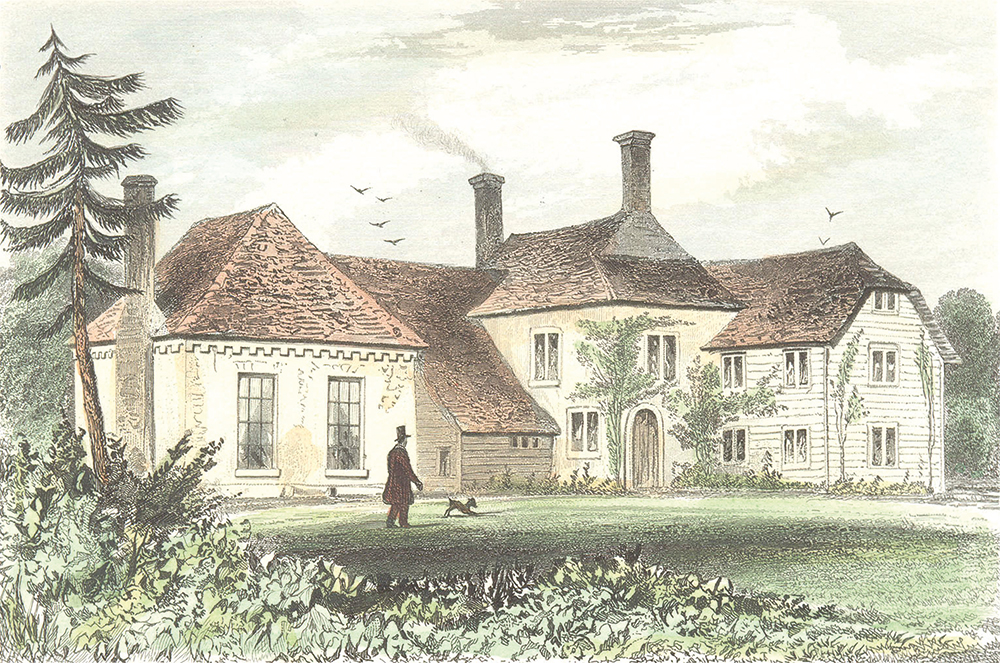

Gilbert White’s Natural History of Selborne is a true classic in that it has never been out of print since its first publication in 1789. It was based on the daily journals White kept for years in which he noted first the weather (‘Rain. Rain. Rain’) and wind direction, then the progress of his garden (he was very proud of his cucumbers) and occasional nature notes, usually about birds.
Jenny Uglow has chosen to concentrate on one year of these journals, 1781, when he was 60 years old and halfway through writing his Natural History, and to interpolate it with her own observations. But these feel oddly irrelevant since she lives in Borrowdale in the Lake District (notoriously the wettest place in England), so the country is completely different to the lush lanes of Selborne in Hampshire. And, anyway, she lacks White’s curiosity. ‘To me’, she writes ‘a wasp is a wasp.’ She would not, like White, go out in December to observe how often earthworms copulate.
White records that a nightjar’s churring on his roof ‘gave a sensible vibration to the whole building’
White was a bachelor with a modest income of about £250 a year, which enabled him to employ a maid and a gardener and to give money to the poor. He grew all his own vegetables and made his own beer. He occasionally travelled to Oxford or to south Lambeth in London to see family and friends, but mainly he stayed in his parish, Selborne, and often just in his own garden.
His great mainstay was Thomas Hoar, his gardener and groom, who worked for him for 40 years and lived in his house. Hoar was generally wary of women, but there was one, Goody Hampton, whom he occasionally enlisted to help with the weeding and said he liked as well as a man. ‘And indeed’, White comments drily, ‘excepting that she wears petticoats and now and then has a child, you would think her a man.’
The same gender ambiguity afflicted White’s other garden companion, Timothy the tortoise, whom a post-mortem eventually revealed to have been female (but whom we shall continue to call male). White took a tender interest in Timothy and was very upset when he mysteriously disappeared for a few weeks in 1784, but luckily he came back. Every year White weighed him when he emerged from hibernation and again in summer and found he gained half a pound. When he began to grow dull and torpid in September, he tried shouting at him through a speaking trumpet, but ‘he does not seem to regard the noise’. By late October, Timothy was retreating regularly under the hollyhocks at 4 p.m. promptly and on 27 October he started digging his hibernation hole. But he emerged occasionally in December ‘looking rather disconsolate’.

White made notes on butterflies, insects and earthworms, but his great interest was birds. Every year he observed when the swifts and martins arrived, when they started nesting, when their broods hatched and when they departed. He was the first person to record that swifts mate on the wing and the first to see them drinking. He distinguished three different species of willow wren and noticed that woodcocks were becoming much rarer in his neighbourhood. He recorded the dates that redwings and fieldfares arrived and wondered why the latter chose to roost on the ground. He was a bird-watcher, not a twitcher. The rarest bird he ever saw was a hoopoe. His favourite bird was the nightjar, which he called the churn owl, though it was also sometimes called the fern owl or goatsucker. He said he planned to write a monograph about it but, alas, he never did, because it remains our most mysterious bird. Being nocturnal, it can usually only be seen at dusk, in the last half hour of daylight, but its churr, which sounds like a sawmill, carries across huge distances. White records that once, when a nightjar started churring on his roof, it ‘gave a sensible vibration to the whole building’.
He worried that he was going deaf, because hearing the birds was important. He noted the dates when he first heard various birds’ songs – the blackcap on l3 July for instance, the yellowhammer on 21 August. He noted that in all species the males sing more than the females, and that August was generally the quietest month.
He thought about writing his Natural History for many years, and in l775 sent an early draft to his friend John Mulso, who urged him to publish it, but it would be another l4 years until he did. He admitted that he had suffered all his life from ‘that evil power, call her the Daemon of Procrastination’. He decided that he should also write about the antiquities of Selborne, which gave him the excuse for many more years of delay, while Mulso complained that ‘the Farrago of Antiquities, routed out of the Rusts and Crusts and Frusts of time’ was holding up the book he longed to see.
When White finally sent his manuscript to the publishers, he felt ‘like a schoolboy who has done some mischief and does not know whether he is to be flogged for it or not’. He need not have worried. The book attracted rave reviews and Mulso assured him that ‘it is everywhere spoke of, and with the highest praises’. Coleridge called it ‘this sweet, delightful book’; Darwin said it taught him the pleasure of bird-watching; James Russell Lowell called it ‘the journal of Adam in paradise’. Writers who believe they have to travel the world, have great romances or wild adventures in order to publish a book should contemplate Gilbert White, who never went abroad, seldom ventured further than Alston, his nearest town, and had no adventures at all. Just quiet days in his garden listening to birdsong, counting his cucumbers and keeping an eye on Timothy the tortoise was material enough.




Comments