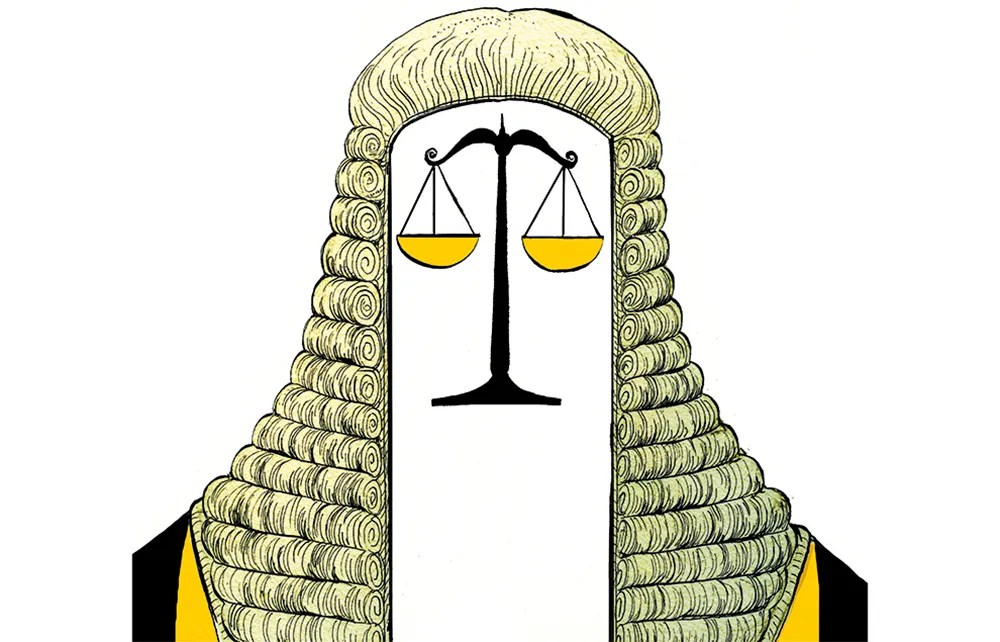
Criticising m’learned friends has been a risky undertaking since a certain newspaper described a few beaks as ‘enemies of the people’ during the kerfuffle about Europe a few years back. In the age of populism, you are either a defender of the rule of law or an incipient fascist accusing an honest judge of being an ‘ex-Olympic fencer’.
It is therefore with some trepidation that I’d like to suggest the government’s plans to restrict jury trials might not in fact signal the end of democracy. An absence of 12 angry men (or indeed women) at the trial of Burglar Bill probably won’t ‘break the increasingly thin connection between the state and ordinary people’, leading to rising ‘fears of tyrannical governments’, as has been claimed by Riel Karmy-Jones KC, chair of the Criminal Bar Association.
It is with some trepidation that I’d like to suggest the government’s plans to restrict jury trials might not in fact signal the end of democracy
Karmy-Jones’ response has been rather typical of her trade since the reform proposals were conveniently leaked last week, in a move that provoked the fury of everyone who has ever opened a copy of Tom Bingham’s The Rule of Law. Even with Justice Secretary David Lammy retreating to the safety of milder recommendations from Brian Leveson, the hysteria has barely died down.
In brief, Lammy is proposing the creation of ‘swift courts’, which will handle what are currently ‘either way’ cases triable by jury or magistrates, where the sentence is likely to be three years or less. Juries will likewise no longer serve on ‘exceptionally technical and lengthy fraud and financial trials… where appropriate’.
Defendants’ right to opt for jury trial will also be restricted, the decision turned over to judges and magistrates. Magistrate courts will be handed sentencing powers of up to 18 months, allowing them to handle more low-level offences, with an option to extend the sentencing powers to two years.
All of this would take a slice from what has been solemnly intoned as an ‘ancient right’, with many asking whether Magna Carta died in vain. Cutting back on jury trials would ‘destroy a criminal justice system that has been the pride of this country for centuries’, to again quote the CBA’s Karmy-Jones.
That was echoed by Law Society president Mark Evans, who claimed that British society’s ‘concept of justice rests heavily on lay participation in determining a person’s guilt or innocence’, and that allowing a single judge to send somebody to jail for a few years ‘would be a dramatic departure from our shared values’.
The trouble with this kind of talk is that it tends to be mostly believed by those who sacrificed their twenties at the altar of Blackstone. Asked by YouGov whether they supported the more radical measures floated in the leaked memo, the British public were fairly evenly split, 41 per cent were happy for judges to try cases alone, compared to only 36 per cent opposed.
That’s probably for the best, since 90 per cent of cases are already dealt with by magistrates, with only 3 per cent of trial cases in England and Wales going before a jury. And outside of our green and pleasant land, most countries don’t rely on jury trials, including ones that wouldn’t require an Act of Parliament to be declared safe for refugees.
I suspect too that some public scepticism is based on direct experience. While jury deliberations remain shrouded under threat of the Contempt of Court Act, many people who’ve served on a jury will surely agree with the American comedian Norm Crosby: ‘When you go into court, you’re putting your fate into the hands of 12 people who weren’t smart enough to get out of jury duty.’
The legal profession may run a closed shop that would be the envy of any trade union, but the bar for serving on a jury has continued to slip. Having jettisoned property qualifications for jurors in the seventies – admittedly a tad classist – rules on English language proficiency ‘have effectively been abandoned’, in the words of journalist Ed West. My own experience is that jurors now wear flip-flops to murder trials.
That there is something unserious about jurors is effectively conceded by Lammy’s decision to take juries off any case involving dread phrases like ‘financial derivative’. Observers of existing trials will already have noticed how cosseted juries are, contextual information being carefully rationed lest they make a statistical inference about the guilt of the man in the dock. This is Schrödinger’s juror: a cornerstone liable to break if too much weight is placed on it.
On the wider subject of race, while a previous review from Lammy argued that juries supplied ‘equitable results’ regardless of jurors’ or defendants’ ethnicity, other studies have drawn more troubling conclusions. Notably, a Ministry of Justice report found that ‘same-race leniency’ was common among non-white jurors, though largely absent in white ones.
I’ll concede that juries have some upsides, not least in frustrating the enforcement of laws that the public does not support. Writing in The Spectator yesterday, Andrew Tettenborn pointed to communication offences, whistleblowing and the right to self-defence as three areas where jury trial can curb overzealous lawmakers and their enforcers.
And yet outside of prosecuting spicy tweets, is it really the case that England still has a hang ‘em and flog ‘em judiciary? While judges presiding over the obscenity trials of yore might have been slightly right of Genghis Khan, the average lawyer today probably skews left on social issues as much as parliamentarians do – not least because some of them probably studied law at the same school.
So juries have their place. Listening to a defence barrister exhaustively explain why the chap with the gang tattoos isn’t guilty despite the incriminating footage circulating on TikTok is certainly a lesson in civic engagement. But English justice will survive fine without it.




Comments