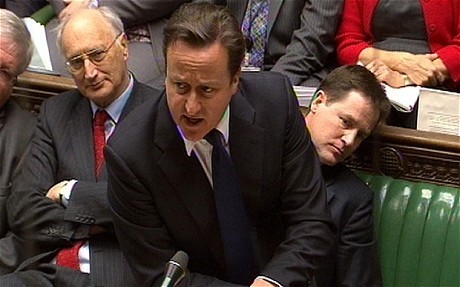
 If you listened to PMQs yesterday, then you’ll have heard two very different accounts of what’s happening in the
labour market right now. Had Ed Miliband been able to get anyone’s attention, they’d have heard him say:
If you listened to PMQs yesterday, then you’ll have heard two very different accounts of what’s happening in the
labour market right now. Had Ed Miliband been able to get anyone’s attention, they’d have heard him say:
Cameron’s response:‘over the last three months, for every job being created in the private sector, thirteen are being lost in the public sector.’
According to the Labour leader’s figures, public sector losses are far greater than private sector growth. But according to Cameron’s, the private sector is more than filling the gap. Why the difference? It comes down to the timescale you chose. Miliband’s looking at the change from Q2 to Q3 this year. Cameron’s looking at a longer timescale: from Q1 2010 and Q3 2011. Neither’s completely right, and neither’s completely wrong. The truth is it’s not clear — the private sector may be able to make up the slack, it may not.‘Since the election, in the private sector there have been 581,000 extra jobs. In the public sector, he’s right, we have lost 336,000 jobs.’
The government’s confidence is based on what happened under Major. Following the recession of the early 1990s, the private sector more than filled the gap left by public sector cuts: for every job lost in the public sector, three were gained in the private sector. This is what the government thinks — and hopes — will happen now:

But for now, Miliband’s point holds — even if he can’t get anyone to listen to it. Worryingly, it seems that the private sector is, so far, struggling to fill the gap. Since the coalition took over, public sector employment has fallen by 305,000, while in the private sector it has grown by just 267,000:

In fact, public sector employment has dropped below 6 million for the first time since 2003. As the graph below shows, Gordon Brown’s pronounced enlargement of the public sector in response to the recession has now been completely reversed — in employment terms at least.

CoffeeHousers may be wondering how public sector employment is falling at a time when, as we’ve often pointed out, central government spending is not being cut. The answer is that the cuts are largely being borne at a local level. For every job lost in central government over the past year, four have been shed in local government. This means that, for the first time since at least 1990, fewer people are employed by local government than by central government.





Comments