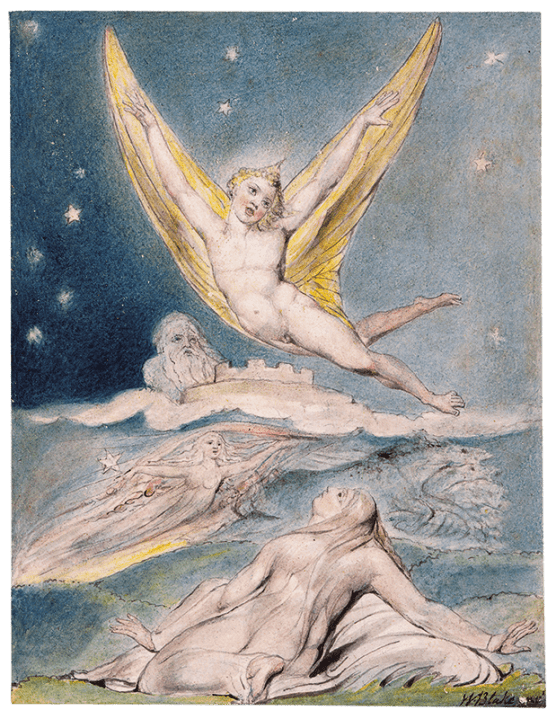

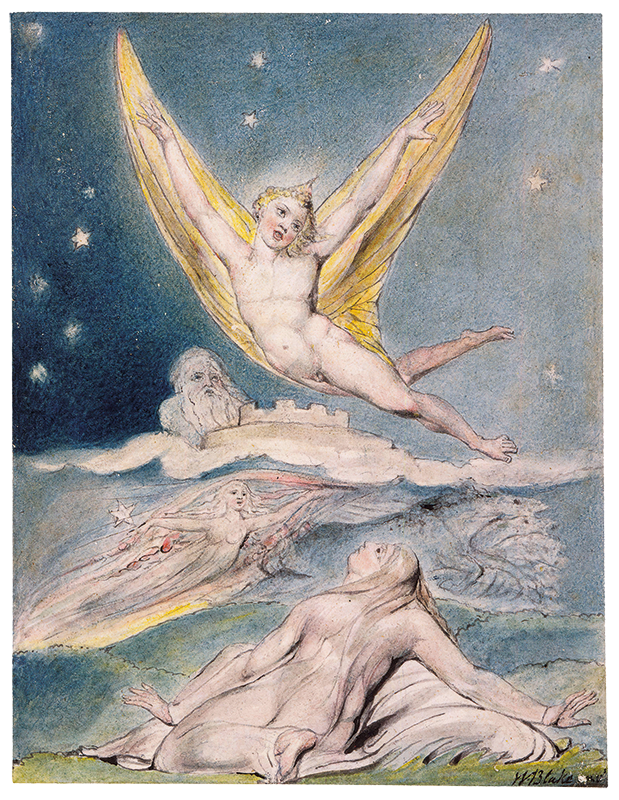
One day while walking in Peckham Rye Park, William Blake saw angels sitting in the trees: ‘bright angelic wings bespangled every bough like stars’. He was eight years old. His fascination – some have called it obsession – with angels lasted for the rest of his life. When he sat to have his portrait painted by Thomas Phillips, the two men began to argue about who painted a better angel, Michelangelo or Raphael. Phillips, not unreasonably, suggested that since Blake had never seen even an engraving by Michelangelo, he was not qualified to give an opinion on the matter. ‘But I speak from the opinion of a friend who could not be mistaken,’ replied Blake. ‘And who may he be, I pray?’ asked Phillips. ‘The Archangel Gabriel, sir.’ Blake clarified that Gabriel had proved his heavenly credentials by opening the roof of his study and moving the universe. Case closed.
If the greatest thinkers have taken angels seriously then they deserve not to be dismissed so casually
Today, even among Christians, angels don’t feature in people’s imaginations as much as they used to. Perhaps we need to think again. In my early twenties I saw Wim Wenders’s extraordinary film Wings of Desire (1987), about an angel who falls in love with a trapeze artist and renounces his immortality. The film moved me profoundly and it also reinforced something in me that I’d felt since I was a boy. Angels seemed probable and I liked the idea of them.
What are they? The word ‘angel’ in Hebrew and Greek means simply ‘messenger’. There has been so much theological debate over the centuries, but I boil it down to this: angels are heavenly beings, created by God, and can act as our defenders, encouragers and messengers.
Some, of course, have fallen and moved to the dark side. But even heavenly angels are creatures of awe, power and fear. In the Bible they are described variously as having multiple faces, wielding swords or surrounded by fire. Visions of them are trippy, even terrifying. Which is probably why they tend to introduce themselves with: ‘Do not be afraid!’
It seems that the modern Church is somewhat embarrassed by angels. They get dusted down for nativity plays, then put back in their box. This is a missed opportunity. The Revd Dr Jonathan Macy, an angelologist, says that as the new atheism championed by Richard Dawkins, Sam Harris, Christopher Hitchens and others has withered away, it has been replaced by a kind of spiritual openness. ‘During Covid, spiritualism seemed to be everywhere,’ he says. The Church could appeal to this newfound spiritual curiosity with something to say about angels.
But there’s a more interesting dimension to all of this. What if angels are out there, among us? Jonathan does the odd talk about angels, open to all. What astounded me was that these events are packed – in sharp contrast to many churches on a Sunday. What’s more, after the talk, hordes of people want to speak to Jonathan about their experiences of encountering angels. Some report an experience of a person, unknown to them, turning up out of the blue, at just the right moment, to help them, even save them. And then that person melting away never to be seen again.
It would be easy to write all this off as absurd – merely the wishful thinking of the gullible or the kooky. But if many of the greatest thinkers and writers in history have taken angels seriously then they deserve not to be dismissed so casually. C.S. Lewis, a believer in angels, pointed out that there is ‘a deeper magic’ at the heart of the world, something ancient and supernatural. As a proud medievalist, he understood a world in which angels were everywhere and also at our side. Lewis’s line was that angels are not effete things hovering around in the clouds. They are not to be messed with. J.R.R. Tolkien believed the same. Just perhaps the world is a lot odder and stranger than we like to believe. G.K. Chesterton mused that ‘angels can fly because they take themselves so lightly’. He picks up on that otherworldliness of them, something carefree, almost Pucklike.
Another priest friend tells me: ‘I want there to be angels, even if that is wishful thinking.’ In fact, just about everyone I spoke to said the same – ‘We want angels to be real.’ And so do I.
When I was in my mid-thirties, I had what I now think might have been an angelic encounter. I was an agnostic. I ran a business, and I saw myself as a logical modern person. One evening as I was trying to sleep, I experienced the room full of light, and a presence beside me that seemed huge and awesome and unearthly. There were no feathers in sight and I didn’t think I was going bonkers. Years later, I still feel that I met my guardian angel.
As Jonathan says: ‘The thing with angels is that they just won’t go away.’




Comments