-
AAPL
213.43 (+0.29%)
-
BARC-LN
1205.7 (-1.46%)
-
NKE
94.05 (+0.39%)
-
CVX
152.67 (-1.00%)
-
CRM
230.27 (-2.34%)
-
INTC
30.5 (-0.87%)
-
DIS
100.16 (-0.67%)
-
DOW
55.79 (-0.82%)
Is Whitehall inadvertently funding Sturgeon’s push for separatism?
Is Whitehall at last baring its teeth in response to the Scottish government and SNP’s separatism push? A look into how the Scottish civil service conducts itself is long overdue.
Scotland Secretary Alister Jack confirmed earlier this week that senior civil servants in the Cabinet Office are examining whether their Edinburgh counterparts should be allowed to keep working on plans for independence following last week’s Supreme Court ruling. Unless Whitehall intervenes or the Scottish government junks its plans, around £1.5 million worth of taxpayer money will reportedly continue to be spent each year on the team of 25 civil servants tasked with providing a revised prospectus for separation.
Given the unit’s risible output to date (remember the reheated currency plans which have wilted at the first exposure to scrutiny), you’d think more cerebral nationalists would be demanding a refund. However, in keeping with the histrionics unleashed following last week’s ruling, this has been portrayed by nationalists as another provocation towards ‘Scottish democracy’.
After all, under the current legislation, it is a matter for the Scottish government to do what it sees fit with the money it receives from Westminster. However, following the Supreme Court ruling about the competencies of the Scottish government vis a vis the constitution, this money is in effect being spent on what will amount to the SNP manifesto at the next general election, given Sturgeon’s pledge to turn it into a referendum on the future of the union.
While this is not a formal review, it’s an opportunity for Whitehall to shake itself out of the ‘devolve and forget’ mindset which has blighted its approach to Scotland for too long, and to show that the days of internalising the nationalist interpretation of events is also at an end.
Many will see the clear farce at play: UK government money – albeit funds which have been allocated to a devolved administration – is being used to further the cause of breaking up the country. Very few countries would stand for this. It is as clear a symptom as any of the casual approach towards the Union that governments of various shades have exhibited since devolution came on stream in the late 1990s.
Alongside the waste of money – unless, of course, you are a unionist pleased with the ruling – generated by the Scottish government and SNP’s pursuit of the Supreme Court case, it will no doubt stick in the craw of many Scots that while nationalist ministers plead poverty elsewhere, funds can always be found for constitutional chicanery.
While it is only £1.5 million – at a time when teachers have been striking, ferries aren’t running and cuts are being made elsewhere – surely the money, and indeed manpower, could be deployed more effectively to protect the nationalists’ beloved public sector? Little wonder a group of unionist businessmen are considering a legal challenge should government time and money continue to be expended on a party-political matter.
Sue Gray (of partygate fame) will be involved in the Cabinet Office inquiry, which should be enough to send a shiver down the corridors of St Andrew’s House, the Scottish government’s stolid looking Edinburgh headquarters.
What she and others are likely to find on Calton Hill is an institutional culture where government and party are almost indistinguishable. The devolved political classes in Edinburgh are keen to tell each other that they are somehow different from those ‘down there in Westminster’. But if Westminster is a village, then Holyrood and its environs are a cosy house party. This is especially true of relations between civil servants and ministers in Edinburgh.
Academics earlier this year noted that Scottish officials have not lodged formal objections to any ministerial spending decision in more than 15 years, compared with 46 since 2010 at UK level. While some Conservatives would no doubt fantasise about such a level of synergy between ministers and officials, the fact no senior official in that period has stuck their head above the parapet to challenge Scottish ministers speaks to an unhealthy culture.
All of this is rendered against a background of sustained criticism from Audit Scotland about how the Scottish government and its agencies spend money and anecdotes aplenty about a civil service culture which is enthusiastically performative in its support for the objectives of the governing party. To prove the point, the Daily Record has obtained footage of the Scottish government’s director-general of strategy and external affairs, Ken Thomson, joking that the only reason ‘strategy’ is included in his job title is that it ‘gets me through some doors in Whitehall – and then they discover that what I’m actually there to talk about is breaking up the Kingdom’.
Reports suggest that the UK government wants to take a softly, softly approach to Scotland off the back of last week’s Supreme Court decision – while watching the nationalist coalition rip itself apart. But this situation merits a tougher response. It is time to have a serious discussion about how government works in Scotland and, crucially, put an end to what is effectively one arm of the UK state apparatus being weaponised against the other.
PMQs: Starmer’s prickly questions over Sunak’s wealth
A Labour leader opening Prime Minister’s Questions with a description of the luxurious private schooling that the Conservative Prime Minister enjoyed doesn’t sound particularly informative – or indeed relevant – to many voters. Keir Starmer’s opening question this afternoon was this: ‘Winchester College has a rowing club, a rifle club and an extensive art collection. They charge more than £45,000 a year in fees. Why did [Sunak] hand them nearly £6 million of taxpayers’ money this year in what his Levelling Up Secretary calls “egregious state support”?’
The Prime Minister has a large group of critics and rebels in his party who he just can’t seem to please
What Starmer was trying to do today was to draw together his recent policy announcement on ending the charitable status of private schools and similar noises made by senior Tories including Levelling Up Secretary Michael Gove. The Labour leader wanted to paint Sunak as weak – as well as loaded – by arguing that he was too weak to do the right thing and use the millions of pounds in tax breaks enjoyed by private schools to better fund state education instead. Sunak was happy with the question, because it allowed him to attack Starmer for his own weaknesses: ‘I listen to parents and he listens to his union paymasters,’ he said, reminding the Chamber that Labour pushed to keep schools closed for longer during the pandemic. It’s worth pointing out that the teaching unions don’t have a funding relationship with Labour, but never mind that. Starmer contrasted Sunak’s alma mater with schools in Southampton, where four in every ten pupils failed their English or Maths GCSE this year. Sunak liked this question, too, as it allowed him to contrast the Tory emphasis on aspiration with Labour’s discomfort with it. ‘Whenever he attacks me about where I went to school, he is attacking the hard-working aspirations of millions of people in this country. He’s attacking people like my parents, Mr Speaker. This is a country that believes in opportunity, not resentment. He doesn’t understand that and that’s why he’s not fit to lead.’
Those first three questions suited Starmer and Sunak just fine. Labour has for the past few years thought it safer to complain about private schools given fees are becoming more and more out of reach for most aspirational families. The Tories think voters understand why you would, if you could afford it, give your child the very best start possible in life – with a rifle club presumably being a bonus. Where the balance shifted was when the Labour leader moved to the rather more difficult topic of housebuilding. Here, again, he wanted to attack Sunak as too weak to stand up to his own party. He claimed the Conservatives were ‘killing off aspiration in this country’ because the ‘dream of home ownership’ had become ‘far more remote now than it was when his party came into power 12 years ago’. He then asked how tough Sunak would get ‘with his backbenchers who are blocking the new homes this country so badly needs?’ Finally, he offered Labour’s support in defeating the amendment Theresa Villiers tabled to the Levelling Up Bill to make housing targets ‘advisory’. Sunak didn’t react to the points about his party at all, presumably because it is hard enough to engage with those backbenchers privately – let alone defend or attack them in the Chamber. Instead, he talked more about Labour frontbenchers joining picket lines and the small successes the Conservatives have enjoyed on housebuilding.
Both men said the other was weak, but Sunak had to resort to more sidestepping this week to avoid answering the questions on housebuilding. The private schools ding-dong set up the more potent housing question well, but Starmer does need to be careful that he doesn’t appear to be retreating into a Labour party comfort zone – moaning about the wealthy – even if his design was to paint a wider picture about Sunak’s character.
There was a more troubling question for Sunak to answer even before Starmer had got to his feet, though. Sir Paul Beresford delighted the Chamber by announcing he had just returned from the South Pacific (prompting a number of MPs to start dancing and giggling). He then reported ‘deep concern at the expanding tentacles of communist China’, adding: ‘Would my right honourable friend agree with me that China is more than just – as he’s put it – a systemic challenge, but in fact an expanding, serious geopolitical threat?’ Sunak didn’t engage on the language but listed the ways in which he felt the government was protecting the country’s national security. The fact is that he has upset some in his party by apparently downgrading the government’s stance towards China – whether that’s weak or not depends largely on your view on how to approach this world power. But it’s a reminder that, whether on domestic issues such as housing, or foreign policy, the Prime Minister has a large group of critics and rebels in his party who he just can’t seem to please.
Is Nicola Sturgeon now guilty of ‘transphobia’?
Yesterday Nicola Sturgeon spoke at an event celebrating 30 years of the charity Zero Tolerance and its long running – and essential – commitment to ending violence against women. In a revealing sign of the times in Scotland today, organisers emailed those attending the event to warn them certain subjects should be ignored. As they put it: ‘We wish to create a safe and supported environment for our guests and ask you to support us in this aim by refraining from discussions of the definition of a woman and single sex spaces in relation to the gender recognition act.’
The intellectual poverty displayed here is embarrassing
Well, good luck with that. It should be noted that there is no evidence or even suggestion this request emanated from the first minister’s office but, for the moment and whether Sturgeon likes it or not, this is the hot-ticket women’s issue in Scotland. I say women’s issue but, really, it’s not just a women’s issue. It is, in the end, a choice between those who wish to inhabit a reality-based world and those who insist truth is an endlessly moveable, malleable, feast.
To recap: the Scottish government intends to allow people to change their legal sex because they feel like doing so. Until now, those seeking a Gender Recognition Certificate (themselves a minority of those identifying as ‘trans’) required a medical diagnosis of gender dysphoria. A majority of Scottish MSPs – including most Labour and Liberal Democrat MSPs as well as all the Greens and most SNP members – consider this a stigmatising and intrusive requirement. Henceforth a GRC should be available to anyone over the age of 16 who says they wish one. The door to gaining one has not just been unlocked, it has been removed from its hinges. For, as the Scottish government has argued in court, sex is no longer considered ‘immutable’.
A good deal of the reaction to Sturgeon’s appearance at yesterday’s Zero Tolerance event has focused on the fact she was, despite strictures to the contrary, heckled by a lady appalled by the SNP-Green government’s reckless disregard for the concerns expressed by many women. That was a shoe-throwing moment, right enough, but what Sturgeon actually said during her address was more interesting and more revealing.
For, as she accepted:
‘Much of what I’m going to say today is about male violence against women because it is men who commit violence against women. In my long experience, most men who commit violence against women don’t feel the need to change gender to do that. Those who do, my argument is we should focus on them because they are men abusing a system to attack women. What we shouldn’t do is further stigmatise a group of women who are already too stigmatised.’
The intellectual poverty displayed here is embarrassing. For this is exactly what Sturgeon’s critics have been saying for years. Trans people – of whom there are not many – are hardly the issue and certainly not really the problem. Those who would seek to take advantage of a newly-lax approach to identity and, with it, the functional ending of single-sex spaces are the problem. Those women – for it has mostly been women – brave enough to insist upon this have been denounced as bigots for their troubles. (This is before we even consider the related-but-distinct issue of putting young children on a medicalised motorway to transition that has few, if any, exits.)
And yet, by her own government’s (admittedly quite mad) definition, Sturgeon is, I think, now guilty of ‘transphobia’ herself. It has hitherto been deemed ‘transphobic’ to suggest not all trans people are the same and that some people claiming to be trans might in fact scarcely be trans at all. And yet here is the first minister accepting precisely that proposition. Not all trans women are women, some may be ‘men abusing a system to attack women’.
God loves and will forgive even a slow learner but it says something about this debate that even this concussion to palpable reality – predatory men will take advantage of even well-intentioned schemes for their own ends – counts as a moment of shining, revelatory, progress.
Once this is accepted, however, other questions follow: why would you wish to make it easier for so-called ‘bad actors’ to access previously single-sex spaces? This is what the Scottish government’s proposals for self-ID do. It may not be their chief intention but it is an unavoidable consequence of the Bill currently being rammed through parliament.
Moreover, if a system of self-determined identity becomes the norm there is precisely no way of distinguishing between the ‘bad actors’ and genuine trans people with a history of gender dysphoria. This is not accidental. The point of the legislation is to widen the definition of ‘trans’ so a new – and theoretically real – sense of true identity is more easily available to anyone who desires it.
And since it is considered ‘transphobic’ to even hint at questioning anyone’s bona fides we are left in the laughable situation of pretending that everyone must be precisely who and what they say they are. In which light, it seems worth noting – and worth repeating, in fact – that fully 50 per cent of the trans prisoners currently incarcerated in Scottish prisons only discovered their new gender identity after they were charged. The twinned mantras of ‘no debate’ and ‘trans women are women’ require one to avoid even raising an eyebrow at this.
Of course, men do not need a gender recognition certificate to commit acts of violence against women but, while insisting her government’s Bill offers no ‘new rights’ to trans people, there is no avoiding the reality that Sturgeon’s gender recognition reforms grant new opportunities to men minded to infiltrate women’s spaces.
Now the first minister herself suggests that men taking advantage of these provisions are not actually good faith trans people. This is precisely what her critics have been saying for years and for years Sturgeon has disdainfully ignored these critics, most of whom have been women and feminists of unimpeachable credentials. Their concerns are, in Sturgeon’s own words, ‘not valid’.
The Scottish government has lost itself in a maze on this issue. On the one hand, it argues in parliament that its Bill will have no impact on the provision of single-sex spaces protected by the Equality Act even as, in court, it also argues that the issuance of a Gender Recognition Certificate changes a person’s sex ‘for all purposes’. It is simply impossible for both these views to be true concurrently.
Nor does the state seem interested in discovering if self-declared, newly-minted men or women are actually ‘living’ in their new personae. Guidance issued for the Gender Representation on Public Boards Act states ‘The Act does not require an appointing person to ask a candidate to prove that they meet the definition of woman in the Act.’ Thus biological men may qualify as women for the purposes of a gender-balanced boardroom. So, there you have it.
It is not clear whether Sturgeon has actually changed her mind on this issue or if she even understands the implications of her own remarks. For, taken at face value, they suggest a significant shift in emphasis and a long overdue capitulation to reality. But once you start down this road, further questions arise and the entire basis upon which the Scottish government’s Bill is built begins to crack. Why on earth would you wish to make it easier for men to ‘abuse a system to attack women’? At some point even a first minister as stubborn and intellectually incurious as Nicola Sturgeon will have to answer that.
What the census misses about Christianity in Britain
When asked about their religion in a census, many British people have the same response: that it’s none of the government’s business. For a while, as a joke, tens of thousands stated their faith as ‘Jedi’, a fictional order of knights from Star Wars. Nevertheless, this year’s figure marks an important trend: just 46 per cent identified as Christian, down from 72 per cent two decades ago. Muslims are growing in number, but slowly: from 5 per cent of the population ten years ago to 6.5 per cent now. By the next census, those who profess any religion may be outnumbered by those who do not.
We remain a country steeped in Christian values and culture
The decline of organised Christianity will not surprise those who attend churches, which have been closing at the rate of about four a week. Too many church leaders seem to think their job is managing decline. During lockdown, churches across the country were closed even for private prayer. Church leaders didn’t just support this: some demanded it. If bishops don’t seem to think that worshipping in the pews is an essential part of British life, it’s hardly surprising that the laity feel the same way.
It’s common for Christians to regard the decline of worship – especially among the young – as a sign of a country going to the dogs. But this conclusion is hard to reconcile with the behavioural trends of young people who are, according to pretty much every survey, more studious, conscientious and abstemious than their parents’ generation. Teenage pregnancy is at its lowest rate since records began in 1969 and, in the past decade, the numbers of crimes committed by teenagers have fallen by more than half. An increasingly godless Britain has somehow managed to produce a generation of young people who are better-behaved than their parents.
The trend was anticipated and satirised by Jennifer Saunders in Absolutely Fabulous, the comedy about a louche mother, Eddie, despairing of her austere daughter Saffy, who preferred homework to men. ‘I don’t want a moustached virgin for a daughter,’ she tells her in one episode, ‘so do something about it!’ Secular Saffyism is prevalent in modern Britain. Instead of fretting about moral decay, parents now worry that their children are not enjoying themselves enough.
But no matter how many churches are deconsecrated, we remain a country steeped in Christian values and culture. Britain’s majority-secular young generations believe very strongly in qualities such as humility and charity. They believe in standing up for the persecuted and the sick, in helping people to help themselves – all fundamentals of Christian teaching. We still salute Good Samaritans, we still think the rich have a responsibility towards those less fortunate, and that societies can be judged by how the poorest are treated. We remain suspicious of people who, like the Pharisee in the temple, loudly profess their own virtue.
A generation or so ago, it might have been argued that the rise of Islam or other religions was a threat to our society. But the integration of people of other faiths has been a British success story. Polls show that Muslims are more likely than others to say they are proud to be British. In the rare cases where abandoned churches have become mosques, the old congregations have been pleased to see the building preserved for worship – and not turned into a pub. Some Christian and Muslim groups align to campaign on issues such as abortion or the teaching of sexuality in schools.
Mass immigration is slowly giving Britain a new face, if not a new identity. We are moving from a country with an explicitly Christian government to one with a government rooted in certain secular, national, unifying principles. The Home Secretary, who is Buddhist, is attacked for all kinds of reasons but not for her faith. The Prime Minister has a Hindu shrine in No. 10 and no one minds. It’s hard to imagine the same thing happening in America.
The Book of Common Prayer has bequeathed many phrases to everyday life, as has the King James Bible. Phrases such as ‘by the skin of his teeth,’ ‘the writing on the wall’, ‘like a lamb to the slaughter’ are used without any consideration of their biblical origin. Moral concepts from the gospels have been internalised in our society.
Bemoaning the end of faith is a long British tradition. In his 1851 poem ‘Dover Beach’, Matthew Arnold lamented the ‘melancholy, long, withdrawing roar’ of the ‘sea of faith’ leaving a godless country with ‘neither joy, nor love, nor light’. But as G.K. Chesterton later pointed out, the terminal decline of faith has been proclaimed many times before – and yet faith has a way of rising again, in unexpected ways and at unlikely times.
It is a peculiar British tendency to assert that we have moved on from religion, that we have left everything behind as we seek rationality, that religious belief is now nothing more than medieval superstition. A more rational approach would be to recognise that most of us are still the product of the predominantly Christian culture in which we have been raised – and which unites us still.
Why Tories are taking early retirement
Conservative party strategists face nervous days ahead as they wait to see how many Tory MPs will announce they are standing down at the next election. The last two general elections – 2017 and 2019 – were called unexpectedly in the middle of parliament, meaning MPs had next to no time to decide whether or not they were going to stand. This time, with no real prospect of a snap election before 2024, a dozen Tory MPs have already said they won’t fight the next general election. It would be a surprise if more didn’t join them in the coming days, although the mass departures that were predicted a few weeks ago have not yet come to pass ahead of Monday’s deadline.
The MPs who choose not to stand in 2024 will cause a headache for Conservative Campaign Headquarters because the party will have less of an incumbency advantage in these seats. A popular local MP can be worth a few thousand votes, which can be vital in a tight election. In 2015, the Tories particularly benefitted from the name recognition and job approval of those elected for the first time in 2010. It also means that, for the next two years, the MPs who have announced they are standing down will be more difficult to whip.
One of the striking things about the Tory retirees is how young some of them are. Their average age is below 50, which is 20 years younger than their Labour equivalents. Chloe Smith, the former welfare secretary, was just 27 when she won her seat in a by-election in 2009, which made her the youngest MP in the House at the time. She is retiring, having fought the seat five times, had children during her time as an MP, survived breast cancer and served in five ministerial jobs.
Dehenna Davison, the MP for Bishop Auckland and one of the signature Tory gains of 2019, has announced her political retirement before her 30th birthday. What makes Davison’s decision all the more remarkable is that she is currently a minister. Normally someone who becomes a minister in their twenties wouldn’t contemplate retirement, given their rapid progression. But when Davison explained why she was standing down, she said that because of politics she hadn’t led a ‘normal life for a twentysomething’.
It’s hard to get around the fact that any Tory in a competitive seat knows they have a fight on their hands, and the past 12 years in politics have contained enough drama to fill several decades, let alone years. Indeed, a Tory first elected in 2010 has campaigned in four general elections, two referendums and four Tory leadership contests. This constant level of activity is draining and explains why some MPs want to walk away. One of those who is standing down told me that they were going because they were ‘just exhausted’.
Then there is the sheer level of ministerial churn of the past few years. Remarkably, more than half of Tory backbenchers have previously served as ministers. Once people have been a minister, they are more inclined to view their political careers as done. The more stringent attitude to second jobs also means that former ministers are less inclined to stay on than they once were – although it should equally be noted that there are three former prime ministers in the House of Commons.
Another factor pushing people towards retirement is the pressures of the job. There is the tragic fact that two MPs have been murdered in recent years while carrying out constituency duties. MPs say that online abuse feels more direct and personal than the green ink letters of years gone by. The Victorian novelist Anthony Trollope once said: ‘It is the highest and most legitimate pride of an Englishman to have the letters MP written after his name. No selection from the alphabet, no doctorship, no fellowship, be it of ever so learned or royal a society, no knightship – not though it be of the Garter – confers so fair an honour.’ His words do not find much favour these days.
These early retirements suggest that political careers these days move quickly. Take Matt Hancock. He was George Osborne’s chief of staff when the Tories were in opposition and was elected to a safe Tory seat in 2010, aged just 31. Two years later, he was made a minister and succeeded to cabinet before his 40th birthday. Ye, before he has even reached the age of 45 he has appeared on a reality TV show, trying to turn himself into some kind of national treasure.
One of the striking things about the Tory retirees is how young some of them are
Knowing Hancock, it would be foolish to conclude that he thinks his career is over: he is far too politically ambitious for that. But it is easier to imagine him coming back in some extra-parliamentary role than attempting to climb the Westminster greasy pole again. Indeed, one of the changes of the past few years is that you no longer have to be in parliament to have political influence. Andy Burnham, for instance, left the Commons five years ago but has arguably had as much effect as any other Labour figure in that time in his role as Mayor of Greater Manchester. If Hancock is going to attempt to return to the political front line – and given his high embarrassment threshold and his sheer determination to be involved this seems probable – his most likely route would be the Tory nomination for Mayor of London.
It is easy to say that the attrition rate of modern politics is nothing to worry about. After all, there are undoubtedly far more people who want to be MPs than there are vacancies. But this loss of experience is a problem. The Commons works best when there is knowledge on both the front and the back benches.
My week of dining with the enemy
Olena Zelenska, Ukraine’s First Lady, is a remarkable woman. I listened to her in a packed meeting room in Westminster as she talked of repeated rape and sexual torture. This is what ‘liberation’ means in Russian. She spelled out how Vladimir Putin is using the desecration of women on an industrial scale. Women as old as 84 have been raped by his troops. Their youngest victim was just four. ‘We will not surrender,’ Madame Zelenska said, ‘but victory is not the only thing we need. We need justice.’ This demure, neat figure seemed so slight in the historic surroundings of Committee Room 14, yet her words beat down upon us. Women as defiant as Olena Zelenska will never forget or forgive. Even if Putin occupied every inch of Ukrainian territory, he could never achieve victory. The anger of Ukraine’s women is too great for that.
I’ve spent the week dining with political opponents. Chris Evans is a Welsh Labour MP, the sort of dinner companion who might make my chief whip squirm. But I bumped into him during the royal funeral preparations and found he has a gift not only for explaining his views with courtesy but also for listening. That makes him a rare political beast. He’s written two gripping books in the past couple of years on controversial sporting stars – the football manager Don Revie and the notorious heavyweight boxer Freddie Mills – and frankly I’m hoping Labour loses the next election simply so he can keep on writing. I also met David Willoughby de Broke. He’s a non-affiliated peer, formerly Ukip, and he knows his own mind – so much so that he refused to participate in a scheme dreamt up by the Lords authorities entitled ‘Valuing Everyone training’. The mind-numbing premise of this taxpayer-funded programme inflicted on us lordly dullards is that if we are old, male, bibulous and lecherous, we shouldn’t take advantage of young assistants. Because David concluded this was box-ticking rubbish he declined to attend the course, with the result that the powers-that-be have banned him from many of the facilities, including the Peers’ Dining Room. So I took him there as my guest. A small act of defiance in a world losing any sense of proportion.
Dinner with some passionate Greeks during which we discussed the Elgin Marbles. They’re shown off in unforgivable dreariness in the British Museum and could be so much better displayed back in Greece where they came from – but while the Greeks say we stole them, we say we rightfully own them. It’s a classic standoff worthy of the siege of Troy. My friends and I think there may be an elegant solution. Create a well-funded Anglo-Hellenic foundation that will help share the Marbles with Greece, in return for which other Greek treasures would come here on a regular basis to be exhibited at the British Museum. The Foundation would also fund a large number of scholarships and exchanges for British and Greek students, underpinning one of the greatest of international friendships. Win-win, perhaps, and retsina all round if we can get the terms right. It might pave the way for similar deals elsewhere. Yes, I’m a dreamer, but I’m also a realist. Doubtless others will try to kick the idea to pieces. In which case, we’ll probably end up giving the Marbles back, and in return be given nothing but abuse.
About a year ago I caught a virus, possibly Covid, that laid waste to my inner ear, mashing my hearing and totally destroying my balance. Every step I take nowadays is an adventure, but twice a week I go to Matt, my personal trainer, who has pushed and pounded my body into coping. I’m now fitter than at any time since I was 20 – although a little while ago in the Lords chamber I staggered into the red benches and fell upon Ruth Davidson, who rescued me.
My wobble problems are one of the reasons I can’t get to Manchester this week to help with the gala dinner of the Graham Layton Trust. It’s a charity that treats blindness and helps repair eyes in Pakistan. It was set up by Layton, a senior British Army officer during the war who later made good money on the subcontinent and, in his own words, ‘wanted to give something back’. And how well he succeeded. This year we treated our 50 millionth patient. Graham Layton was an old-fashioned British officer with a thin moustache and unconquerable spirit who helped transform countless lives in one of the most turbulent parts of the world. Long after his death he continues to spread happiness and hope. Bloody brilliant.
It is harder to run a dictatorship than a democracy
Things are currently so bad in the western democracies that we tend to ignore how much worse they are in what one could politely call ‘non-democracies’. China’s policy of developing Covid in a lab, and then covering up its leak, seemed to work at the time. Western scientists, some corrupted by their links with China, helped persuade many that Beijing had the best policy for infection control. But it is increasingly clear that Chinese people themselves do not believe this and are rebelling. In Russia, Putin’s policy of war has isolated his country, humiliated his armed forces and bound his democratic enemies more closely even than did anti-Soviet feeling in the Cold War. In Iran, more than 300 people have been killed in riots against the oppression of women. Contrary to popular belief, it is much harder to run a dictatorship than a democracy. Rishi Sunak’s Lord Mayor’s Banquet speech on Monday developed the thought that our security and prosperity depend on ‘the depth of our partnerships’ with countries which, very roughly speaking, do not think like dictatorships. The countries he name-checked give clues to his thinking – the United States, Indonesia, Australia, Canada, Malaysia, Singapore, New Zealand, Japan, the Gulf States, Israel, India. Good European relationships were emphasised, but the EU countries he singled out were Sweden and Finland – because they are joining Nato. Together with its allies Britain would ‘protect the arteries and ventricles of the global economy’, the Prime Minister said. He was politely telling China that the free world will not permit its imperial Belt and Road Initiative to take over the globe. Good. It is not an original thought, but it has been neglected: consistently oppressive and violent powers consistently threaten the rest of us.
My friend the frontline doctor describes the feelings of nurses as they prepare to strike: ‘The interesting silent split,’ he writes, ‘is between the homegrown and the imported nursing staff. The homegrown have more grievances because of their student debt and perceived sacrifices.’ The foreign nurses see things differently, ‘Having come here for a better life, they are more accepting, not feeling politically involved in this country.’ This makes them agreeable employees: ‘Despite government assurances that homegrown nurses are the priority, they really are not. It is ultimately cheaper to steal the well-trained workforce of the Philippines, Nepal and India, and they cause so much less fuss.’ He adds this arresting thought about the dismal state of the NHS: ‘The prospect of not having nurses around for a day or two in some departments is no longer hugely terrifying. Every day features staff shortages and misery for patients. At least there will be some purpose to the misery on strike days.’
Intrinsic to the coming coronation, as to its predecessors, are numerous privileges, rights (and rites). Some of these – notably the right to be King – are hereditary. So it seems prudent to treat all such claims with respect. This is not happening. One right cherished in the south-east of England is the claim of the barons of the Cinque Ports. The original cinque are Hastings, New Romney, Hythe, Dover and Sandwich. The barons, nowadays mayoral and aldermanic choices, have the right to carry the canopy in the coronation procession. In 1902, Edward VII said he wanted no canopy, so the barons were invited to process without one, an invitation renewed at all subsequent coronations. This time, no baron of the Cinque Ports has heard anything. Natalie Elphicke, the MP for Dover, is reasonably asking why these historic ports are being ignored. They should be told by the Earl Marshal, the Duke of Norfolk, but – so far at least – not a dickie bird, a Sussex martlet or a bluebird over the white cliffs of Dover.
Frances Campbell-Preston, lady-in-waiting to the Queen Mother, recently died, aged 104, one of the last people with adult memories of events before the second world war. But she admitted she did not necessarily know much, in that era, about grown-up life. She told my sister (she was our remote cousin) that when she went to finishing school in Paris, her only excitements were thés dansants with young French officers and eating delicious pastries. Growing very stout and believing that one could be made pregnant by the touch of a man, especially a Frenchman, she concluded she was enceinte. She wrote home to inform her mother, who sent Frances’s sister out to check. Frances certainly looks pregnant, she reported. Summoned back to England, Frances was taken to a distinguished doctor. He declared her not pregnant, but too fat. He ordered that her ‘contours’ be hosed down and horse-brushed, actions performed by the butler as she stood in her bath. Her father forbade the doctor’s further prescription that she run round Hyde Park in a little vest. Her marriage, in 1938, put her right about pregnancy, producing four children.
My old friend Edward Stourton has entered the debate about BBC accents, but is too gentlemanly to point out that he was denied a permanent place on the Today programme because he sounded ‘too posh’. Edward calls for a truce, saying that what matter are clarity and authority, not class. This is the truth, but not the whole truth. We supporters of received pronunciation should admit that we like it not only for its clarity, but for its air of education. This is one reason, for example, why Sir David Attenborough remains a deity of the BBC. An educated accent is not the same as an upper-class accent, but it does carry a class register – the tone of people who have encountered what Matthew Arnold called ‘the best that is thought and known’. One of my two objections to Amol Rajan’s ‘mockney’ accent is that it seeks to conceal his high (Oxbridge) education, thus implicitly scorning Arnoldianism. My other is that it is consequently very hard to understand.
Portrait of the week: Record migration, nurses on strike and Christmas turkeys struck down
Home
Rishi Sunak, the Prime Minister, proposed in his speech at the Lord Mayor’s Banquet to treat China with ‘robust pragmatism’. The Chinese ambassador to Britain was summoned to the Foreign Office following the arrest and beating of a BBC journalist, Ed Lawrence, in Shanghai. Net migration reached 504,000 in the year to June – the highest recorded, the Office for National Statistics estimated. A man was arrested in Gloucestershire over the deaths of at least 27 people who drowned in the Channel in a dinghy last year. Migrants with symptoms of diphtheria would be put into isolation, ministers said, as more than 50 cases were detected. The Online Safety Bill retained a clause obliging the removal of ‘legal, but harmful’ material, if only for those under 18; some feared it could bring in censorship. The former prime ministers Boris Johnson and Liz Truss supported an amendment to the Levelling Up Bill to allow construction of onshore wind farms.
Jaguar Land Rover reduced output in Solihull and Halewood until the spring, because of a shortage in supplies of computer chips. The Royal College of Nursing announced strikes on 15 and 20 December; Great Ormond Street children’s hospital and the Royal Marsden Hospital specialising in cancer would be among those affected. Ambulance drivers planned strikes. The RMT union would hold rail strikes in December and January; regional strikes were also planned. Postmen continued with their strikes. Driving test examiners would go on strike. BT prevented strikes by offering workers another £1,500. The Conservative MPs Dehenna Davison, 29, William Wragg, 34, and Chloe Smith, 40, would not stand at the next election. Half the 1.3 million free-range turkeys produced for Christmas in Britain had been culled or had died because of avian influenza.
The census of 2021 had only 46.2 per cent of people saying they were Christian, compared with 59.3 per cent in 2011. Those identifying as Muslim rose from 4.9 per cent in 2011 to 6.5 per cent. Only 89 per cent of households in Scotland had returned the census form. A 16-year-old boy was arrested after two 16-year-old boys were fatally stabbed a mile apart in Abbey Wood and Thamesmead in south-east London. One in four 17- to 19-year-olds in England had some probable mental disorder in 2022, according to an NHS Digital report. National Grid decided not to put into effect this week a scheme offering discounts on bills to households that cut peak-time use. Revolutionary activists calling themselves Just Stop Oil began a campaign of disrupting traffic in London. Norway’s annual gift of a Christmas tree, 68ft tall this year, went up in Trafalgar Square.
Abroad
Demonstrations against Covid restrictions spread across China, with large crowds gathering in Beijing and Shanghai. Some called on Xi Jinping to resign. The protests followed a fire at Urumqi in Xinjiang in which ten died. Police clamped down on the protests. Stewart Rhodes, the founder of the Oath Keepers militia, was found guilty of seditious conspiracy in trying to stop President Joe Biden from taking office. Avian flu has killed 50.54 million birds in the US this year, the deadliest outbreak ever, according to the US Department of Agriculture. The World Health Organisation said monkeypox would be known as mpox, as a way of somehow countering racism.
Russia continued attacks with missiles and drones on Ukraine’s energy network. At a meeting of Nato foreign ministers, Jens Stoltenberg, the secretary general of Nato, accused Russia of using winter as a weapon of war. ‘We share your pain,’ President Vladimir Putin of Russia told a group of mothers of Russian soldiers who had been fighting in Ukraine. ‘Nothing can replace the loss of a son.’ Meta, which owns Facebook, was fined £228 million by the Irish Data Protection Commission after the phone numbers and email addresses of up to 533 million Facebook users appeared on an online hacking forum. The US threatened Mexico with legal action if it persisted with a ban on imports of genetically modified maize. In Hawaii, the world’s largest active volcano, Mauna Loa, erupted for the first time since 1984.
Europol said that a drug cartel that controlled about a third of Europe’s cocaine supply has been dismantled after 49 people were arrested in six countries. England beat Wales 3-0 in the football World Cup in Qatar. Zimbabwe suspended power generation from its main source of electricity, the Kariba Dam, because water levels were too low. In Australia, white ibises were found to have discovered how to eat toxic cane toads by washing them first. CSH
The new vandals: how museums turned on their own collections
This week I had the pleasure of going to the Pitt Rivers Museum in Oxford. I say ‘the pleasure’ but visiting the Pitt Rivers was never precisely a pleasure. Twenty years ago, as an undergraduate, the collection was something of a rite of initiation. The place, filled with strange and wondrous objects, was famed above all for its gruesome pickled heads: artefacts reminiscent of the ‘coconut’ that the one-eyed Brigadier Ritchie-Hook collects in Evelyn Waugh’s Sword of Honour.
What did we think of them in those now distant days? That they were part of another age, naturally – a collection of artefacts from another time, representing another era, with its interests and curiosities.
Today the collection is still there, although the heads are not. But after a recent refurb the place has transformed into a shrine to a different time: our own. For the museum is now dominated by signs telling you that the collection is a terrible thing. Huge billboards tell the visitor that the museum is ‘a footprint of colonialism’, is ‘not a neutral space’ and yet ‘can be an instrument of resistance’. Throughout the collection we are repeatedly hectored about ‘imperialism and colonialism’, naturally, but also colonial attitudes towards ‘race, class, culture, gender and sexuality’. The signs by the exhibits repeatedly parrot the mantras of our day about ‘hierarchies’ and ‘Eurocentric ideas’.
You might imagine the Pitt Rivers is something of an anomaly. But it is not. In today’s Britain it is to be expected that our cultural institutions are run by people who hate the collection in their care as well as our culture and our history more broadly. Lest we forget, all this has happened under a Conservative government.
Today it is to be expected that our cultural institutions are run by people who hate the collection in their care
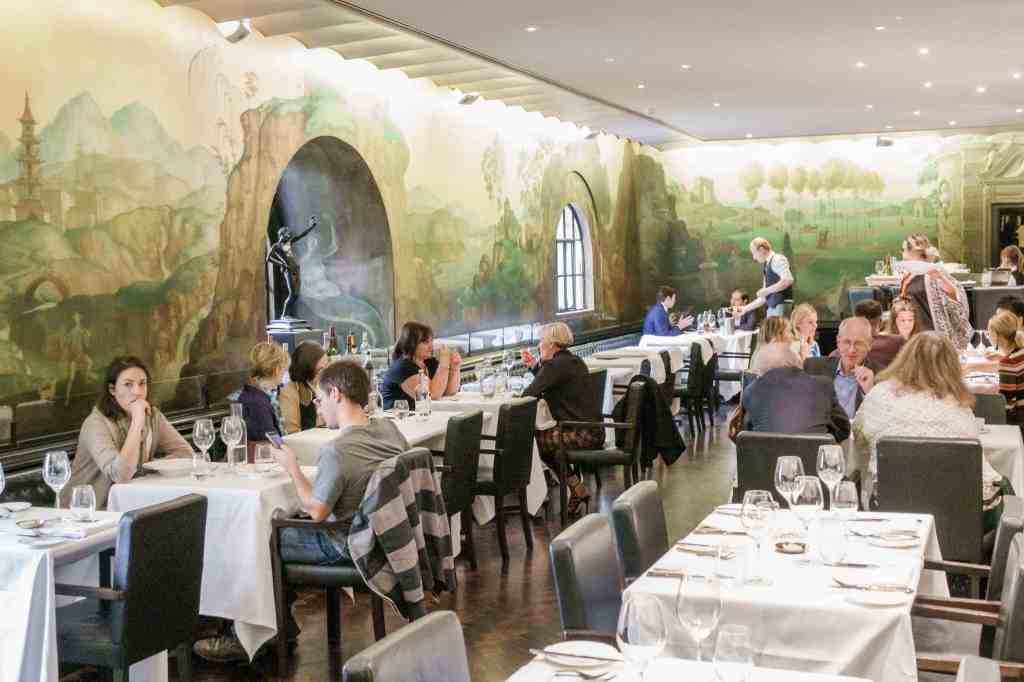
Take Tate Britain, perched gloriously on the banks of the Thames. It is the home of one of the great collections of these islands. Yet today the trustees of the Tate do not seem to think that they should simply conserve the collection. They do not even think that their job is to explain it. They appear to believe their task is to condemn it – to stand as judge, juror and executioner over it.
I have written before on the atrocious treatment of Rex Whistler’s vast Arcadian mural in the museum’s basement. In recent years the Tate closed the room, looked into removing the work from the plaster walls and now says the room is locked until the gallery can add ‘interpretative material’ on the mural’s ‘racist imagery’. A committee which looked into the mural was ‘unequivocal’ in finding ‘the imagery of the work offensive’. All because the mural includes two details so tiny that almost nobody ever notices them – a black child being pulled by a woman in a frilly frock and another being pulled from a chariot.
For any non-malevolent observer, the message is clear. As in all of Whistler’s mural, he leaves a signal that even in Arcadia there exists the worm of human evil. But the ‘experts’ at the Tate did not approach the work in that way. Instead they bowed to the chants of malevolent activists and effectively agreed that the mural was ‘pro-slavery’ and that Whistler held racist views. This libel is made even more appalling by the fact that the artist died in Normandy fighting the Nazis in July 1944, aged just 39.
It’s not just Whistler whom the Tate has taken against. One of the treasures of the collection in its care is ‘The Resurrection, Cookham’, by Stanley Spencer. Possibly the artist’s most famous painting, it depicts the dead all rising from their tombs in Spencer’s local churchyard on the Day of Judgement. When I worked nearby, I often used to go to the Tate at lunchtime just to sit in front of this painting.
Today the gallery’s description beside this masterpiece condemns the artist. It was Spencer’s somewhat progressive vision to put people of all races rising from their tombs on the day of resurrection. But the Tate’s signage says that while the white people in the painting are friends of Spencer’s, he painted the black figures in ‘a generalising way’ based on images he saw in National Geographic.
A reasonable curator might simply note that there weren’t many black people in Cookham in the 1920s. But the Tate says that Spencer ‘reinforced racist stereotypes and divisions accepted at the time by most white British people’, thus simultaneously smearing the British people and demeaning a visionary masterwork by grinding it through the remorseless mill of identity politics.
If any museum curator in the land wonders where all this might lead, we can now point them somewhere. Specifically to the Wellcome Collection on London’s Euston Road. In recent years the museum has been struggling with its collection, which was put together by Henry Wellcome in the late 19th and early 20th centuries. The organisation has been commissioning ‘anti-colonialist’ writers to conjure up denunciations of its Medicine Man permanent exhibition. So a new sign meant to accompany the casket for Henry Wellcome’s ashes consisted of a denunciation of him for his ‘power’, ‘money’ and the British Empire. A collection put together by an open, energetic mind has been turned into a source of shame and provoked an urge for patricide.
This past weekend the collection had an online meltdown. ‘What’s the point of museums?’ asked the Wellcome’s official Twitter account. ‘Truthfully, we’re asking ourselves the same question.’ The museum went on to flagellate itself over its collection, saying that the whole idea of it was ‘problematic for a number of reasons’. One was that apparently the Medicine Man exhibition ‘told a global story of health and medicine in which disabled people, black people, indigenous peoples and people of colour were exoticised, marginalised and exploited – or even missed out altogether’. And whereas the remains of minorities cannot be displayed, the remains of white people can be displayed but only so long as they are insulted. At the Wellcome, a fragment of the skin of Jeremy Bentham has an accompanying note by a pseudo-scholar, Dan Hicks, that says that Bentham leaving his body to science simply demonstrates the centring by museums of ‘the white cis-male body’. Hicks goes on (at the invitation of Wellcome): ‘Time’s up. Dismantle Wellcome’s enduring colonialism, its white infrastructure.’ After that, I wouldn’t just avoid donating my skin to a museum in this country. I wouldn’t leave them the shirt on my back, and don’t see why anyone else should either.
Showing that the curators had at least learned something from the 20th century (notably China), their struggle session continued interminably. And so: ‘The display still perpetuates a version of medical history that is based on racist, sexist and ableist theories and language. This is why this Sunday on 27 November, we will be closing Medicine Man for good.’ They had tried to find a way around it, but in the end the fact that this display had been put together at all – by a man ‘with enormous wealth, power and privilege’ – made it impossible to continue.
Tate Britain, the Pitt Rivers and every other collection in the land should take note. Once you start playing this game, you cannot win. Once you begin to shut yourself down, there is only one logical end point: total self-destruction. The late Robert Conquest explained the phenomenon well. Any organisation not explicitly right-wing eventually becomes left-wing, he said, and the simplest way to explain the behaviour of any bureaucratic organisation is to assume that it is controlled by a cabal of its enemies. Conquest used the example of the Church of England, but he could these days have pointed to almost any museum or gallery in the West, or the whole discipline of curating as it is imagined now. The aim is no longer to collect and curate but actively to dismantle.
Once you begin to shut yourself down, there is only one logical end point: total self-destruction
The Pitt Rivers, for instance, is especially keen to ‘interrogate’ the way in which the collection has been presented until now, and why that is wrong. The collection is attacked for ‘problematic past research practices’, while Europeans are described as ‘a race of scientific criminals’ and also responsible for paving the way for ‘modern legal and illegal drug networks’. If there is anything good to be said about the museum, then the museum itself certainly doesn’t say it.
No cliché of the modern academic and curatorial left is left untouched. There are signs labelled ‘Beyond the binary’ which inexplicably acclaim ‘queer icons’. One cabinet celebrates a figurine from the 1990s with ‘a huge queer following’. The small bookshop does the same. Alongside the books on Ancient Rome and Egypt, the visitor can buy children’s books of ‘Queer heroes’, books on diversity and also The Little Book of LGBTQ+: An A-Z of gender and sexual identities.
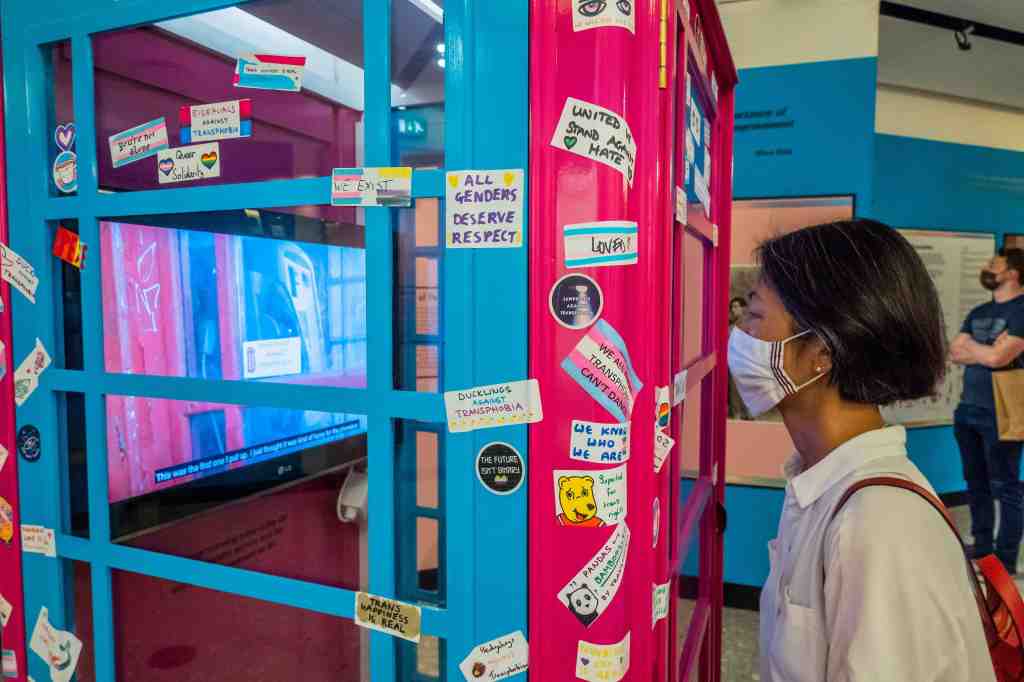
The whole thing is curious, just not in the way it used to be. The curators would appear to despise the museum and the people who put it together. And while the negative aspects of all other cultures are ignored entirely (slavery in Benin, anyone?), the in-iquity of Europeans is stressed everywhere.
Some might imagine that the Pitt Rivers, the Wellcome and the Tate are rogue institutions run by a few extremists, but the self-destructive, iconoclastic mania is actually encouraged everywhere. The Museums Association – a professional members organisation which more than 1,800 museums in the country have joined – has issued guidance and resources to its members on how to ‘decolonise’ their collections. They warn that there may be problems with the ‘comms strategy’ of their decolonisation work thanks to ‘negative press or feedback’, but that ‘pushing through those hesitations is essential. Remember, we must be brave in this work’. And there was me thinking Rex Whistler was brave to join up the moment war was declared.
Worse even than the claim of bravery is the warning that ‘discomfort’ is inevitable, yet worth it. The guidance quotes Sathnam Sanghera, one of the sages of the decolonisation movement, as saying our nation has been ‘wilfully white supremacist and occasionally genocidal’ and ‘our failure to understand how this informs modern-day racism’ is apparently ‘catastrophic’. As one academic on the Museum Association puts it, there is a problem with ‘the overwhelming whiteness’ of our cultural institutions.
Well, in my observation there is an overwhelming blackness in those museums that exist in Africa, an overwhelming Chineseness in museums in China and an overwhelming Egyptianness about museums in Egypt. Only in the West, and especially in this country, do we decide that our past is so appalling that it needs to be ‘decolonised’ – which we can now see means assaulted, insulted and eventually closed.
2581: In the balance – solution
The theme word is scales: 1D, 14 and 40 are creatures with scales; 5, 9 and 17 are musical scales; 13, 34 and 39 all gave their names of scientific scales. 33 was to be highlighted.
First prize Mrs D. Selvidge, Vale, Guernsey
Runners-up G. Snailham, Windsor; H.A. Hyman, London W1
2584: Song XI
‘10/30’ (4,1,4,3,2,4) is the first line of a song whose tune, originally called ‘1D’ (6,2,1,5), was composed by a future 40D/2 and was often played by 39/6. The song’s title explains 34. The composer’s surname will appear diagonally in the completed grid and must be shaded.
Across
1 City in Israel bloke traverses (5)
7 Mate inside once stole jelly (6)
12 Purgative rice pariah concocted (5-5)
14 Perhaps Daphne ruled wearing crown (9)
16 Danced tango with Pole (4)
17 Fish connect mentally (7)
18 Languishing Welshman cried continuously (3-4)
19 Short rope secures sail (3)
20 Wiseacre stops career criminal (7)
22 Veteran acquired gun (3)
23 I like absorbing books and letters (5)
27 Objects being finally stowed within (4)
31 Coach one is on daily (5)
33 Bishop abjured evil drink (3)
38 Clever old Penny freed amphibian (3)
40 Scots engineer composed mass with shanty (7)
41 Affirmed (as bible went astray) (7)
42 Father of musicians (4)
43 Asians in offences secret police chief crushed (9)
44 Flamboyance of asters – none dismal (10)
45 Opera holds nothing for Parisians lacking energy (6)
46 Quite ordinary green (5)
Down
3 One type of bean in the field (6)
4 New baby oil less unknown in Basque city (6)
5 Outlaw Ned beginning to pine for large sheepdog (5)
8 Breathing ailment in LA chap nearly catches (5)
9 Bard’s chilled, a little croaky and worn-out (5)
11 Spider about 1.3lb in Hong Kong post office (6)
13 Soldiers left on active duty charge again (6)
15 Deity changes wildly (not constant) (6)
21 No good spirits in Poet’s pubs (3)
24 Course where tee can be found (6)
25 Some sail lateens with difficulty (3)
26 Maltreating daughter for son’s fooling (8)
28 Film director shooting by a weird rodent (8)
29 Bird’s place? Above (6)
32 Sun browns climbers (6)
35 Finest party (it’s topping) (6)
36 Pabulum’s brassy energy drink (6)
37 Dish in the can that’s underdone (5)
A first prize of £30 for the first correct solution opened on 2 January. There are two runners-up prizes of £20. Please scan or photograph entries and email them (including the crossword number in the subject field) to crosswords@spectator.co.uk, or post to: Crossword 2584, The Spectator, 22 Old Queen Street, London SW1H 9HP. Please allow six weeks for prize delivery. The dictionary prize is not available at present.
Download a printable version here.
It’s time we stopped subsidising the railways
Rail travel has never been cheap, but should we really each be paying £500 a year even if we never set foot on a train? That, according to figures released by the Office of Rail and Road today, is astonishing sum that each household had to contribute to government subsidies for running the railways in the year to March 2022: a total of £13.3 billion.
That is just the subsidy for running existing services; it doesn’t include the billions being spent on HS2. Not that this largesse has, of course, prevented rail workers from demanding above-inflation pay rises, and striking when they are denied them. If they were working in any other hopelessly unprofitable industry they would long since have been put out of a job.
It is time the government stopped sitting on the fence and told the rail industry that the party is over
Surely, one of the main reasons for privatising the railways was to relieve taxpayers of the financial burden of running them. Instead, the subsidies have grown and grown. True, the year 2021-22 began with the tail end of a Covid lockdown which severely suppressed travel, but other private industries had to put up with loans and furlough payments – employees didn’t carry on being paid the full whack whether they were providing a service or not. Moreover, the rail industry was swallowing large subsidies even before the pandemic: £6.5 billion in 2019/20.
The rail industry hasn’t really been privatised at all. It remains underwritten by the taxpayer. Nor is there much in the way of competition: local monopolies are guaranteed by the franchising system. The only difference is that the system is rigged so as to allow the private companies owning the franchises to make a profit, even if their underlying operation is making a thumping loss. This, in turn, has served to embolden unions in making pay demands, driving up subsidy even more.
This really cannot go on. Much as I like travelling by train, we cannot have a rail system which continues to impose a hefty tax burden on people who never do – a group which is disproportionately represented by poor people who live outside London and the South East. By contrast, bus services (which are used more by low-income groups) are increasingly expected to wash their face. In the last year prior to the pandemic, buses received a rather more modest £2 billion in annual public subsidy, a sum which had been falling consistently for the previous decade.
Rail subsidies were £6.5 billion in 2019/20 – and rising. In other words, more than three times as much subsidy was going into trains than buses. This was in spite of the fact that more than twice as many journeys were made by bus as by train (4.32 billion compared with 1.74 billion)
So far, the government has tried to stay out of the rail strikes, taking the line that the dispute is a private matter between unions, employees and their private sector employers. Sorry, but it isn’t – not with £13.3 billion of taxpayers’ money going into the industry. It is time the government stopped sitting on the fence and told the rail industry that the party is over – it is going to have to cut its costs dramatically. It should announce the phasing-out of rail subsidies – and let the industry work out how it is going to balance its books.
Balenciaga and fashion’s child sexualisation problem
For a long time now, high fashion – with the alibi of being ‘art’ – has tried on rape, self-harm, heroin-chic and of course the simple, timeless classics of anorexia/bulimia as titillating ‘looks’. Anything to keep an enervated haute couture industry (for many years selling mainly in Russia, China and the Middle East, though post-pandemic even these are dropping off) in the headlines.
Ambiguous – to say the least – about the beauty of the female body, the mainly gay male world of high fashion has, after a brief period of pretending to embrace ‘diversity’ (anything above a size eight) returned to physiques in which any semblance of female sexual characteristics has been excised.
Society as a whole has been groomed by fashion to accept the unacceptable for far too long
Covering Milan Fashion Week in the Mail recently under the headline ‘The return of heroin chic is a cynical betrayal of young women’ Liz Jones said: ‘This season, the female models aren’t even pretty – their bodies are sinewy, hard, not feminine at all. What it means to be a woman is under attack like never before and now the eradication of women is evident in fashion too – in the skeletal figures that bear little resemblance to a normal woman’s body. The men in charge don’t want to see hips and breasts, just the colour of our money. We’re being erased, while simultaneously having our pockets picked.’
One form of diversity which fashion is keen on is the employing of ‘transgender’ models – the inspiration for an Insider piece called ‘13 Transgender Models Who Are Changing The Industry’. But the claim to be ‘making fashion more inclusive’ is inclusive in the way that women not being allowed to play female roles from the Greeks to early Shakespeare was, or indeed the recent theatrical revamp of Joan of Arc’s story, changing her from a brave young woman into an introspective non-binary ‘Them’. Funny how being inclusive generally means excluding women.
And now fashion has come for the children – pre-teen girl children with no messy female bodies to spoil the line. In case you haven’t seen the Balenciaga ‘holiday gifting’ campaign I’ll describe it, though even typing this feels grubby. Very young female children pose with bags fashioned from teddy bears dressed up in gimp outfits – which was released alongside Balenciaga’s recent runway show in Paris, carried by models made up to look bruised and bloodied. In another Balenciaga photograph a little girl lies face-down next to empty wine glasses. As if this wasn’t enough, an earlier campaign showed a handbag sitting on top of a stack of documents; zooming in, they show papers from a Supreme Court ruling on whether child pornography was in violation of the first amendement. Making up a hat-trick of heinousness, Balenciaga also ran a recent campaign in which the actress Isabelle Huppert sits in front of a stack of books including one showcasing Michael Borremans, a Belgian painter whose work includes what appears to be castrated toddlers. It’s hardly surprising that #Burnbalenciaga – following on the heels of #BalenciagaGroomers – is trending.
How could women like Huppert, Kim Kardashian and Nicole Kidman (who have all worked with the brand) lend themselves to this unholy mess? (Kim Kardashian has since said she is re-evaluating her relationship with the brand.) Society as a whole has been groomed by fashion to the unacceptable for far too long – first with violence against women, and now the sexualisation of children.
This isn’t just confined to fashion either. Many lesbians now boycott Pride marches, which are often attended by children, as they increasingly resemble fetish meetings.
It is a strange society indeed which has less of a problem with sexualising seven-year-olds (the age of ‘Desmond Is Amazing’ when he started out as drag queen, his mother beaming from the gay-club wings) than it does with sexualising 17-year-olds (the age of Virginia Giuffre when she met the ghastly Prince Andrew.)
Meanwhile, Balenciaga is practising damage-limitation, removing the images and soberly swearing that it is ‘taking action’ over the photoshoots. ‘We sincerely apologise for any offence our holiday campaign may have caused – we have immediately removed the campaign from all platforms.’ This is a grim affair, but if it results in fashion no longer being given a free pass to fetishise violence against women and children, maybe it was worth those horrible images briefly seeing the light of day. And if it reveals the people who have a vested interest in the processing of dazed, compliant, medicalised children – even better.
Why not let pharmacists prescribe medication?
It started as a small red shadow on my nose that gradually began to spread as the inflammation took hold. Soon the lesion was painful. A golden crust appeared and my suspicions were confirmed: impetigo.
Impetigo is an incredibly infectious skin condition – and if left untreated, it can scar. Topical antibiotics – fucidin ointment – work a treat, but I had just moved to London and had no GP in the city.
I wasn’t too worried, though. The importance of the ‘multidisciplinary team’ had been branded on to my brain from day one of medical school and so I called my nearest Boots. ‘I have impetigo,’ I told them, ‘and I’m looking for fucidin.’ I was to come in and ask for the pharmacist, they said. So I did exactly that.
Peering over the top of his glasses, the pharmacist wrinkled his nose. ‘It does look bad,’ he murmured, and then shuffled the papers in front of him and pulled out some form of impetigo checklist. It didn’t feel necessary. I clearly met the criteria. He asked me some questions. I answered them. ‘You’ll have to go to your GP,’ he said at last. ‘You need an antibiotic for this.’
‘I was told I could get that here,’ I replied. He shook his head, eyes already on the customer behind me. ‘We can’t prescribe you antibiotics without a prescription from your GP.’ ‘My GP is in Glasgow,’ I said, and it was a Sunday. ‘Phone 111,’ he advised. ‘You need to get it treated quickly. Today.’ Really? I could see the cream only a metre behind him.
I phoned 111, listened to the pre-recorded message about going straight to hospital if you have chest pain, and felt like an idiot. An hour later, I was still on the phone. ‘You’ll have to go to your nearest A&E,’ the woman on the line told me. A&E? I had a rash on my nose.
If I’d felt like an idiot phoning 111, it was nothing compared with how it felt to be sitting, three hours later, in an A&E waiting room with a patient vomiting on one side of me and a groaning man, head in his hands, on the other. I kept apologising to the staff. They didn’t seem especially surprised. ‘This is what happens on weekends,’ one said.
A&E waiting times have reached record highs in recent years. Trying to get an appointment with your GP is a challenge, too: doctors are overworked and patients aren’t getting seen quickly. The issue isn’t a lack of money (when it comes to health spending, the UK is the fifth highest in the 32-member OECD), it’s how the money is spent. The way the system is organised needs to change.
Why couldn’t that pharmacist simply have passed me the cream? The problem is that pharmacists are not automatically allowed to prescribe when they graduate after five years of education. Despite their courses being the same length as a medical degree, pharmacists lack the clinical decision-making their medical counterparts see as vital for any clinical setting. No, if pharmacists want to prescribe the medicines they’ve spent so long studying, they have to do an additional course on top of their five years. This is optional, and so many haven’t done it. Of almost 27,000 community pharmacists in England, only 1,000 have completed an additional prescribing qualification.
It doesn’t have to be this way. In France it’s easy to get wound care, such as stitches, at the chemist. In American states such as Florida, independent pharmacists have been prescribing for years, and in other states chemists can prescribe alongside a doctor. In Canada, pharmacists with prescribing rights can write up scripts independently, while in New Zealand, legislation has been introduced enabling appropriately qualified pharmacists to prescribe.
There are signs that change might be coming to the UK – albeit slowly. In December 2020 the General Pharmaceutical Council approved new standards for education and training, ensuring that pharmacists who graduate in 2026 will leave as prescribers. ‘With these course changes, all pharmacists will be prescribers and so will be able to treat urinary tract infections, ear infections and upper respiratory tract infections,’ a senior pharmacist working in medical education told me. ‘The aim is for pharmacists to run COPD (chronic obstructive pulmonary disease), asthma and diabetes clinics.’
Data from Scotland suggests that enabling all pharmacists to prescribe antibiotics for urinary tract infections alone could save 400,000 GP appointments a year – and approximately £8.4 million.
‘You’ll have to go to your nearest A&E,’ I was told. A&E for a rash on my nose?
This year, the Core Advanced Pharmacist curriculum was introduced by the Royal Pharmaceutical Society to help bridge the gap between the scientific and clinical sides of their work. Scotland is a slight step ahead with its ‘Patient Group Directive’ and ‘Pharmacy First Plus’ service which allows independent prescribers to treat patients with common conditions, but this remains a contrived, tick-box process. Next year, a trial of independent prescribing services for pharmacists in England will begin, a test for a wider rollout of independent prescribing services: the first NHS-funded independent prescribing service in England.
While the vision is admirable, the timeline is not. Former health secretary Sajid Javid was ready to roll out ‘Pharmacy First’ plans for England last year, but the scheme was squashed by Boris Johnson’s No. 10 at the final hour due to fears that it could look too anti-GP. But emergency departments are crumbling now; patients are struggling to access GPs: 2026 feels too far away. As the NHS struggles to deal with the post-pandemic fallout, the volume of patients who require help is multiplying all the time.
And then there’s medication supply-chain problems and prescription waiting times in pharmacies that already are usually upwards of 20 minutes. If the plan is going to succeed, patients also need to be prepared to stop calling their GP and go straight to the chemist for minor ailments.
My impetigo has gone. Thankfully I wasn’t left with a scar. It worked out fine, if you can call a five-hour hospital wait ‘fine’. But if I’d been prescribed fucidin by my pharmacist, I wouldn’t have taken up a space in the virtual phone queue – or the very real hospital one.
In defence of fairy tales
One by one, life’s harmless little pleasures are outlawed by an overweening, repressive government. The Online Safety Bill has been doctored by MPs to stop people making use of ‘deep fakes’. This means that my enjoyable pursuit of Photoshopping the heads of politicians I dislike onto the naked, writhing bodies of Russian porn stars and sending the resultant images, anonymously, on Christmas cards to members of the local clergy is now illegal. In future I will have to get the consent of each politician before I send them off to the vicar. I had a great one recently of Liz Truss going at it like the clappers with Mark Drakeford, the First Minister for Wales. It seems to me harmless fun and if discovered could surely only improve Mr Drake-ford’s image and poll ratings, although he does not seem to me the kind of chap who could take a joke. Anyway – all gone. I wonder what they will ban next?
Quite possibly it will be fairy stories. A recent opinion poll has revealed that they terrify people under the age of 30, who consider them horribly inappropriate for children. Some 77 per cent of those surveyed believed – with a crushing inevitability – that they were ‘sexist’. Nine in ten said they are old-fashioned and outdated.
I suppose it is hard to argue against the allegation that many fairy stories are indeed what would be called ‘sexist’ now, in that they portray men and women in a slightly different manner and often occupying what we might call ‘traditional’ roles. (It rather reminds of that old joke. Why are children’s storybook adventure heroes always men? Answer: to make them more believable.)
I do find it all a little depressing, though, for it is simply more evidence that millennials and even Generation Zers wish to abolish everything from history and everything we have learned from it. Some of these fairy tales date back 6,000 years – the Neolithic period in Europe and around about the time we first domesticated horses. That they have lasted, often scarcely changed, over the intervening millennia seems to me evidence that they contain certain immutable truths, applicable to all, regardless of whether we were chasing the last handful of mammoths or attempting to split the atom. If we think of them as largely Victorian in origin, then that is primarily the responsibility of the Brothers Grimm, who collated these ancient stories and made them popular again for young children via the newish technology of mass printing. The point, though, is that every one of these fabulous stories was created in order to inculcate some sort of moral or practical lesson.
The legend of Rumpelstiltskin is one of the very oldest and is largely a lecture on the importance of title, of naming something – as well as a warning not to brag too much. Rumpelstiltskin was a rather unpleasant imp who, for a price, wove straw into gold for the daughter of a local miller, who had unwisely claimed his hapless offspring had this ability in order to big himself up to the local king. She was no more capable of doing this than you or I, but Rumpelstiltskin helped her out, at the cost of a necklace, then a ring, and finally her own firstborn. Distraught, she was told she could escape from this last tariff only if she discovered the name of the imp, which she did when she heard him injudiciously singing it out loud in a nearby forest. And so we have the enduring and useful ‘Rumpelstiltskin Principle’, as used in modern psychology: to know the name of something, or to give a name to something, is to hold a sort of power over it, the power of title (as in the word ‘entitlement’).
All of these tales contain helpful warnings to the young. The Three Little Piggies yarn was about the necessity of working hard and not skimping, especially concerning building materials, while The Sleeping Beauty suggested the benefits of deferred gratification and waiting for love. Goldilocks taught children to respect the property and privacy of others, particularly if they are bears, while Jack and the Beanstalk enjoined children to make the best of opportunities which come their way.
The problem with the current generation, then, is twofold. First, they have been schooled to see all texts through only the very narrowest of prisms – according to the complaints of victimhood from anybody with a ‘protected characteristic’. These fairy stories thus become simply conduits for grievance and resentment – the king’s treatment of the miller’s daughter and the fact that she is anxious to marry into royalty. The real point of the story is entirely lost, because today such stories are read with blinkers on. I remember when one of my sons was reading John Steinbeck’s Of Mice and Men and his essay question was about the sexism inherent in Curley’s relationship with his squeeze, Candy – the point of the little fable entirely lost on this new audience. The same occurred later with a reading of Othello. Such a suffocatingly narrow approach to literature.
The second problem is that we have a generation for whom history means absolutely nothing: it is a dark and dismal place where people behaved terribly badly to one another and may even, on occasion, have misgendered people.
We need take no lessons from history, then – better to abolish it. History will only inculcate in our children the outdated and frankly obnoxious stereotypes which we have done so much to banish. And so 6,000 years comes to a rather abrupt end.
We have a generation for whom history means absolutely nothing: it is a dark and dismal place
In their place, the current generation give us their own fairy stories about everybody being equal in everything and men happily turning into women – a complete inversion of the old fairy stories in which the actors in each were obviously fictitious but the moral real and immutable. In the current fairy stories the people are real enough, but the lessons wholly fictitious.
Spectator competition winners: poems to mark the centenary of the discovery of Tutankhamun’s tomb
In Competition No. 3277, you were invited to supply a poem to mark the 100th anniversary of the discovery of Tutankhamun’s tomb. Fifty years ago, amid a wave of Tut mania, some 1.6 million people queued up to see the boy king at the British Museum. Nick MacKinnon and his mum were among them and he earns a commendation for his account of their outing. In a diverse, clever and technically accomplished entry, Roger Rengold, A.H. Harker, Michael Jameson, Paul A. Freeman, Donald Mack and Robin Hill also shone, but the prizes go to the seven printed below, whose authors snaffle £20 each.
Three thousand years of strangers own his bones
And traffic in the trappings of his reign –
From mummy mask of gold and precious stones
To canes that helped him limp with bent-foot pain.
Though robbed a wee bit in antiquity,
His tomb stayed untouched to a great extent
Till Europe’s Great War was a memory
And foreign scholarship could pitch its tent.
Then doors long sealed were breached, braving a curse.
They found his mummy, coffined in pure gold,
Afflicted by a twisted spine and worse.
He hadn’t lived to be two decades old.
He died so young, endured so weirdly long,
Our fascination feels both right and wrong.
Chris O’Carroll
So, Mr Carter, why disturb my rest?
Three thousand years at peace, before you broke
that sacred seal. I thought you might have guessed
the fury of the Gods that you’d invoke.
I’ve treasures that will help me on my way:
gold artefacts – and games that I can play
while heading for the Afterlife – for, hey!
beneath the mask I’m just a mummied boy.
‘See everywhere the glint of gold,’ you cried,
within the gilded shrine where I’m entombed
to journey with Osiris by my side,
but listen, mate, I’ve news for you – you’re doomed!
So don’t make plans, but fix yourself a hearse,
you know you can’t evade the Pharoah’s curse.
Sylvia Fairley
Though Howard Carter had a charter, time
Was running out; his patron’s doubt remained.
He’d have to fast explore the vast, sublime
Necropolis Diospolis contained.
He stumbled on a crumbled stone that led
Below; he breached a door, and reached a crypt
And what he saw inspired his awe, he said.
Agog, his funder waited, wonder-gripped.
Within the calm of Tutankhamun’s tomb
Antiquities for centuries unseen
Were stacked and strewn; he knew he’d soon exhume
The once-iconic pharaonic teen.
And so it came to pass that fame was won
For Akhenaten’s long-forgotten son.
Alex Steelsmith
As Nefertiti’s son-in-law, you ruled
When you’d have better been out kicking gourds
Instead of hunting hippos. You weren’t schooled
In anything. The vizier whispered words
And you performed them, false beard on your chin.
Pharaoh of glam, mascara dark, exquisite,
You limped through life and married next-of-kin,
But died a teen – not very cheerful, is it?
Now after death, your buckteeth grin’s on view,
As is your charcoal skin. Two thousand years
Between us? Gold is gold, old friend, and you
Were buried with a shedload, it appears.
History observes you, a nonentity,
Though, gawping, we will offer you identity.
Bill Greenwell
One hundred years since Howard Carter found
my tomb, peered in and saw ‘Wonderful things!’
Since then my golden face has been around
the world – a wonder, like a pig with wings.
But what’s a century? We old Egyptians
held our dominion for three thousand years.
It’s you strange folk who go into conniptions
over a hundred. We reserve our cheers
for Bastet’s seven-thousandth anniversary.
We’ve barely reached the top of history’s hill.
Your gods are hardly out of heaven’s nursery,
while Isis, Ra, and Horus guard us still.
A hundred years – you think the world is yours
at such a trifling number? Amateurs!
Gail White
Immured, entombed, his coffin, too, encased,
Tutankhamun, King’s trappings laid around,
Was readied for the voyage that he faced
To reach the afterlife deep underground.
Untouched then for millennia he lay,
A silent presence in that lightless place,
His earthly remnants proofed against decay,
A golden mask to represent his face.
No more. The modern day broke in, revealed
The secrets of his tomb, his regnal name,
What gross return his glittering mask might yield:
The afterlife for him meant worldly fame.
His story had appeal but – truth be told –
It was transcended by the glow of gold.
W.J. Webster
Did you go gentle into that good night
Great king, whose short life led you to this tomb?
For three millennia, hidden from our sight,
You’ve rested silent in your second womb.
Then in the daylight, light to which you’re blind,
Men scoured your rocky, arid valley till
The smallest tomb became their greatest find
Yet, in the end, would bring them only ill.
Now, poised like vultures, wondering how you died
Men scan your bones, while those who brave the cold
And queue to see your treasures, eagle-eyed,
May yet be jinxed for gazing on your gold;
With this I close my valedictory verse:
‘Be wary, all, of Tutankhamun’s curse!’
Alan Millard
No. 3280: you’ve got mail
You are invited to submit an updating of W.H. Auden’s ‘Night Mail’ entitled ‘Email’. Please email entries of up to 16 lines to lucy@spectator.co.uk by midday on 28 December.
When did oranges become ‘easy-peelers’?
‘Jersey Royals are easy-peelers and I don’t fancy one in my stocking,’ said my husband, lapsing into sense.
I had been complaining about supermarkets labelling all little orange citrus fruits ‘easy-peelers’. We have called oranges oranges since the 14th century. The bitter orange became known as the Seville orange. Both Thomas Nashe and Shakespeare joked at the end of the 16th century about being civil like an orange.
In contrast, the sweet kind was known as a China orange. Pepys was pleased to get hold of some China oranges in March 1666, but by the days of the racehorse Eclipse (foaled during the solar eclipse of 1764 and living till 1789), this fruit came proverbially in betting terms to stand for something of small worth, as in ‘All Lombard Street to a China orange’. I don’t think anyone says that now, though they might recognise the saying.
Among China oranges, tangerines turned up in the 1840s; satsumas, from Japan, in the 1880s. The clementine came to notice in the 1920s as an accidental hybrid of tangerine and Seville orange. Nadorcott was a chance cross-pollination in 1982 of an unknown variety with the Murcott clementine, and Tangold is apparently derived from mildly irradiated budwood of a Nadorcott tree and thus seedless.
Back in Eclipse’s day, a Swedish botanist, Pehr Osbeck, went to China botanising and came back with the description of an orange he called in Swedish mandarin. His work was translated into English in 1771 and the mandarin orange was born. Mandarin, in the original sense of ‘a Chinese official’, has a zigzag etymology, coming to us from Portuguese mandarim, taken from the Malay menteri ‘functionary’, itself derived from mantri, ‘counsellor’, in Sanskrit (an Indo-European language like ours).
A characteristic of the mandarin orange was its easily detached peel. This kind was called in the China of Osbeck’s time gām. So perhaps easy-peeler is not such a bad designation after all. Unless you prefer to keep gām and carry on.
No. 731
White to play. Sindarov-Sarin, World Team Championship, Jerusalem 2022. Sindarov has an extra pawn and a dominant position. Which move did he play to ensure a quick knockout? Answers should be emailed to chess@spectator.co.uk by Monday 5 December. There is a prize of £20 for the first correct answer out of a hat. Please include a postal address.
Last week’s solution 1 Be5+! Bxe5 2 Qxe8+ or 1…Rxe5 2 Qf6+ and mate follows next move.
Last week’s winner Cecil Taitz, London NW4
World Team Championship
The young team from Uzbekistan, who took gold medals at the Olympiad in Chennai, came close to repeating that achievement at the World Team Championship in Jerusalem last month. They cruised through the group stage, quarters and semis, and met China in the final, who got there despite fielding none of their elite players, such as world No. 2 Ding Liren. The match promised to be close, and it was China who triumphed. Their star player was Jinshi Bai, who scored 8.5/11, including this crucial win from the final.
Bai Jinshi-Shamsiddin Vokhidov
World Team Championship, Jerusalem, Nov 22
In the diagram position, 34 Qa7 Rc8 is balanced, but Bai found a clever counterblow. 34 f4! The point is that 34…Rxb6 35 fxe5 Rxc6 36 exf6+ Kh6 37 Rd7 wins. But 35…Ng4! (instead of 35…Rxc6) improves on this. 36 hxg4 Rxc6 37 Rd7 Kh6 38 Rfxf7 Rc5! Black’s king will make a cosy nest on g5, with reasonable drawing chances thanks to White’s weak pawns. Qxf4 A clever desperado sacrifice, but it backfires. 35 Qa7 Qe5 36 Rxf6! Now 36…Qxf6 37 Qxb8 wins, so the king is drawn forward. Kxf6 37 Rf1+ Kg5 37…Kg7 was a better try, but after 38 Qxf7+ Kh8 39 Qe7 Rg8 40 Kh1 Black is still in trouble. 38 Rxf7 Rh8 39 Qe7+ Kh6 40 Qh4+ Qh5 41 Qf6 Rg8 42 Bf3 Black resigns in view of 42…Qg5 43 Rxh7+ or 42…Qf5 43 Qh4+
Bai also cooked up a stunning idea which helped China win their semi-final match against Spain.
Bai Jinshi-Alexei Shirov
World Team Championship, Jerusalem, Nov 22
1 d4 d5 2 c4 c6 3 Nf3 Nf6 4 Qc2 g6 5 Bf4 Na6 6 e3 Bf5 7 Qb3 Nb4 This exotic sacrifice was first tried by the late Viktor Kupreichik in 1989. 8 Qxb4 e5 9 Qxb7 Rb8 10 Qxc6+ Bd7 11 Qa6 Players have also ventured 11 Qxf6 Qxf6 12 Bxe5 Qb6 and in this messy position 13 b3! is best. Keeping the Black queen out counts for more than a stray rook. exf4 12 Nc3 fxe3 13 fxe3 Bh6 14 Qa3 Bxe3 (see diagram) White has an extra pawn, but the Be3 prevents castling on either side. Bai (presumably in his preparation before the game) found a magnificent solution. 15 Ke2! Bf4 16 Re1! The king will enjoy relative safety on d1, and White’s Qa3 ensures that Black is not permitted to castle either. Be6 17 Kd1 dxc4 18 Bxc4 Qe7 19 Qxe7+ Kxe7 20 g3 Bh6 21 Re2 Rhc8 22 Bxe6 fxe6 23 Rhe1 White is a clear pawn up, and converts without difficulty. Kf7 24 Kc2 Nd5 25 Ne5+ Kg8 26 a3 Rc7 27 Kd3 Bf8 28 Rc1 Bg7 29 Rcc2 Rb3 30 Nc4 Rd7 31 Na5 Rb6 32 Nxd5 Rxd5 33 Rc8+ Kf7 34 Rc7+ Kf6 35 Nc6 Bh6 36 Ne5 Ra6 37 h4 Black resigns
Dear Mary: How do I stop guests at my overseas properties leaving with the plug adapters?
Q. I have become a lodger in a fortunate friend’s flat in Mayfair. We are both single and I am keen to start giving parties there. I had a trial run which was successful, bar the presence of one inebriated guest who went around indiscriminately insulting people – for example he walked up to a female guest and swore at her, before jeering at another guest’s hairstyle, proclaiming: ‘Only a Nazi would have hair like that.’ To top it all, he fell asleep on the dancefloor. He has a loyal harem of female handlers who look after him and go around apologising in his wake. Inexplicably this man is ‘best friends’ with my flatmate and fellow host – so how can I prevent him from attending our next event?
– Name and address withheld
A. Suggest to your landlord that instead of inviting the offending guest to your next party, you host a separate dinner party in his honour, inviting only those who inexplicably like him. In this way he can enjoy an evening of drinking to excess and insulting people with no repercussions. Say in kind tones: ‘He will enjoy that so much more than going to a party with people who don’t see the point of him.’
Q. I live in central London but also maintain small homes both in France and in the Swiss mountains. Throughout the respective seasons, we host a cavalcade of lovely UK friends and guests. Delightful and trustworthy though they all are, the annual rate at which our electric plug adapters ‘disappear’ is truly exasperating. Mary, can you suggest a way in which I could put a stop to this once and for all? Or is it just a question of getting some better quality friends? Since all our friends are Spectator readers I hope you will understand why I need to have my…
– …name and address withheld
A. The Sandals luxury resorts in the Caribbean feature bespoke sockets to fit European plugs without the need for adapters, so why not replicate this solution in your other houses?
Q. The daughter of one of my mother’s friends keeps inviting me to parties in London. I don’t want to go because I don’t know any of her friends and they all sound quite intimidating. I understand that these parties also go on till about 6 a.m. I am running out of excuses. Mary, how can I say ‘Don’t ask me again’ without causing offence?
– R.H., London SW10
A. No need for this. Reply at once to the next invitation asking could you possibly come just for the drinks, as you have another commitment later that night. You will feel much less intimidated by the thought of a one-hour appearance. You will also get the measure of these events, and once you have tested the waters, so to speak, you may well find you want to plunge in fully.