Ancient rome

Augustus vs Jeremy Corbyn

Jeremy Corbyn has been re-elected leader of the Labour party not by MPs but by his teenage ‘fans’ in Momentum. So what does Corbyn need to do when he wins power? Follow the example of the emperor Augustus, that’s what. When Rome was a republic, its monuments and military banners proclaimed it as SPQR — Senatus Populusque Romanus, a combination of the senate, mostly consisting of Rome’s elite families, and the people. The Greek historian Polybius greatly admired its clever balancing of powers between senate, people and office-holders. In the course of the 1st century BC, this system collapsed in bloody civil war. From that final conflict in 31 BC
Let the right ones in

As the UK prepares for Brexit into the big wide world outside, it has been pointed out that the Foreign Office is sadly lacking in people with hard experience of that world, and even more lacking in people from that world. But if the Romans can do it, surely we can too. Whatever else the Romans were, they were not hung up about race. That did not mean they admired all foreigners. The satirist Juvenal was cynical about the Greeks, who would happily turn into anything you wanted them to at the drop of a hat; and doctors observed that different environments produced not only different physical make-ups but also different mentalities

Nero’s scandalous spads

Theresa May has brought her own advisers with her into No. 10, and as usual the knives are out for them: they are parasites, and what are the civil service and the cabinet for anyway? Romans had the same trouble with freedmen. A ‘freedman’ (libertus or libertinus) was someone who had been a slave but been freed by his master. The emperor had hundreds of such slaves at his service, many with valuable skills, and any who were freed could be invited to retain their position in the imperial entourage, a duty they had to fulfil if their master asked them. While such a man was a slave, whatever his position,

Above the law

Because no country can interfere in another’s legal system, there is little the UK can do to help the six Britons jailed in India for possessing ‘illegal’ firearms which were, in fact, fully authorised for the protection of shipping against piracy. Where David Cameron failed, Boris might try an appeal based on ius gentium, ‘the law of nations’. Cicero was the first Roman to discuss the idea. He talked of societas (‘the state of association between people’) having the ‘widest possible application, uniting every man with every other man’. The jurist Gaius (c. AD 150) put it in legal terms like this: ‘Every people governed by statutes and customs observes partly its own peculiar law and

Rome’s border policy

Whether the EU commission knows what is good for it or not — always a tricky call — post-Brexit Britain should follow Roman practice in intelligently organising its borders. These were not meant to be barriers, but traversable, under Roman control. Take the Red Sea ports. Travellers to and from Egypt were given trackable passes, at a cost, to access both the roads and the ports. Everyone understood the system, and services sprang up along the routes to keep trade flowing. The very presence of Roman soldiers created mini-markets of their own for clothes, food and sex. An inscription records the hire of a prostitute, Procla, to a military outpost

Sophocles vs the luvvie Remainers

Is the Labour leadership hopeful Owen Smith, who longs to reverse the obviously undemocratic outcome of the recent referendum, aware of the company he is keeping — artists, writers, pop singers and other riffraff? Plutarch would not have rated these know-alls as especially useful allies. Plutarch (c. AD 100) mused on whether classical Athens gained its reputation more from its military or cultural achievements. He agreed that Athens was the ‘mother and well-disposed nurse’ of many arts, inventing some and burnishing others. But it was all a matter of priorities. Take historians and painters: since they lifted their subject matter from military leaders’ famous victories, they had little to add.

Rome’s Hilton

A traitor to one man is a hero to another. So debate rages around the role of David Cameron’s old friend and adviser Steve Hilton — is he a noble Brutus who saved parliamentary democracy by throwing in his lot with Leave, or the traitor who destroyed Cameron’s European dream? A foundational story of Rome was the expulsion in 509 BC of the last king, the tyrant Tarquinius Superbus (‘the arrogant’), and birth of the free republic. Well before Caesar met his end on the Ides of March 44 BC, Romans were remembering that story and relating it to Caesar’s growing power and ambition. ‘Absolute power vested in one man

Show business

Sport has never held much appeal for me, so I rarely venture into stadiums. But I do appreciate their peculiar power: I was present at the 2012 Paralympics when George Osborne ill-advisedly turned up to award a medal while engaged in a campaign against disability benefits, and was roundly booed by the entire stadium. It was a transporting lesson in the joy of crowds and the proudest I have ever felt to be British. The stadium, ostensibly a facilitator of mass spectatorship, is actually a machine for producing such feelings. The Greeks were explicit about the ritualistic, community-forming function of their games, but it was the Romans who secularised the

Cicero’s Brexit moment

If Remain has won, for all the political and financial flurries, it will be business as usual for us plebs. But such is the EU’s octopus-like embrace, so it will be if the Leavers win, creating much disillusionment. Cicero felt equally impotent at a similarly dramatic turning point — the assassination of EUlius Caesar. Cicero had long despaired at the slow collapse of the ‘free’ republic and the rise of the tyrant Caesar. ‘We ought to have resisted him while he was weak — then it would have been easy,’ Cicero wrote in a letter. When Caesar started the civil war in 49 BC, he exclaimed ‘Are we talking about a

Rome vs Brussels

The principle of countries working harmoniously together is wholly admirable. Why, then, has the European Union become such a disaster area? The success of the Roman empire may offer a clue. Romans won that empire almost entirely by military might. But they could not have maintained it that way: for some 500 years, a mere 300,000 legionaries patrolled this area of approximately two million square miles and about 60 million inhabitants. So what was their secret? The key is pleasingly paradoxical: the Romans never consciously planned an empire at all. Once they had started down that road, they saw the material advantages it could bring, but there was no blueprint for it. Success was a

What lies beneath | 2 June 2016

It was not so unusual for someone to turn into a god in Egypt. It happened to the Emperor Hadrian’s lover, a beautiful young man named Antinous, who was drowned in the Nile in the autumn of 130 AD. It was also the fate of Queen Arsinoë II, who had a complicated life. At the age of 15 she became wife to the 60-year-old ruler of Thrace. When he died in battle, she married her half-sibling, who murdered two of her sons. Her next husband was her full brother. A headless sculpture of Arsinoë stands about halfway around Sunken cities at the British Museum. It is, as a label rightly

Plutarch and the EU

Boris Johnson argues that the current European Union is yet another failed attempt to replicate the golden age of a Europe united under the Romans. But how golden was it? The Greek biographer Plutarch (c. AD 100) thought it brought ‘peace, freedom, prosperity, population growth and concord’ but agreed that there was a price to be paid. In his essay on statecraft, he advised the Greek politician ‘not to have too much pride or confidence in your crown, since you can see the boots of Roman soldiers just above your head. So you should imitate an actor, who puts his own emotion, personality and reputation into a play but obeys the

The great pretenders

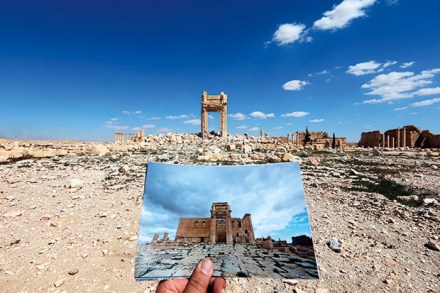
There is fakery in the air. And maybe the French are done with deconstruction. A drone operated by a French archaeology consultant called Iconem has been languidly circling Palmyra, feeding back data about the rubble with a view to reconstructing the ruins and giving the finger to Daesh. Cocteau said he lies to tell the truth. Iconem flies to tell the truth. In April, an exhibition called The Missing: Rebuilding the Past opened in New York which examined ‘creative means to protest preventable loss’. It was timed to coincide with the temporary erection of a frankly underwhelming two thirds-scale replica of the Palmyra Arch in Trafalgar Square, London. It goes

How Rome did immigration

Last week it was suggested that the questions asked of London mayor Sadiq Khan had nothing to do with racism, but more with multiculturalism. As St Ambrose could have said, ‘If you live in Rome, live in the Roman way; if elsewhere, as they do there.’ Until the large-scale irruption of Germanic tribes fleeing the Huns in the 4th century AD, eventually ending the Roman empire in the West, Romans had been fairly relaxed about immigrants, temporary or permanent. Many came under compulsion: hostages, prisoners of war and slaves, this last group keeping wages low across a range of service industries. Rome itself actively welcomed foreign doctors and teachers, while lawyers, diplomats,

Rome, racism and Sadiq Khan

‘Racism’ refers to the belief in racially determined inferiority, most often recognised in body-type, about which, by definition, nothing can be done. It is hard therefore to see why accusing London mayor Sadiq Khan of sharing platforms with terrorists was ‘racist’. It was simply a comment on the company he kept. The ancients are often accused of racism. The Roman architect Vitruvius, for example, said that southerners living in hot climates were intelligent but cowardly, while northerners were mentally slow but brave to the point of foolishness. Obvious racism? Far from it. A Greek doctor, following the same train of thought, gave the game away. He asserted that in Asia

Pliny on the joy of elephants

In order to deter poachers, hundreds of tons of elephants’ tusks are being incinerated in Kenya. But even for Romans, elephants were special: of all the animals cruelly slaughtered in the Roman arena, it was only the elephants that, on one occasion, moved the crowd to pity when they were put up against 20 armed gladiators. In Book 7 of his encyclopaedic 37-book Natural History, Pliny the Elder (killed in the explosion of Vesuvius in AD 79) turns from describing the physical world to the animal world and, first and foremost, man. His account is by no means an encomium — of all creatures, Pliny remarks, none ever shows more cruelty

Tax returns to boast about

As Jeremy Corbyn and John McDonnell whinge away about how rich David Cameron’s family is, they might consider that in the last six years he has funded schools ’n’ hospitals to the tune of £402,283. How much have they put in? Since wealthy ancient Athenians loved to boast about the vast sums they contributed via property taxes to the public benefit, they would have been amazed that Cameron did not long to reveal how rich he was. The 5th-century BC thinker Democritus argued that there was nothing like the rich giving to the poor to produce concord that strengthened the community. The Greek orator Hyperides (389–322 BC) pointed out that Athenians allowed statesmen

Seneca on bouncers

The papers are full of top stories about important people who cannot get into important parties because the doorman does not recognise them and tells them to shove orf, and other stories about the wizard wheezes that various nobodies employ to bluff their way in. The Stoic Seneca (c. 4 BC–AD 65), multimillionaire adviser to Nero, has stern words to say on these piffling urges. Seneca’s basic point is that there are indeed things that will hurt the wise man — infirmity, death of loved ones, the ruin of his country — but he will be able to deal with them. When it comes to trivial rebuffs, the truly wise man will exhibit

...Long live ENO!

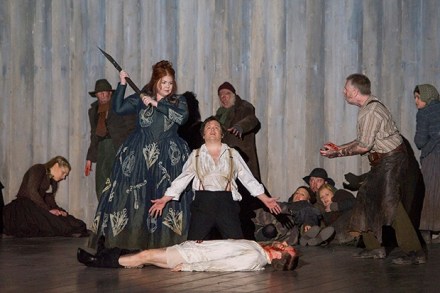
The three most moving, transporting death scenes in 19th-century opera all involve the respective heroines mounting a funeral pyre — partly, no doubt, a matter of operatic convention and fashion, but also recalling opera to its duty as a rite of purification. Berlioz’s Didon in Les Troyens, like her creator, is so relentless in her grasp of the truth that she fails to achieve anything but a vision of Carthage overcome by Rome, and ends in despair and execration. Brünnhilde in Götterdämmerung rides into Siegfried’s pyre in a state of ecstasy, imparted to the audience with all Wagner’s unlimited capacity for exaltation. In Bellini’s Norma things are more complicated: Norma’s

Oscar vs Augustus

There was something admirable about the spirit of careful mockery behind the doggy bags on offer to the finalists in this year’s Oscars and Daftas. The chance to hire a car or visit a New Zealand winery (pay your own airfare) cannot be very high on even the most grasping star’s list of ultimate desiderata. That said, the organisers are missing a trick here — the element of chance. The Roman emperors can come to their aid. Apophoreta, literally ‘takeaways’, were standard features of Roman dinner parties (the satirical poet Martial wrote a book of 221 couplets about them, celebrating everything from bras to nail-scissors and food for dealing with stretchmarks).