Marriage

Your problems solved | 6 June 2019

Q. My mother died a few months ago. Her collection of colourful clothes, hats, shoes and an immense amount of costume jewellery was donated to various charity shops in nearby Devizes. Consequently, I now see a diverse range of ladies wearing one of my mother’s ‘little numbers’. If I bump into a friend festooned in these purchases, what is the right compliment to make? — N.C., Stanton St Bernard, Wilts A. Say nothing. Part of the joy of vintage clothing is the mystery of its provenance. The buyer can fantasise — surely it must have cost a fortune originally! It’s so chic it might even have belonged to Catherine Deneuve? Or

Divorce’s faultless history

The Christian church ordained that marriage, a sacrament imparting divine grace, was for life. In 1857, the state enacted its first generally applicable divorce law, to be triggered only by sexual misdemeanours. Liberalisation slowly followed,and now ‘no fault’ divorce is being proposed in England. We edge closer to pre-Christian practice. To generalise: in both Greek and Roman worlds, marriage was essentially an understanding between two families, with fathers on both sides agreeing to and sealing the deal (that does not mean the couple’s view was irrelevant), and the bride being given a dowry by her father. The state had no official stake in the relationship. It did not keep records

Ending the divorce ‘blame game’ is a mistake

“Why do people get married?” It’s a question worth asking, not least because the government has announced the biggest change to divorce law in 50 years without attempting to answer it. Under the present law justifying reasons (adultery or unreasonable behaviour), must be given for a divorce to be finalised, usually within three to six months. Where there is no justification, the couple must live apart for at least five years, unless both spouses agree, in which case the divorce will come through after two years. The change to the law introduces ‘no-fault’ divorce, which means that no justifying reason is required. All divorce applications will go through in six

The problem with no-fault divorce | 9 April 2019

It looks as if I’m the only one who wants to keep fault in divorce then. Perhaps it’s because I’ve seen so many divorces where there was actually fault, usually one of the parties running off with someone else. I can see why the adulterous party in the business should want to remove the distasteful fault element; I can’t quite see how it improves the situation for the cuckolded or otherwise wronged spouse. Some women I know whose husbands have moved onwards and upwards to marry their mistress have referred to them  in a fashion that would make that poor woman who was banged up in Dubai for saying that

Dear Mary | 4 April 2019

Q. A woman I’ve known for years is getting divorced and rings me every day to talk about it. I have closer friends with ongoing problems and, though I do care, I don’t have the emotional energy or time to deal with her problem as well. I work and she never has, so she can’t really understand how tired I am. Your advice? — Name and address withheld A. Confide that you are finding it difficult, both at work and at home, to talk on the telephone without being overheard. Explain that this is inhibiting your ability to empathise and strategise with her. Suggest that instead she begins to communicate

China’s singles market

 Shanghai ‘How old are you, young lady?’ A small, curious crowd starts to surround me. ‘How tall are you? What do you work as?’ The parents camping out in Shanghai’s infamous marriage market have no time for small talk. They come here every weekend, rain or shine, seeking a partner for their grown-up son or daughter. Age, wage, height, education — everyone has a wish list, and they also condense their own child into such a list. Today’s special: me. The so-called Matchmakers’ Corner has seen tens of thousands of Chinese parents, including members of my own family, come to investigate what (or who) is out there. A great many

Clucking hell

‘Last fling before the ring.’ ‘Buy me a shot, I’m tying the knot.’ ‘Keep calm and bridesmaid on.’ If you find yourself on a train to Brighton, Paris or Amsterdam with a group of women in T-shirts bearing the above slogans, change carriages. You are about to witness Jen’s hen in full prosecco-and-Pringles feather. On the lash, off the leash, bonded together in squealing sisterhood for one night only. If only it were for one night. The hyper-inflation that has seen weddings go from church and breakfast to three-day wonders now extends to the hen. Away we go to Lisbon, Barcelona, Marbella on a dawn flight in matching hoodies and

High life | 14 February 2019

Gstaad   Who was it that said we always hurt those we love the most? I did just that last week, skiing out of control, making a sharp left turn and crashing into my wife Alexandra — a beautiful and terrific skier — who was standing still in front of a mogul. As I knocked her down, my skis ran over her face crushing her nose and causing two deep gashes on her forehead. I then rolled down the mountain unable to stop because of the ghastly plastic garments we now wear that accelerate our speed on the ground. Neither Alexandra nor I wear a helmet while skiing, something to

The kiss of death

I once threw Tony Parker’s Lighthouse across the fo’c’sle of a ship at sea when I read that his characters were composites. Oral history should be historical, or it goes into the ocean. So it is a shame that I sometimes question Xinran’s authenticity in this account of the loves and lives of four generations of Chinese women. I question conversations recalled verbatim when they clearly weren’t recorded; and perfectly rendered speech when only notes were taken. Is this too severe? Then it is appropriate, because severity is something you must get used to, though this is a book about the Chinese concept of ‘talk love’, defined as ‘the process

The problem with allowing straight people to have civil partnerships

Tomorrow, the Civil Partnerships, Marriages and Deaths Bill – which would allow opposite sex couples to enter into civil partnerships – gets its second reading in the Lords. The bill has already made it through the Commons; and if the formidable Equal Civil Partnerships lobby group succeeds, it will become law by the end of the year. Supporters of the bill say it is a minor and sensible tweak to messy marriage legislation. They make the argument that a system allowing gay couples to choose a civil partnership over marriage, if it suits their purposes, but doesn’t afford the same privilege to straight couples is quirky and unfair. The legislation provides Parliament with a

A golden era has ended

When I proposed to Caroline back in 2000, she was a trainee solicitor and I was a freelance journalist. In my mind’s eye, I pictured myself enjoying several years as a DINK — Double Income No Kids. Imagine my horror, then, when she got pregnant as soon as she qualified and showed no intention of returning to work. Three years later, I had become a SITCOM — Single Income Two Kids Oppressive Mortgage. So much for my dreams of eventually retiring as a GLAM — Greying Leisured Affluent Married. For years, I’ve been complaining about this in a half-serious, half-jokey way, by which I mean I needle Caroline about it

Why didn’t the Tories back down over civil partnerships earlier?

Much as I deplore the integration of the European Convention on Human Rights into domestic law there are some battles which really aren’t worth fighting. Today, Theresa May announced that civil partnerships are to be made available to heterosexual couples for the first time. This follows a ruling by the Supreme Court in June that the current arrangements – whereby gay couples can enter into a civil partnership but not heterosexual ones – are in conflict with the convention. Why on Earth did the Government resist this change in the first place when it was so plainly obvious that it was discriminatory? David Cameron made a huge fuss about enabling

The delights of divorce

Looking around at my immediate group of female friends I notice a marked difference between the seven or so of us who are married with kids, and the three who have left their husbands and are going it alone. Guess which group appears to be more content? Yes, it’s the divorcees. I have been a long term, close up observer of the lives that my newly single friends carve out for themselves and I have to say, I’m envious. The Sunday Times finds that 53 per cent of women report that they are “much happier” post-divorce. This does not surprise me. Once the initial split has occurred (interestingly in my

Rod Liddle

Why is no one sticking up for marriage?

I took part in a debate organised by the Times this week about reform of our divorce laws. Well, I say a ‘debate’. There wasn’t much of that. Not much in the way of dissent. The four other panellists, who included a government minister, all wished to liberalise our divorce laws. And it was chaired with great impartiality by Sir James Lawrence Munby, who was until recently the president of the Family Division of the High Court of England and Wales. He made a stirring ten-minute speech on why we need to liberalise the divorce laws. Yes, it was like one of those exquisitely balanced Newsnight debates, then. The audience

Ebbsfleet or bust

Dominic Savage had an early start. In Barry Lyndon (1975), Stanley Kubrick’s sprawling take on Thackeray, he played a prepubescent toff called Bullingdon blessed with a blond pudding-basin crop. By the time Savage started making his own films in the early Noughties, the hair had vanished, and so had any of Kubrick’s civilising varnish. For television Savage made a loose trilogy of dramas which plummeted circle by circle into a pit of social deprivation. His subjects were teenage parenthood (Nice Girl), underage drug use and prostitution (When I Was 12), and suicide in a young offenders’ nick (Out of Control). These cheerless vignettes felt all the more raw because his

An unhappy marriage shouldn’t be grounds for an instant divorce

It is wrong to dwell on the misfortunes of others, but was there anything in the news more riveting than the Supreme Court hearing which ended with Hugh and Tini Owens, 80 and 68 respectively, being told they were going to stay married after her bid to end her 40 year marriage was thrown out. Naturally, Lady Hale, president of the court said that she was only reluctantly persuaded that the case should be dismissed; the ruling has been met with near-universal calls in the commentariat for the introduction of no-fault divorce. There were details that would probably strike a chord with lots of married people, chiefly the fact that

Letters | 12 July 2018

Marriage proposal Sir: Matthew Parris’s proposal that marriage be abolished, and civil partnerships installed in its place, is absurd (‘The term “marriage” needs to be untangled’, 7 July). This would not simplify the ambiguous connotations that the word ‘marriage’ has come to hold; rather, it would diminish its importance at a time when it is greatly needed. Committed and legally recognised relationships are a salient component of a functioning society: providing a stable environment in which to raise children, and serve as a welcome source of privacy in an era where such a concept is scarce. However, the distinctive quality of matrimony — at least in a Christian sense —

The term ‘marriage’ needs to be untangled

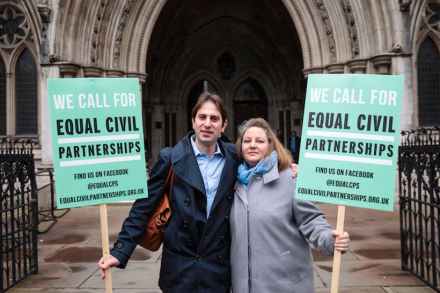
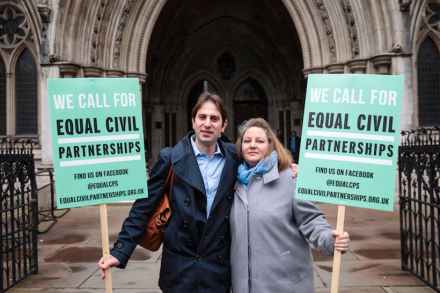
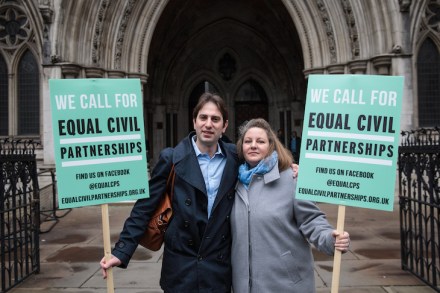
Rebecca Steinfeld (37) and Charles Keidan (41) have a moral objection to marriage. They’ve been together since 2010, have two very small children, but haven’t tied the knot. This, they say, is because the law doesn’t offer a knot they’re comfortable tying. ‘Charlie and I see each other as partners already in life, and we want to have the status of being partners in law,’ says Rebecca. They hold (and you may agree or disagree but it’s not a crazy view) that the concept described by the word ‘marriage’ is asymmetrical between the man and the woman, and inextricably tangled with religion and with cultural attitudes this couple (and others)

Are wedding vows unfair against men?

We went to the perfect midsummer wedding of my wife’s god-daughter in Norfolk this weekend. The service was pure Book of Common Prayer, omitting only some of the longer prayers and the woman saying ‘obey’ and (I think) ‘serve’. The service states the theological nature of marriage (‘signifying unto us the mystical union that is betwixt Christ and His Church’), and then its purposes. These are 1) children, ‘to be brought up in the fear and nurture of the Lord’. 2) as ‘a remedy against sin, and to avoid fornication’. 3) for ‘the mutual society, help and comfort, that the one ought to have of the other, both in prosperity and

High life | 28 June 2018

Schloss Wolfsegg   I was watching two very old men slowly approaching the open doors of the Pilatus airplane I was leaning against when it dawned on me that they were the two pilots who were about to fly me to my daughter’s wedding. The one called Willy extended his hand, as did Alex, a short guy who looked as though he was in his nineties. ‘Ah, Herr Tennisman,’ he said, referring to a match I had won more than 50 years earlier when I was on the tennis circuit, ‘wie geht es?’ Willy then told me that Alex had retired from flying airbuses 30 years before, and now flew