Nick clegg

The morning after the debate before

So, like last week: what’s changed?  And, like last week, it’s probably too early to judge.  The insta-polls may have Cameron and Clegg on level footing, but, really, we need to wait for voting intention polls before coming to any firm conclusions.  As we saw the day after the first debate, they can work in quite surprising ways. My instinct, though, is that things will remain relatively steady.  The Clegg surge of last week was, at root, a cry for change from the electorate – any change.  So it will probably take more than a solid Cameron victory in one TV debate to have voters flooding back to the Tories. 
Fraser Nelson

Cameron starts to pull the Tory campaign out of the fire

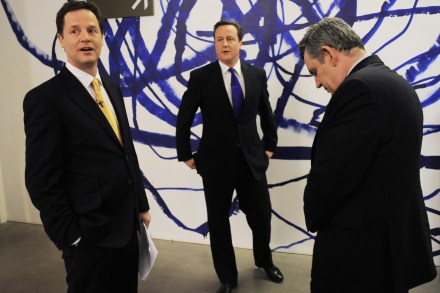
The headlines will be “score draw”, but I’d say Cameron won – and comfortably. I write this as someone who could have happily have sunk a few pins into a voodoo doll of David Cameron earlier on this evening – for taking the Conservatives (and Britain) to this appalling point where he may yet lose the election. But he raised his game, substantially. At best, he spoke with passion and authenticity. This time, he looked like he was fighting for his political life, which (of course) he is. Things are looking up. Here’s my participant-by-participant verdict: Brown Brown was his normal automaton self. He does tend to mangle his words,

Cameron is much improved – but the Lib Dem bubble hasn’t burst

It seems that the general election of 2010 will turn on 90 minutes next Thursday. David Cameron was far better tonight than he was last week. This time he managed to bracket Brown and Clegg together and had the moment of the debate when he called Brown out on Labour’s leaflets claiming the Tories would scrap various things that pensioners currently get free. If there was a YouTube moment in the debate, it was that exchange when Brown said he didn’t authorise the leaflets making these claims. The Tory press team then delighted in pointing to a Labour party political broadcast where they had suggested the Tories would take away

James Forsyth

Does Clegg go for a Love Actually moment?

The foreign policy portion of tonight’s debate offers Nick Clegg several opportunities to bracket Labour and the Tories together. Both of them supported the war in Iraq, both won’t take the military option off the table when it comes to Iran and both believe in the centrality of the alliance with the US to UK foreign policy.   On this final point, it’ll be fascinating to see if Clegg launches a full-on assault on the view that the America alliance is the cornerstone of UK foreign policy.  He sketched out the arguments against thinking about the special relationship in a speech the other day and there’s no doubt he could

James Forsyth

Tonight’s tactical battle

If seven days ago, anyone had suggested that the first debate would propel Nick Clegg and the Lib Dems to the top of the polls we’d all have thought that their lunch had gone on rather too long. But that’s what happened. Tonight, the questions are whether Gordon Brown reprises his ‘I agree with Nick’ routine or tries to check Clegg’s momentum and whether Cameron can turn in the kind of performance that begins to turn things round for him.   Cameron shouldn’t be angry tonight. But he does need to bracket Brown and Clegg together at every opportunity. When three people are debating, the person who does the best

Team Brown playing the same old tunes

The strange thing about last week’s TV debate is that, for all its transformative power, it doesn’t seem to have changed Labour’s campaign strategy in any fundamental way.  Team Brown were hoping for a hung Parliament, and courting the Lib Dems, before last week.  And, as Peter Mandelson demonstrated earlier, they’re still doing the same now.  The only difference is that it’s more likely their wishes will come true. But this creates problems for Brown so far as tonight’s TV debate and the rest of the election are concerned.  His instinct may well be to repeat the “I agree with Nick” positioning of last week.  But this has already been

People loathe politicians – but do they loathe the political media too?

One thing’s for certain: the Lib Dems are coming in for greater scrutiny and attention from the media.  The covers of the Telegraph, Sun, Mail, Express and, yes, The Spectator are testament to that – even if some are less substantial than others.  But the question is: will this derail the Clegg bandwagon?  And, like Iain Dale, I’m not so sure. Iain’s point is that some of the coverage is so spiteful that it will “serve to increase his popularity and position in the polls”.  He adds that this would be a “sure sign that the power of the press to influence an election is on the wane”.  He’s right,

Paul Rowen and the anatomy of a Lib Dem expenses scam

Now the Lib Dems are riding high in the polls, they attract greater scrutiny – which, to put it mildly, they do not always stand up to. In this week’s Spectator, we look at what can be seen as the Lib Dem vice. They may not charge for duck houses, or mortgages. But they do specialise in taking money intended for MPs expenses, and finding “innovative” ways of putting it into their war chest. Here is a hard example that may interest CoffeeHousers and it stars Paul Rowen, whom Mr Clegg visited last week – and declared “has done a great job”. He certainly has: for filling the Lib Dem

Taking the attack to Vince

With Cable’s and Clegg’s personal ratings being so high, the trick is to play the ball not the man. Ken Clarke and George Osborne achieved that at this morning’s press conference. Clarke said: “(Nick Clegg’s father was) a very nice, very wise guy, he was a very successful City guy, but he wasn’t a flashy guy… he was a Tory. It would have been better if Nick had stuck to the political principles of his father. (Nick Clegg) must regret going into the strange wastelands of Liberal Democrat politics.” He added that whilst he agreed with “70 percent” of Vince Cable’s analysis on the financial collapse, Cable’s solutions left him

The Tories need to get economical

Nick Clegg handed Gordon Brown a lifeline in one respect: the economy’s old hat compared to the Clegg frenzy. Not any more. The news that unemployment rose by 43,000 between December and February, together with yesterday’s dramatic inflation rise, has dumped the economy back onto the front pages. The Tories must keep it there; this election should be about the economy and nothing else. Obviously, these figures, which are worse than expected, lend weight to the argument that Brown’s policies impair recovery. Also, they demolish Brown’s claim that he ran up a deficit in the boom years to protect employment: unemployment is now higher than it was 16 years ago.

Nick Clegg and the 3 am phone call

Compared to many CoffeeHousers, I don’t find the Liberal Democrat’s foreign policy positions as problematic. Nick Clegg is smart, internationalist and has – unlike David Cameron and Gordon Brown (and Tony Blair) – plenty of foreign policy pre-leadership experience. But looking through the Lib Dem manifesto, I came across its pledge on Iran, which is quite problematic for a party that is keen to shed its beardie-wierdie, peacenik image and whose leader may even end up running the Foreign Office. The manifesto says that, on the one hand, the Lib Dems support “action by the international community to stop Iran obtaining nuclear weapons.” But the party also makes clear that

Numbers which show why the TV debates are priceless for Nick Clegg

How valuable was the TV debate to the Lib Dems?  Well, we’ve seen the poll numbers, of course.  But the Electoral Commission has just released some figures which shine a different light on proceedings.  They show that the Tories received party donations totalling £1.46m in the first week of the campaign.  Labour, nearly £800k.  And the Lib Dems were way, way behind on £20,000.  So, Clegg & Co. are heavily outgunned financially – but they’ve still had the biggest upsurge in publicity and popularity. True, donations to the Lib Dems have risen dramatically since the TV debate – but it’s still unlikely that they’ll reach Tory, or even Labour, levels

James Forsyth

Just another politician

Nick Clegg’s response to Andrew Neil’s question about his expenses at the Lib Dem press conference this morning, highlighted Clegg’s greatest vulnerability: he’s just another politician. As the question pointed out, Clegg’s own expenses were by no means perfect. The danger for Clegg is that many of his new supporters see him as totally different from Brown and Cameron. When they find out that he’s a lobbyist turned Eurocrat turned MEP turned MP who has had problems with his expenses they might not be so keen on him.  

Not so squeaky clean

“All my life, I’ve opposed the old politics,” says Nick Clegg ad nauseam. Not so it seems. Peter Oborne’s Mail column reports that one youthful indiscretion has been omitted from Clegg’s CV: ‘In fact, he has a background as a Westminster lobbyist with the firm GJW, where he worked as an account executive for 18 months. (Something he has omitted from his curriculum vitae on the Lib Dem website).’ So, Clegg glosses over his stint of political kerb-crawling. Hypocrisy always makes a good story but the Tories should, and probably will, shun this story. They have lost the media narrative and the last thing Cameron needs is for the campaign

Brown’s leadership back under the spotlight

Things have clearly moved on since I wrote this back in March.  From Rachel Sylvester’s column today: “…those close to Mr Clegg have made it clear to senior Labour figures that it would be difficult for the Liberal Democrats to do a deal with a Labour Party led by Mr Brown. ‘The whole notion of change is so important to Clegg and Gordon doesn’t represent change,’ says one Labour strategist. ‘It’s hard to see how they could prop up Brown in a hung Parliament.’ With Cabinet ministers openly discussing the prospect of coalition, the question of the Labour leadership is back on the agenda. David Miliband is seen as the

Clegg the politician

Every time a Conservative is asked by the media about Nick Clegg they should reply, ‘Nick Clegg’s a clever politician, a formidable opponent.’ This formulation won’t make the voters think that the Toires are being nasty about their opponent but it will remind them that Clegg is a politician which is a problem for him because so much of his popularity stems from being seen as not just another politician. This, obviously, isn’t the whole answer to stopping and then reversing the surge in Lib Dem support. But it would be of use and, to borrow a phrase, in the current situation every little helps.

Where will Clegg meet his Waterloo?

The FT’s Jim Pickard writes: ‘Cameron will be cursing the order of the debates. He’d much prefer to be attacking Nick Clegg on domestic issues than foreign affairs on Thursday.’ I’m not so sure. Foreign Policy is the arena where the Tories are concrete, populist and accessible. The same is not true for the Lib Dems. Along with Iain Martin and John Rentoul, Pete noted that Ed Davey is vague on the Lib Dem Trident replacement policy. Davey’s vague with good reason: the policy is hopelessly confused. The manifesto says: ‘Rule out the like-for-like replacement of the Trident nuclear weapons system. At a cost of £100 billion over a lifetime

Labour Cheery About Lib Dem Surge

Labour’s press conference this morning was a surprisingly cheery affair. Peter Mandelson was very much in control of proceedings and the media mob was clearly feeling benevolent on a lovely spring morning. I’m not sure it was entirely wise to run a spoof post-election news broadcast on the double-dip recession caused by Tory economic policy. It felt too much like the Labour high command has already accepted the inevitable. However, the focus wasn’t really on the Tories but the Lib Dem surge. The Labour Party has the right strategy on this: hug them close and emphasise how much common ground there is. They know the Tories stand to lose most from