Pop

I agree with pop's war on iPhones – but King Canute might want a word

Before each show on the recent The The tour – reviewed in these pages last week – the pre-recorded voice of singer Matt Johnson politely asked the audience to refrain from using mobile phones when the band was performing. In Edinburgh, while Johnson was speaking, the chap next to me was preoccupied filming an empty stage. A sea of screens can be priceless in a genuine emergency but that’s about it As it happens, most of the crowd complied most of the time, but proscribing phone use at concerts is increasingly challenging. A few artists are up for the fight. As they enter the venue, fans attending Bob Dylan’s forthcoming
At Las Vegas's Sphere I saw the future of live arts

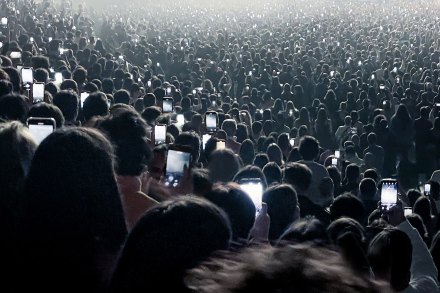
Does Elon Musk have a good eye for the aesthetic? Earlier this month, the Tesla magnate took a break from his incessant political posting to praise something he described as a ‘work of art’ – the Las Vegas Sphere. He then treated his 200 million Twitter followers to a video of an awed crowd, desperately angling their phones to capture the supposed majesty of the Sphere. Admittedly, it was hardly the first time that the Sphere has gone viral on social media. Since its grand opening last autumn, this very modern monument has had a knack for conquering the internet, with videos of its optical illusions prompting both awe and

The world is on fire – yet navel-gazing still reigns in pop

There is no better cultural weather vane than pop. It’s not that pop singers possess incredible analytical skills – they don’t. It’s more that it’s in their interests to reflect some prevailing mood. And what people call a vibe shift can often be gleaned by comparing two artists. Take those featured this week: one very much au courant, the other regarded as a searing commentator on 1980s Britain. It’s a very good album, one for sitting down and listening to rather than standing in a vast shed to hear Over the past couple of years, Raye – a 26-year-old Londoner – has become rather a star. You may remember that

How some of the most derided bands of all time are making a comeback

The fate of the pop musician – at least the pop musician below the top tier of stardom – has historically been to fall from fashion. At some point in their rise they will be of the moment, the spirit of the age, and then they won’t be. At best, they’ll have a slow but perfectly lucrative fade, as their fanbase dwindles to the zealots. At worst they’ll become a punch line, a raised eyebrow: ‘What were we thinking?’ Every hit, every sold-out show, is just another step closer to irrelevance. ‘There’d be 800 teenagers in a club in Minneapolis, which felt absurd: we’re old enough to be their parents’

The ethics of posthumous pop albums

‘At the record company meeting/ On their hands – at last! – a dead star!’ Back when Morrissey was more concerned with writing a decent lyric than sour internet tirades, ‘Paint a Vulgar Picture’ by the Smiths summed it all up rather neatly: a living pop star is all well and good, but a dead one is far less troublesome – and considerably more profitable. Some artists only really get going once they’re dead. Commercially speaking, Eva Cassidy’s entire career has been posthumous; the Van Gogh of the lustreless Radio 2 ballad. The motive feels pure: a family’s wish to keep their sibling alive through her art Death has been

The rise of soapy, dead-safe drama: The Band Back Together reviewed

The Band Back Together is a newish play, written and directed by Barney Norris, which succeeds wildly on its own terms. It delivers a low-energy slice of feelgood nostalgia involving three musicians who reunite in their hometown of Salisbury. The action consists of talk and songs, more talk, more songs, some cider-drinking and a surprise ending to convince the audience that it was worth the wait. The play was commissioned by Farnham Maltings, an arts centre in Surrey, whose aim is to ‘bring artists, makers and communities together’ and it feels a bit am-dram. The script has no conflict, suspense or uncertainty. No harrowing emotions or life-changing experiences. It’s just

Elvis Costello remains the most fascinating songwriter Britain has produced in the past 50 years

Song for song, line by line, blow for blow, Elvis Costello remains the most consistently fascinating songwriter Britain has produced in the past 50 years – an opinion which seems these days to be mostly confined to a smallish section of an ageing demographic. Certainly, Costello’s music has, as far as I can tell, proved largely resistant to TikTokification, even if Olivia Rodrigo did ‘pay homage’ (nicked, with the author’s approval) to the riff to ‘Pump It Up’ for her song ‘Brutal’. Surveying the audience at the Theatre Royal on the opening night of a UK tour with his long-term foil Steve Nieve, these would appear to be mostly the

The unstoppable rise of stage amplification

Recent acquisition of some insanely expensive hearing aids aimed at helping me out in cacophonous restaurants has set me thinking about the extent that modern life allows us to filter our intake of noise. This is big business. As sirens wail and Marvel blockbusters and rock concerts crash through legal decibel levels, controlling sound levels has become an increasingly sophisticated operation, abetted by everything from silicone pastilles and the volume-control knob to the wireless earbud. The National Theatre has virtually given up on ‘natural’ sound Concert halls and opera houses remain havens of what one might call ‘natural’ acoustics, places where the alchemy of balancing convex and concave surfaces with

The Ava Gardner of the ketamine age: Lana Del Rey, at Leeds Festival, reviewed

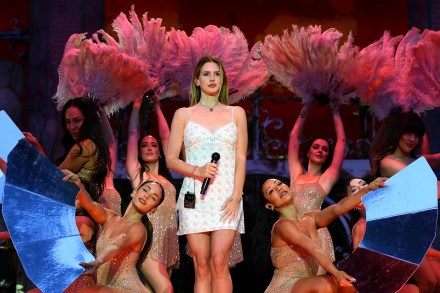
As the American superstar starts singing another slow, sad, rather beautiful song, my mind begins to drift. I’m thinking that our appreciation of music is so much about the who, the when and perhaps most crucially the where; the significance of place is an under-examined element in our relationship with what we’re hearing at any given moment. I’m also thinking that a massive over-reliance on concert revenue to sustain artists’ livelihoods means that nowadays bigger is almost always seen as better – even when ‘bigger’ comes at the obvious detriment of the music. And I’m thinking that an act’s popularity – and indeed their excellence – isn’t necessarily proportionate to

Triumphant: Big Thief, at Green Man, reviewed

One of the first things I learned after seeing Big Thief triumph at Green Man is that some long-time fans are worried about them. There’s an extra percussionist; the bassist has been replaced; and the singer is now front and centre. Have they just become a conventional rock band, people mutter. Have they lost the intimacy they once had? I’d never seen Big Thief before, which is something of an error on my part. Not least because I can’t answer those questions: I have nothing to compare Saturday night’s performance with. I can only say that without caring about what they were in the past, they are extraordinary in the

Fun, frenetic and only a little gauche: Declan McKenna, at the Edinburgh Playhouse, reviewed

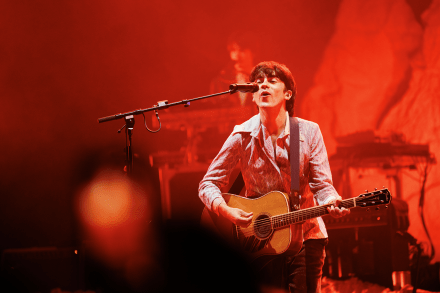
Towards the end of Declan McKenna’s snappy, enjoyable 90-minute set at the Edinburgh International Festival, something quite powerful occurs. The English singer-songwriter returns alone to the stage for the encore and proceeds to play a version of ABBA’s ‘Slipping Through My Fingers’ with only his electric guitar as accompaniment. It becomes a strange, emotionally layered moment. A young musician singing from the perspective of a parent ruefully reflecting on their child growing up, away and beyond reach; a predominantly teenage crowd singing those words back to him; and the older members of the audience, many attending with their own kids, staring blurrily into the middle distance. The first song is

Fantastic – and genuinely indie: Personal Trainer, at the Shacklewell Arms, reviewed

Remember when we all knew what indie meant? Indie was what John Peel played. It was music that was recorded, manufactured and distributed independent of the major labels. In practice, that tended to be music played by young white people, usually more in hope than expectation of either competence or success. As the years passed it came to be applied particularly to a kind of whey-faced, solipsistic music, played on guitars by people who were either too clever by half or too wimpy by half. By dusk, what had not long before looked like the seventh circle of hell had transformed These days, though, indie means whatever you want it

Jack White's new album will be of close interest to Led Zeppelin’s legal team

The ploy of releasing an album without any advance warning comes into play when an artist feels they are being paid either too much or too little attention. The stealth arrival of Jack White’s new solo album falls firmly into the second category. Putting out music in this way ensures additional media coverage and a certain level of intrigue I didn’t love White’s old band, the White Stripes, back when they were a garage-rock/blues revival phenomenon in the early 2000s. Since their demise in 2011, the world seems to be coming around to this way of thinking. Their most successful albums, Elephant and White Blood Cells, hold little cultural currency

Charismatic, powerful and raw: Patti Smith, at Somerset House, reviewed

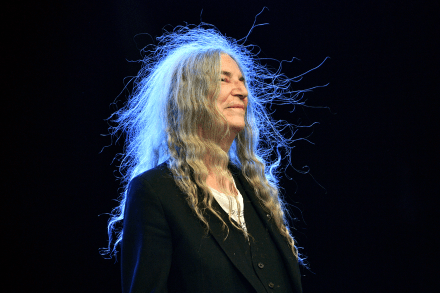
There are certain long-established rules for describing Patti Smith. Google her name and the words ‘shaman’ and ‘priestess’ and you’ll see what I mean. For the best part of 50 years she’s been treated as though she’s a mystical object, a human convergence of ley lines, as much as a rock singer. In the courtyard at Somerset House, she didn’t exactly discourage the clichés. There was a long lecture on the power of the full ‘buck’ moon, which was hidden by clouds but still prompted the people in front of me to pull out their phones to check astronomy apps. There was a lengthy hymn to William Blake that concluded:

Hard to love – but Shirley Manson is terrific: Garbage, at Usher Hall, reviewed

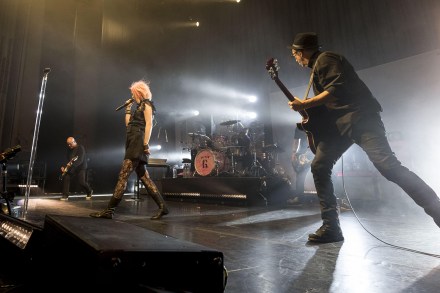
There’s nothing quite like the drama of a prodigal’s return. ‘I’ve been singing in this venue since I was ten years old,’ announces Shirley Manson, staring down nearly half a century of personal history at Edinburgh’s ornate Usher Hall. The fact that Garbage’s lead singer made the United States her primary residence many years ago lends this homecoming concert added potency. There are shout-outs to her dad, a ‘Happy Birthday’ serenade for her sister and what looks like a tear or two at the start of the encore. A ‘badass’ attitude is so sleekly applied it seems like a Che Guevara T-shirt in the racks at M&S For all the

Complain all you like but Glastonbury has delivered the goods again

There’s yet to be a Glastonbury line-up that hasn’t provoked a chorus of naysaying. Refrains like ‘looks rubbish. I wouldn’t go’ and ‘not like it used to be’ are de rigueur. Dismissing the headliners as ‘crap this year’ rivals football as the nation’s favourite sport. Yet there’s something to be said for trusting the Glastonbury bookers: check out, say, the lower-tier bands on the 1994 poster and see how many greats they discovered before they were famous – Radiohead, Pulp, Oasis… Nowhere else in the world could hand written signs for toilets induce a Proustian yearning to return Glastonbury’s prestige and legendary ‘vibe’ are now such that the festival is

Camila Cabello's new album presents an existential threat to songwriting

It is always interesting to observe the ways in which pop stars try to negotiate first growing up, and then growing old. From teen scream to respected mainstay to elder states(wo)man is not an easy path to walk without a few stumbles. At certain times, it requires making some blatantly strategic moves. Cabello wants so badly to grow up that she evolves from a past incarnation practically into thin air Few readers will remember that the first solo single George Michael released after dissolving Wham! was called ‘I Want Your Sex’, a forgettable bump-and-grind with a steamy video designed purely to shift audience expectations away from all things teenybopper and

Teenage Swifties restored my faith in strangers

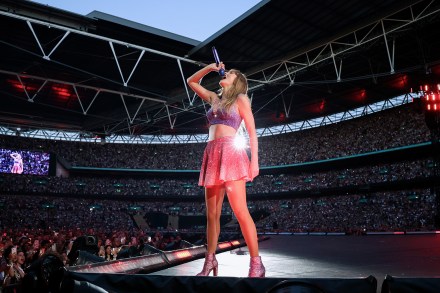
Taylor Swift is the last of the monocultural pop icons. Put it this way: I bet you’ve heard of her. Your parents have heard of her. Your children have heard of her – and so have your grandchildren. This used to be commonplace – but not now. She transcends pop music. This might be why so much of the discussion of the Swift phenomenon has been about the facts and figures: hers is the first tour to gross more than $1 billion, while global leaders have begged for her to visit their countries due to the financial boost she brings. Not to mention her tendency to pump out new editions

Rod Liddle

'Left me stunningly bored': Brat, by Charli XCX, reviewed

Grade: C I don’t doubt the ingenuity. The mastery of a technology which now exists as a substitute for melody, heart, soul, rhythm and meaning. I get the manifesto, too – a pop music that in a certain shallow sense reflects the modern predilection for meta-fiction: novels which mash up all the genres, so that your detective story suddenly becomes magic realism and a little later, sci-fi. I understand, too, that this is probably the closest our Gen Zers have to a music which they can call their own, given that the technology required to produce it would cause an embolism in a Gen X listener or a Boomer. So

Meet the musicians trying to revive French-language pop 

The other day, I went to see a nouveau riot-girl band called Claire Dance play in a disused factory in Bagnolet on the edge of Paris. They were great: the kind of sonic kick in the nuts I’d been waiting more than a decade for an all-female band to deliver. I half-wondered whether it was just my own imperfect command of French that left me clueless as to their message. ‘C’était tout een eenglish,’ came the response from the guitarist afterwards. How come they never considered accompanying such emotionally charged music with lyrics in their mother tongue? ‘It’s considered cringe,’ she replied. ‘We only like English music.’ The alternative scene