Culture

Culture

The good, the bad and the ugly in books, exhibitions, cinema, TV, dance, music, podcasts and theatre.

Keeping calm and carrying on

More from Books

An ordinary woman, rather like yourself.’ These were Peter Fleming’s words when he commissioned Jan Struther to write what became her ‘Mrs Miniver’ columns for the Times. Critics complained then, and have complained ever since, that Mrs Miniver is no ‘ordinary woman’. She rings the bell for tea, takes taxis everywhere, and has a second


The most inscrutable of poets

More from Books

Where our great Victorian writers are concerned we live in an age of rolling biography and contradictory interpretation. I’ve read half a dozen lives of the poet since picking up, as a schoolboy, the Penguin paperback of Harold Nicolson’s Tennyson: Aspects of his Life, Character and Poetry, with its diagnosis of a crippling case of

Murderous mullah games

More from Books

Montesquieu observed that popular governments are always more vindictive than monarchies. So it proved in Iran in 1979, where the demise of a 2,000-year-old monarchical tradition made most ‘Arab spring’ revolutions seem like child’s play. More than 30 years on, the descent of Ayatollah Khomeini from a jumbo jet, wearing an American bullet-proof vest, also

Carve their names with pride

More from Books

On a ridge high above the River Ancre, four miles to the north of the town of Albert, stands the greatest of all Britain’s memorials to its dead. For some curious reason the Thiepval Arch has never touched the imagination in the same way as Blomfield’s Menin Gate, but as an evocation of the pity

Too much time in the library

More from Books

Donna Leon’s The Jewels of Paradise (Heinemann, £17.99)has a promising premise. A young musicologist, Caterina Pelligroni, returns to Venice to trace a legacy left by the 17th-century composer Agostino Steffani, a slippery customer who mixed libretti with realpolitik in the courts of Europe. The bequest turns out to consist mainly of nasty secrets, which seem

About to cop it?

More from Books

Rebus is back, in a novel long, meaty and persuasive enough to make up for the years of absence. Actually, he is only part-way back — on a civilian attachment to the Edinburgh & Lothian Police, and working on cold cases. However, the retiring age has been raised, and he has applied for re-instatement. He

Lloyd Evans

Tragically flawed

More from Books

This is a story of impossible gifts. The Chancellor, George Gideon Oliver Osborne, stands to inherit a 17th-century baronetcy and a large fortune accumulated by his enterprising father. He was also blessed with intelligence, charm, ambition, eloquence and the mysterious ability to seek out power and use it for his own ends. His biographer, Janan

Nostalgic nationalist piety

Lead book review

Parish churches are the sentinels of England’s past. They soar over every town and village, pinning it to the nation’s soil. The nave may be empty, the graveyard unkempt and the roll-call of the faithful soon to cede primacy to the mosque. But the Church of England guards our rituals and speaks for our communities.

Puffing Pamela: Book hype, 18th-century style

There are quite a few candidates competing for the title of the first novel in English literature. You can make a strong case for Robinson Crusoe, published in 1719, or Gulliver’s Travels of 1726, or even – at a push – argue for Sir Philip Sidney’s Countess of Pembroke’s Arcadia, issued over a hundred years

Shelf Life: Iain (M) Banks

Scottish novelist Iain (M) Banks is this week’s Shelf Life provocateur. He tells us how he likes to test his potential lovers and what extreme punishments he exacts on books he doesn’t like. 1) What are you reading at the moment? The Hell of it All by Charlie Brooker and Anatomy of the Orchestra by

Writing the Tory Wars

On starting a new job at Westminster in the early 2000s, and despondent about my party’s lot, I began to write a political novel. Aspiring writers are told to write about the world around them, and, as an observer on the ‘inside’, there was no shortage of material. Gloom and frustration hung heavily in those

The Fuhrer was not amused

‘The German sense of humour,’ Mark Twain famously observed, ‘Is no laughing matter.’ Although many Greeks, stretched on the Euro’s rack at Berlin’s behest, may be inclined to agree, Rudolph Herzog’s intriguing study of humour in and against Hitler’s Germany, Dead Funny: Telling Jokes in Hitler’s Germany, proves conclusively that the Teutonic funny bone, while

William Rowley and the death of Prince Henry – poetry

‘To the Grave’ Unclasp thy womb, thou mortuary shrine, And take the worst part of the best we had. Thou hast no harbourage for things divine, That thou had’st any part was yet too bad. Graves, for the grave, are fit, unfit for thee Was our sweet branch of youthful royalty. Thou must restore each

Interview: Ciaran Carson on translating Rimbaud

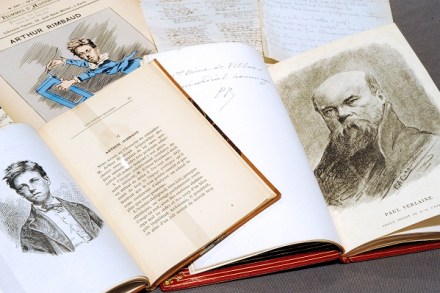
Ciaran Carson was born in Belfast in 1948, and published his first book of poetry, The New Estate, in 1976. Fans of Carson had to wait eleven years for his second book, The Irish for No (1987), which earned him the Alice Hunt Barlett Award. Belfast Confetti (1990) won The Irish Times Literature Prize for

Everyone loves a Penguin

Markus Dohle, Chief Executive of Random House, must have had a long hard think about what a booklover could possibly treasure more than a Kindle. The answer is, of course, a Penguin. Everyone loves Penguin. Their paperback covers have become such a design cult that people flock to buy not just their books, but also

Paper talk

The rainforests must be jumping for joy these days. Which is ironic, as they’ve largely got Amazon to thank for it. As the e-book continues its rise, there’ll be less and less demand from publishers for that horrible, immoral, eco-balance-wrecking stuff called ‘paper’. But before the trees get too complacent, they should remember that there’s

A ladykiller at large

More from Books

Ever since Sergeant Cuff appeared in The Moonstone in 1868, we English have loved our detectives. Moody Scandinavian fiction might come and go, but Peter Wimsey, Poirot, Marple and of course Sherlock Holmes continue to delight us. In Simon Serailler, Susan Hill has created a detective that ranks alongside all these greats. Like Cuff, he

Exhibitions of narcissism

More from Books

The summer exhibition at the Royal Academy, with its overstuffed galleries and motley collection of overblown portraits, twee still lifes and garish landscapes has become an event where you go to be seen rather than to see; it’s less about the art than the experience. But the first-ever public show of paintings, sculpture, architectural drawings

Homage to the Goddess Mother

More from Books

Cometh the hour, cometh the many men (and women). The 2012 centenary of Captain Scott’s death inspired a series of heroic forays into print: glory-hungry (or just plain hungry) authors questing for something new to say about this much-described event. Next year is the 60th anniversary of the first ascent of Everest, and so we

An exhausting mixture of boredom and concentration

More from Books

The wartime code-breaking successes of Bletchley Park are deservedly well known.  The story of how they decrypted German and Japanese codes, most famously the Enigma, has been the subject of histories, novels and films, so much so that Bletchley is glamour. Much less well known, however, and much less glamorous — rarely even thought about

Slippery slopes | 1 November 2012

More from Books

Being sent to finishing school in Bavaria in 1936 was a dream for some English girls: there were winter sports and sachertorte, opera and sausages, and troupes of handsome Nazis in shorts. In Rachel Johnson’s new book, Daphne Linden and Betsy Barton-Hill, 18-year-old beauties who’ve never properly met any boys, find themselves at large in

The worldling’s pleasure

More from Books

Two women are the only heroes of this book. One is Princess Margaret, whom the author points out was far more instrumental in the early years of Colin Tennant’s ramshackle creation of Mustique than merely lending it her unparalleled presence. Quite apart from insisting, after Tennant had fallen out with a slew of architects, that

The darker side of Dawn

More from Books

I like Dawn French when she is playing a sinister nurse much more than when she’s a jolly vicar. As her new novel, Oh Dear Silvia (Michael Joseph, £18.99) is set in a hospital, her darker side is gloriously indulged. We are at the bedside of the comatose Silvia, who has fallen off a balcony.

Divided loyalties

More from Books

On his first day at boarding school in Kenya in the early 1950s, Ngugi Wa Thiong’o stood to attention as the Union Jack was raised on the school flagpole. Afterwards the boys sang Psalm 51 which contains the line, ‘Wash me Redeemer and I shall be whiter than snow.’ Then came a tour of the

The plight of the Poles

More from Books

Was a nation ever so beset by calamity as Poland? During the second world war, Polish cities were bombed, fought over hand-to-hand and crushingly shelled. Beyond their ideological differences, Hitler and Stalin were united in a determination to destroy the country. Without the Nazi-Soviet ‘friendship’ treaty of 1939, Hitler would not have been able to

A family at war

Lead book review

The Quest for Corvo started something rather peculiar in biography. A.J.A. Symons’s 1934 classic — described as ‘an experiment’ — set out the biographer’s search for his subject, and not just the results. This was justified in the case of an elusive and unusual figure like the ‘Baron’ Corvo. Nowadays, many biographies are written like