Culture

Culture

The good, the bad and the ugly in books, exhibitions, cinema, TV, dance, music, podcasts and theatre.

Sam Leith

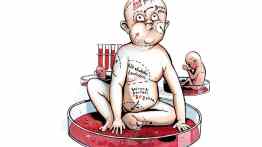
Eugenics will never work – thankfully

Lead book review

In his most recent book, How to Argue With a Racist, the geneticist Adam Rutherford set out a lucid account of how the basis for many widely held and apparently commonsensical ideas about race are pseudoscientific; and he lightly sketched, along the way, the historical context in which they arose and the ideological prejudices that

Don’t listen to Johann Hari to help your attention span

More from Books

In 1887, Friedrich Nietzsche made a complaint about the modern world, writing in The Gay Science: Even now one is ashamed of resting, and prolonged reflection almost gives one a bad conscience. One thinks with a watch in one’s hand, even as one eats one’s midday meal while reading the latest news on the stock

Stalin the intellectual: the dictator cast in a new light

More from Books

The link between mass-murdering dictators and the gentle occupation of reading and writing books is a curious one, but it definitely exists. Mao was a much- praised practitioner of traditional Chinese poetry; Hitler was widely if haphazardly read, dictated Mein Kampf and was a fan of Karl May’s Wild West stories; and Stalin, as Geoffrey

Is it an exaggeration to talk of a ‘gender war’?

More from Books

According to Nina Power’s forceful and rather unusual What Do Men Want?, we in the West are currently engaged in a ‘battle over sex’. And while that has been going on, ‘another war is being waged. This one is against men, the whole damn lot of them!’ To back up this ‘war on men’ idea,

Parallel lives: Violets, by Alex Hyde, reviewed

More from Books

When Violet wakes up in Birmingham Women’s Hospital at the start of Alex Hyde’s debut novel her first thought is of what has happened to the enamel pail of blood, because she hates the idea of someone else emptying it: ‘Was that what it meant, lifeblood? Placental, uterine. She had seen the blood drop out

Is Julian Assange on a hiding to nothing?

More from Books

A question looms throughout this book: is it better to die rather than experience the wrath of a publicly shamed America? The story begins in 2018 when Nils Melzer, a UN Special Rapporteur on torture, received an email: ‘Julian Assange is seeking your protection.’ Melzer’s office receives approximately 50 requests for help each week, and

All hell breaks loose when our senses go haywire

More from Books

Jesus is a Malteser. You might say I’m a liar or accuse me of the most egregious heresy, but the fact remains that Jesus is a Malteser. This is because I have a neurological quirk known as synaesthesia, commonly described as a fusing of the senses. Its most common manifestation prompts people to see colour

A modern Medea: Iron Curtain, by Vesna Goldsworthy, reviewed

More from Books

Vesna Goldsworthy’s finely wrought third novel explodes into life early on with a shocking scene in which Misha — the boyfriend of our protagonist, Milena Urbanska — returns from a short, tough spell of military service, initiates a game of Russian roulette (‘the only Russian thing I could face right now’) and blows his brains

Triumphant: Idles at the O2 Academy Brixton reviewed

Pop

The single thing you don’t want when you are beginning a run of four shows in a prestige venue, with reviewers out in force, is for it all to go tits up at the start. Which is precisely what happened to Idles as they opened their Brixton run. On came the band, up started the

Shades of Tony Soprano: BBC1's The Responder reviewed

Television

Older readers may remember a time when people signalled their cultural superiority with the weird boast that they didn’t watch television. These days the same mistaken sense of superiority is more likely to rely on the equally weird one that they don’t watch terrestrial television. So now that the BBC and ITV find themselves in

The women who challenged a stale, male philosophy

Lead book review

Metaphysical Animals tells of the friendship of four stellar figures in 20th-century philosophy — Mary Midgley, Iris Murdoch, Elizabeth Anscombe and Philippa Foot — who attempted to bring British philosophy ‘back to life’. Fuelled by burning curiosity — not to mention chain-smoking, tea, wine, terrible cooking and many love affairs (sometimes with each other) —

A guide to the apothecary’s garden

More from Books

On 23 May 1804, two months before his daughter’s wedding, John Coakley Lettsom threw open his estate in Camberwell. Some 800 guests made their way to Grove Hill, with its panoramic views across the Thames to London. A leading doctor and noted philanthropist, a prolific author on matters medical, social and moral, Lettsom was famously

Scaling the heights: a woman’s experience of mountain climbing

More from Books

In her memoir Time on Rock, Anna Fleming charts her progress from ‘terrified novice’ to ‘competent leader’ as she scales rocky vertical routes with names such as the ‘Inaccessible Pinnacle’ and the ‘Savage Slit’. There is poetry in the vocabulary of climbing, with its gritstone, gabbro and basalt and its slopers, arêtes, underclings, heel hooks

Adapt or die: what the natural world can teach us about climate change

More from Books

Climate change may be the central challenge of our century, but almost all attention has focused on its consequences for one organism: Homo sapiens. In an original, wide-ranging and carefully researched book, the American biologist Thor Hanson addresses its implications for the rest of life. Rather than overwhelming us with a sense of catastrophe, he

Rod Liddle

The BBC is trapped in its own smug bubble

More from Books

An incalculable number of trees have been hewn down recently in order to provide paper for people writing lengthy, largely admiring books about the BBC. There have been at least five since Charlotte Higgins’s eloquent but slightly eccentric study This New Noise in 2018, including The War Against the BBC by Patrick Barwise and Peter

What did the Russians make of Francis Bacon?

More from Books

The KGB might not have known much about modern art, but they knew what they liked. For instance, at what came to be called the ‘Bulldozer show’ of 15 September 1974, the Soviet secret service instructed a small militia of off-duty policemen to besiege an unofficial exhibition being staged by a group of underground artists