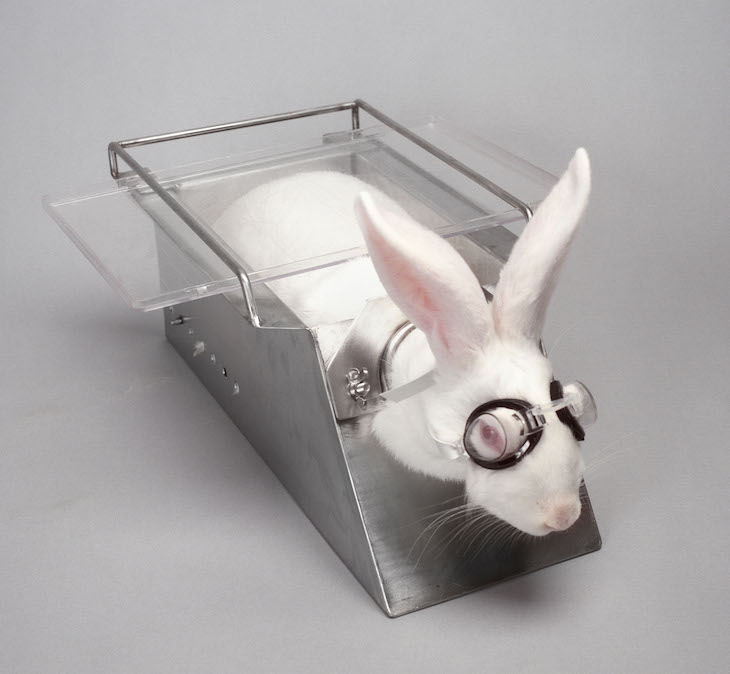
I was 12 years of age and mooching along Putney high street when someone thrust into my hand a leaflet that changed my life. It bore a photograph of a cat with its head covered in electrodes, and the slogan: Curiosity Will Kill This Cat. I had a beloved cat of my own called Chippy. The sight of the leaflet’s tortured feline froze me to the spot.
Last year alone there were 2.64 million animal tests in Britain
This was the mid-1980s, when animal testing was the main animal rights issue. You didn’t hear much about veganism, instead it was a different ‘v’ word – vivisection – that was the focus of the conversation. I began handing out leaflets myself, imagining that others would be as moved as I had been. If we shouted loudly enough, I thought, decency might yet drown out cruelty. It seemed impossible that such barbarism could persist into the 21st century.
Well, maybe this cruel racket’s days are finally numbered. The government has announced plans to phase out experiments on animals. They want other testing methods to be used instead, including a greater use of artificial intelligence, lab-grown animal tissue and computer simulations.
They plan to replace animal testing for some major safety tests by the end of this year and cut the use of dogs and non-human primates in tests for human medicines by at least 35 per cent by 2030. That’s a painfully slow timetable but vivisection is a huge thing to phase out: last year alone there were 2.64 million animal tests in Britain.
Yes, 2.64 million animal tests in one year. Some 488,255 animals faced experiments that caused them what’s termed ‘either moderate or severe pain and suffering’, including long-term disease and death. In just 365 days there were 2,646 experiments on dogs and a further 1,936 on monkeys.

How have we allowed this industrial animal abuse to go on? I suppose none of us like to think about animals suffering in laboratories – and boy do they suffer. Over the past ten years, I’ve written extensively about animal abuse on dairy farms, in slaughterhouses, race courses and fur factories. The research has been grimmer than I could ever have expected, but nothing could have prepared me for what I learned about vivisection.
Consider: rabbits restrained while caustic agents are poured into their eyes; infant monkeys torn from their mothers and locked alone in cages to study the psychological effects of maternal deprivation. Pigs shot, set ablaze, and catalogued. Guinea pigs convulsing in the grip of nerve agents.
Animals routinely cut open, drilled into, drugged, starved, electrocuted or mutilated before ultimately being killed. This is a demonic practice.
We flatter ourselves when we say we’re a nation of animal lovers. Our newspapers fill with outrage when a dog is mistreated in a back alley – and rightly so – yet that same dog, born into the wrong postcode and the right experiment, would be consigned to a legal chamber of horrors.
It’s true that more of us have awoken, to some extent, to the suffering we enable. Many have changed their diets, declined the Grand National, or at least asked what lies behind the euphemisms like ‘free range’ and ‘higher welfare’. But let us extend our compassion further, beyond the abattoir and the racetrack, into the sterile cruelty of the laboratories – those shrines to curiosity without conscience.
‘I abhor vivisection with my whole soul,’ said Mahatma Gandhi, describing it as ‘the blackest of all the black crimes’ that man commits ‘against God and his fair creation’. Having seen what goes on behind the walls of these wicked laboratories, I agree.




Comments