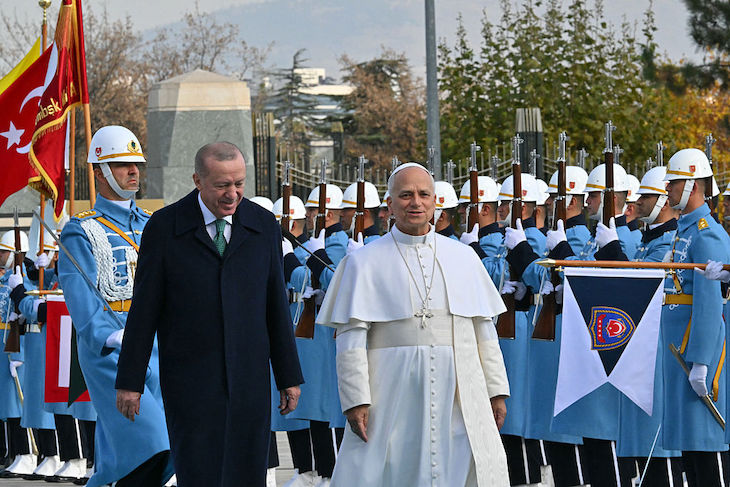
Pope Leo XIV is visiting Turkey and Lebanon on what is his first trip abroad since being elected in May. These are unusual destinations for a first papal visit. Turkey is an overwhelmingly Muslim country with very few Christians left. Lebanon has a much more significant Christian population, but the country is scarred by ongoing crisis and conflict. Just last week, Israel bombed Beirut and killed another high-ranking Hezbollah commander.
Turkey is a country with an often uncomfortable and dark past with Christians
Many expected the Pope to make his first visit to his hometown of Chicago, or perhaps to Peru, where he served as a missionary for two decades. Instead, he decided to follow the schedule made by his predecessor, Pope Francis, before he fell ill.
In the streets of Istanbul, the enthusiasm for the Pope’s visit was limited, to put it mildly. If anything, people seemed bothered by the traffic restrictions. Apart from a handful of still active churches in the city, there were no decorations or signs on the street, unlike in Beirut.
Turkey is a country with an often uncomfortable and dark past with Christians. During the Ottoman period, Greeks, Armenians, Assyrians, and Levantines made up a large segment of the population. Then, through events like the 1915 Armenian Genocide and the 1923 population exchange with Greece, millions perished or were forced to leave their ancestral lands. It was upon these events that the modern secular Turkish Republic was founded.
Christians in Turkey today are no longer persecuted – they themselves are the first to admit that. ‘The Armenian community lives a much freer and more comfortable life, compared to some decades ago,’ notes Ari Haddeler, the Editor-in-Chief of the Armenian-language daily newspaper, Nor Marmara.

‘Our clergymen freely hold their church services, the people freely attend. Our main challenge is maintaining so many churches with such a small community,’ he adds. Little over a century ago, the Armenian Patriarchate of Constantinople recorded around 2,500 ecclesiastical buildings. Today, only a few dozen are active.
On Saturday, the Pope led Mass in the Volkswagen Arena in Istanbul – a rather American Evangelical-style choice. But there are no churches in Turkey that can accommodate thousands of people. The great cathedral of Aya Sofia was converted into a mosque with the Ottoman conquests. With the Republic, it was turned into a museum, but in 2020, president Erdogan made it into a mosque again.
During the visit, the Pope addressed the congregation as ‘little flock’, quite fittingly quoting Jesus. The Roman Catholic community numbers around 25,000 in Turkey. His message was mostly about the need for peace and unity. ‘We live in a world where religion is too often used to justify wars and atrocities,’ he warned.
While the number of Christians in Turkey is dwindling, the country is doing well on the geopolitical scene. President Erdogan has an important position at peace negotiations over both Gaza and Ukraine. This is thanks to both his good personal relationship with president Trump and also having the second-biggest Nato army, situated strategically between the Middle East, Ukraine, and Europe.
The West these days has given up scolding Turkey for its human rights record and democratic backsliding. Just last month, Sir Keir Starmer was in Ankara to sign the sale of 20 Typhoon fighter jets to Turkey. There was no mention of Ekrem Imamoglu, president Erdogan’s main rival, who is facing multiple charges, including alleged links to British intelligence, which he denies.
The same cannot be said for Lebanon. The country bears the heavy marks of a crippling economic and political crisis, and the recent war between Israel and Hezbollah. Despite the ceasefire, IDF jets and drones enter Lebanese airspace daily.
Yet Lebanon is also one of the models of religious coexistence in the Middle East, even if it wasn’t always so peaceful. The Lebanese state is built on a confessional system, with power constitutionally shared between Christians, Druze, Shia and Sunni Muslims. It is certainly not a perfect system, but it guarantees political representation to all communities.
There was some speculation whether the papal trip to Lebanon would be cancelled over security concerns. The Queen of Jordan directly asked Pope Leo during a visit to the Vatican whether it was safe to travel to Lebanon. ‘Well, we are going,’ replied the Pope resolutely with a chuckle.
‘I think the war is also one of the reasons Pope Leo chose to go to Lebanon on his first visit,’ says Milad Yacoub from the Catholic Assumptionists, in his office in Istanbul. ‘It would have been more difficult if he had wanted to go to Syria or to Israel. So Lebanon was a good choice in between, and very significant for this message of peace.’
‘The social teaching of the Church is for justice and peace. Both go together, not just peace alone – that would be a naive thing to say. To build a strong peace is to build it upon justice. And definitely not the justice of the strong, not of the one with the more sophisticated weapon,’ says Brother Milad.



Comments