
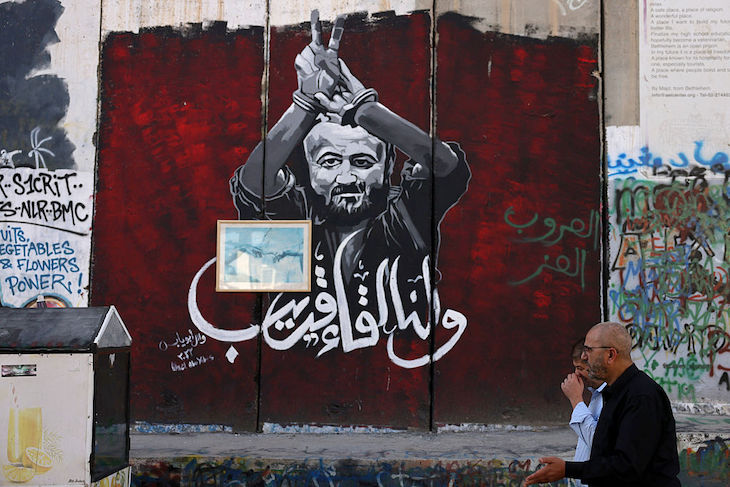
Some scoffed when Donald Trump thought to tap Tony Blair’s decades of involvement in the Middle East for his future plans in Gaza. Perhaps they were right to. But not to worry: the global search for strategic wisdom has now been resolved. The path to peace lies not through seasoned statesmen or regional experts, but through the collective judgment of Delia Smith, Stephen Fry, Benedict Cumberbatch, and naturally, Gary Lineker. They are joined by Mark Ruffalo, Tilda Swinton, Simon Pegg and a list of figures known for their contributions to film, fiction, and light entertainment: people with no background or expertise in jihadist Islamic terror movements, counter-extremism, Middle Eastern politics, or international law. Together, they have issued a letter calling for the release of Marwan Barghouti from Israeli prison.
The letter, signed by more than two hundred ‘cultural personalities’, declares ‘grave concern’ at Barghouti’s continued incarceration, asserting that he has been denied due legal process and must be freed. The implication is clear: here is the Palestinian Mandela, wrongly jailed, broadly beloved, and uniquely placed to lead his people toward peace.
This is the uncomfortable truth that Western petitioners refuse to admit
But the comparison cannot withstand scrutiny. Barghouti is not serving a political sentence. He is serving five life terms plus forty years for a series of violent crimes that left five civilians dead and many more endangered. His conviction was not for speaking out or holding office, but for directing lethal attacks carried out by bloodthirsty, religiously motivated terrorists under his authority.
In June 2001, a Greek Orthodox monk named Father Germanos Tsibouktsakis was driving near Ma’ale Adumim when gunmen opened fire on his car, having mistaken it for an Israeli civilian vehicle. The Tanzim cell responsible for the shooting was under Barghouti’s command. Weeks later, Yoela Chen was killed at a petrol station near Givat Ze’ev – an attack in which Barghouti was also implicated.
The most deadly operation Barghouti authorised was the massacre at the Seafood Market restaurant in Tel Aviv in March 2002. A gunman entered the restaurant with an M-16 rifle, opened fire on diners and pedestrians, stabbed those attempting to flee, and was eventually killed in a firefight with police. Three Israelis were murdered: Eli Dahan, Yosef Habi, and Sergeant Major Salim Barakat, who died attempting to stop the assault. The court found that Barghouti had given prior authorisation for the attack, executed by operatives linked to the Al-Aqsa Martyrs Brigades, which operated under the Fatah umbrella.
He was further convicted for his role in an attempted suicide bombing near the Malha shopping mall in Jerusalem. The explosives detonated prematurely, averting mass casualties by chance rather than intention.
These planned, sanctioned attacks were executed within a chain of command in which Barghouti played a central role. The Tel Aviv District Court established, after a lengthy public trial, Barghouti’s operational responsibility, not just some symbolic affiliation.
The verdict did not rest on vague associations or ideological proximity. It rested on hard evidence, forensic scrutiny, and the specific legal requirement to demonstrate a direct link between the defendant and the attacks in question.
Supporters of Barghouti frequently characterise the trial as flawed. Much of the coverage of this week’s luvvies’ letter mentions the Inter-Parliamentary Union, which echoed this view. This little-known advisory body has no enforcement power, limited public scrutiny, and a long record of issuing symbolic declarations that seldom enter mainstream debate. But the oft-repeated one-sentence assertion that Barghouti’s trial was ‘flawed’ fails to survive closer examination. Barghouti was tried in a civilian court, under judicial oversight, in full view of the public and the press. The evidentiary record was extensive. Crucially, the court convicted him of the crimes for which the proof met the legal threshold, and acquitted him of more than twenty additional allegations where it did not. This pattern is not consistent with a politicised prosecution seeking a scapegoat, but with a judiciary weighing evidence, applying legal standards, and distinguishing between what could and could not be proven.
Much of what is now framed as procedural deficiency stems from Barghouti’s own decisions. He refused to recognise the court, declined to cross-examine witnesses, and mounted no structured defence. His posture was designed to repudiate the legitimacy of the proceedings, and created the very absences that critics now cite as signs of injustice. But these were not structural failings. They were tactical choices. The use of protected witnesses and classified intelligence, also read by some as malfeasance, are standard features in trials involving violent networks and clandestine operatives.
To describe his record as anything less than deliberate, lethal wrongdoing is to strip the victims of their reality. The five people whose murders lie at the heart of his sentence were not abstract statistics; a monk driving on a quiet road, a woman stopping for fuel, diners at a restaurant and a policeman trying to save lives. Their deaths were the result of decisions taken by a man who held power in an organisation that made killing civilians a strategy. Whatever political narrative has grown around him since, these killings and the machinery of violence that enabled them, form the hard core of why he is in prison. They remain acts for which he bears direct responsibility, and which the court found to be not only unlawful but morally grave.
Their image of Barghouti as a peace-seeking statesman is not only unmoored from reality but also profoundly insulting to the victims of his actions
Yet none of this complexity appears in the coverage of the celebrity letter. The media largely echoes the petition’s language.
This absence of detail masks a deeper discomfort. For if Barghouti’s supporters were to engage honestly with the facts of his case, they would be forced to answer an obvious question: why him? Of all the possible figures in Palestinian politics, why choose a man convicted of orchestrating the killing of civilians as your heroic potential leader of a would-be ‘peace loving’ state? Could the campaign not have found someone with a less terminal CV? Perhaps a leader implicated in half as many murders – or, radical as this suggestion might be, none at all?
The answer is sobering. Barghouti retains his appeal not in spite of his record, but because of it. He commands loyalty within Palestinian society precisely because he embodies the strategy of terrorism as ‘resistance’. His political cachet derives from his status as a commander, not a conciliator. His image is built on the foundation that he is a man of action, not of compromise. And that, it seems, is what the movement demands.
Barghouti’s own rhetoric contributed powerfully to the impression of direct orchestration. He repeatedly called for ‘broader resistance’ and an ‘escalation of the Intifada,’ language that made it politically plausible to attribute almost any Tanzim attack to his leadership. But responsible courts cannot operate on the logic of command responsibility. The judges remained bound by the stricter discipline of law, requiring individualised proof of specific acts, not inference, association, or political symbolism.
This is the uncomfortable truth that Western petitioners refuse to admit. Their image of Barghouti as a peace-seeking statesman is not only unmoored from reality, but also profoundly insulting to the victims of his actions, and to the concept of justice itself.
Thankfully, even in these bewildering times, we have not yet turned to Delia Smith for a recipe for dealing with Hamas, nor asked Gary Lineker to draw up the game plan for peace with men who slaughter families in their homes. Perhaps next they will call for the release of Hashem Abedi, convicted for the Manchester Arena bombing, Michael Adebolajo, the murderer of Lee Rigby, or Ahmed Hassan, jailed for the Parsons Green attack, so they can enter British politics. The day we do, we’ll deserve the outcome.

Comments