
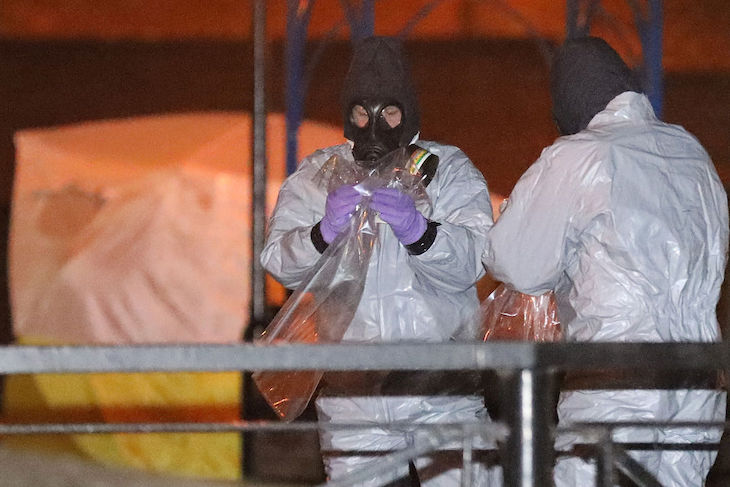
Vladimir Putin is ‘morally responsible’ for the death of Dawn Sturgess, a public inquiry today has concluded. The mother of three died in Salisbury in June 2018 after unknowingly spraying herself with the nerve agent novichok, which had been discarded three months earlier by two Kremlin agents sent to kill the former spy Sergei Skripal. The operation was so sensitive that it ‘must have been authorised at the highest level by President Putin’ as a ‘demonstration of Russian power’, the inquiry’s chair Lord Hughes said.
Keir Starmer condemned the Kremlin’s ‘disregard for innocent lives’
Lord Hughes said that disguising the novichok in a perfume bottle ‘dramatically magnified’ the risk of unintended casualties, and called it ‘an astonishingly reckless act’. Sturgess was given the perfume bottle by her partner, who had found it in a bin and believed it contained a Nina Ricci scent. The inquiry concluded that ‘no medical treatment’ could have saved Dawn Sturgess’s life.
The original attack on Skripal did not kill him, but left him and his daughter Yulia (who was visiting from Russia at the time) as well as a police officer who attended the scene in hospital. It was carried out by two agents of the GRU – Russia’s military intelligence agency – later identified as Anatoly Chepiga and Alexander Mishkin. In a staged interview with Russian media later that year, they infamously denied being responsible and claimed to have visited Salisbury to see the city’s cathedral and its ‘famous…123-metre spire’. In response to the attack, then prime minister Theresa May expelled 23 Russian diplomats from the country.
Today Keir Starmer condemned the Kremlin’s ‘disregard for innocent lives’ as he imposed new sanctions on the GRU and 11 individuals in response to the report. The Russian Ambassador, Andrei Kelin, has also been summoned to the Foreign Office to provide a response. Unsurprisingly, the Russian media has chosen to largely steer clear of reporting on the inquiry into Sturgess’s death. The few outlets that have covered it – including the government news agency Tass – have chosen to lead on Starmer’s new sanctions, burying the news of the inquiry. The newspaper Kommersant was at pains to remind its readers that Skripal pled guilty to treason against Russia and that Putin had called him a ‘scoundrel and a traitor’.
Against the backdrop of the multitude of sanctions already imposed on Russia over the war in Ukraine, and increasingly tense relations between Russia and Nato, it is unlikely that Starmer’s new measures today will phase the Kremlin too much. Nevertheless, it is a reminder that the threat Moscow poses to the West extends far beyond Ukraine.


Comments