

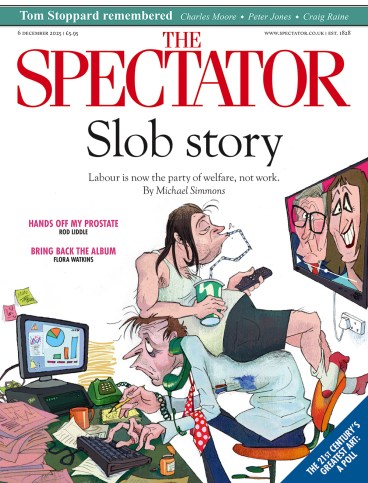
In August, The Spectator began to investigate allegations that Harry Shukman, a 33-year-old freelance journalist, had used a fake British passport as part of a two-year undercover investigation into the far-right in Britain which was sponsored by Hope Not Hate. We published an article about this in our 6 September issue titled: ‘Dirty tricks: the sinister tactics of Hope Not Hate.’ As a result of correspondence from their lawyers, we now know the passport was not ‘fake’ at all: the true story is even more interesting.
Whatever the technicalities of the deed poll process, the essential question is an ethical one
Shukman’s 12-month undercover investigation led to a series of articles in the Guardian, a documentary broadcast by Channel 4 and a book published by Penguin in May called Year of the Rat. The targets of his work ranged from activists in the established British far-right, such as Paul Golding of Britain First, to former special advisers and American citizens who have advocated for policies to encourage higher fertility.
During our investigation, we acquired emails showing an image of a British passport which Shukman had sent to one of his targets, displaying Shukman’s face and other details under the name ‘Christopher Morton’. This image had been used to gain the trust of the target, enabling conversations that Shukman then recorded.
It was our belief that this image constituted evidence that Shukman had either obtained and used a fake passport as part of his investigation, or had modified a digital image of his passport to change the name to ‘Christopher Morton’. In either case, such actions might constitute a criminal offence. As a result, we sent Shukman and Hope Not Hate – alongside the Guardian, Penguin Books and Channel 4 – pre-publication ‘right of reply’ correspondence asking for comment on the allegations. Hope Not Hate and the Guardian both responded (Shukman did not respond directly), with Hope Not Hate refuting the allegation that a fake passport was used – but without any of the respondents explaining what had actually happened.
Only after we published the article did the full truth emerge. In a legal letter to The Spectator intimating claims for defamation, Hope Not Hate’s legal team stated that Shukman had in fact changed his name by deed poll to ‘Christopher Morton’ in order to obtain an official passport from the UK Passport Office – before changing it back to Harry Shukman by way of a second deed poll a year later.
This means that Shukman and Hope Not Hate did not, as we reported, create a ‘fake’ passport or even edit a digital image of a real passport. For that error, we apologise fully and unreservedly. We take accuracy seriously, and we regret that this point was not established before publication. Our readers expect – and deserve – precision from us; in this instance we fell short of the standards we set for ourselves.
However, the clarification did reveal that Shukman used the deed poll process to obtain a second identity for the purpose of deception. Shukman’s lawyers claim that in the first deed poll he ‘fully and formally adopted the name Christopher Morton for all purposes’. It is a legal requirement for those who use deed polls to do so and to renounce absolutely their previous identity. Yet during the period in which Shukman was supposedly acting solely under his new name, he published three separate articles bylined under his original name for the Gentleman’s Journal. The headlines included ‘Where are the super-rich jetting off to this summer’ and ‘Cheers to Wilderness! Britain’s poshest festival’. His lawyers describe this as ‘simply an oversight’. Moreover, his own book states that he continued to use his real email address during the investigation; at one point he even joined a video call using it, nearly revealing his deception.
In truth, we consider that Shukman did not intend to adopt a new identity or abandon his old identity ‘fully and formally’ at all. It seems apparent to us – not least from the use of a second deed poll to change his name back to Harry Shukman – that he used ‘Christopher Morton’ as a pseudonym, which he then leveraged to obtain a genuine passport from UKPO. Whatever the technicalities of the process, the essential question is an ethical one: whether journalists, even in pursuit of stories they consider important, should be acquiring state-backed identification under a fabricated persona (even if done entirely lawfully) in order to deceive their targets.
This practice raises serious concerns about the ability of the UK Passport Office to prevent use and abuse of the deed poll procedure to allow individuals to get British passports under pseudonyms. Given how easy it is to change one’s name through deed poll, it is concerning that obtaining a British passport in a new name is so simple and apparently lawful. Others who might seek to circumvent international identity systems might not have the same motivations as Harry Shukman or Hope Not Hate.
But it also raises issues about journalistic transparency, professional standards and the precedent it sets for the use of official documents in undercover work. The explanation was apparently straightforward, but neither Shukman nor Hope Not Hate included the true state of affairs in their responses to The Spectator. It is therefore reasonable for the public to expect scrutiny, and for us to examine the honesty and ethics of the methods employed in an investigation that generated major media attention.
It is concerning that obtaining a British passport in a new name is so simple and apparently lawful
Hope Not Hate, the organisation that provided Shukman with support and published many of his findings, is a powerful group with strong connections to government. As the original article detailed, several Labour MPs have held positions within the organisation. The Prime Minister’s chief of staff, Morgan McSweeney, is linked to it, as is the Justice Secretary David Lammy. Hope Not Hate leads active political campaigns against politicians it deems too far to the right. In the past, it has targeted Conservative MPs such as Jacob Rees-Mogg and Suella Braverman. More recently, it has actively campaigned against Reform. Its political activity and its senior connections mean that its methods warrant scrutiny.
The Hope Not Hate Charitable Trust, which donates most of its money directly to Hope Not Hate Ltd, has been subject to a compliance case by the Charity Commission to ‘assess concerns about its governance including about the charity’s activities and its relationship with the non-charitable entity’. That the non-charitable entity is engaged in these tactics noted above ought to be brought to the attention of the Commission.
The Hope Not Hate Charitable Trust – which recently changed its name to Hope Unlimited – has, in the past, received tens of thousands of pounds in government grants from the Home Office’s counter-extremism unit. Another part of the Home Office, the UK Passport Office, has since issued an official passport to Hope Not Hate’s reporter under a name that appears to us to be a temporary pseudonym. If public money is being given to an organisation involved in ethically contentious journalistic practices that damage the reputation of British citizens and Americans – with obvious consequences for the UK’s standing abroad – this ought to be a subject of informed debate.
It should also be a matter of public record that the recordings Shukman obtained were secured through these methods. His work has caused serious distress to several individuals we have spoken to, and in some cases posed a risk of financial harm. Many of his targets held views that, while unorthodox, do not meet any realistic threshold for being considered ‘far-right’. In targeting them and grouping them with violent extremists, the intended effect is to shape political discourse through discreditation. We have a responsibility to oppose any curtailment of free speech through the threat or prospect of cancellation.
A free press depends on journalists maintaining appropriate professional standards. It is for our readers to decide whether Shukman – and by extension Hope Not Hate – met those standards when he used the deed poll process to acquire a secondary identity for the purpose of deception.