On the evening of 6 May 1527, Henry VIII entertained an embassy from France at a lavish party in Greenwich. The festivities took place in a banqueting house and a theatre, both built for the occasion. At the feast’s end, Henry led his guests out through a great archway. After a moment, he invited the French to turn around and look at a painting which hung behind them.
It was a vast panorama of the 1513 siege of Thérouanne – ‘very connyngly wrought’, a chronicler reported. As Henry knew, the siege was a sour memory for his guests. Henry himself, in league with Maximilian I, the Holy Roman Emperor, had routed them there. So great had been their humiliation that it was known as the Battle of the Spurs, after the spectacle of the French cavalry fleeing the field.
The man Henry had to thank for this deliciously vindictive moment of political theatre – commissioned late and completed in just three weeks – was Hans Holbein. As Elizabeth Goldring notes in her superbly scholarly biography of the artist, we usually associate Holbein’s articulation of Tudor power with his role as King’s Painter, later in the 1530s; but his usefulness was apparent early. It was his first visit to England and he had been in the country barely six months.
He was born Johannes Holbein, in the late 1490s, in Augsburg, where his father, Hans Holbein the Elder, was a successful painter of devotional works. In Basel, to where the young Holbein moved prior to 1515, his first identifiable work was adding marginal illustrations to an edition of Erasmus’s satire In Praise of Folly. Leafing through it, Erasmus paused when he came to an image of a scholar seated in his study. ‘Oho,’ he exclaimed, ‘if Erasmus still looked like that, he would certainly take a wife.’ In some sense, Holbein’s whole career in England sprang from that moment of surprise. Erasmus commissioned two portraits from Holbein in 1523 and later gave him a letter of recommendation to Thomas More, whose patronage and hospitality Holbein enjoyed when he first arrived in England in late 1526.
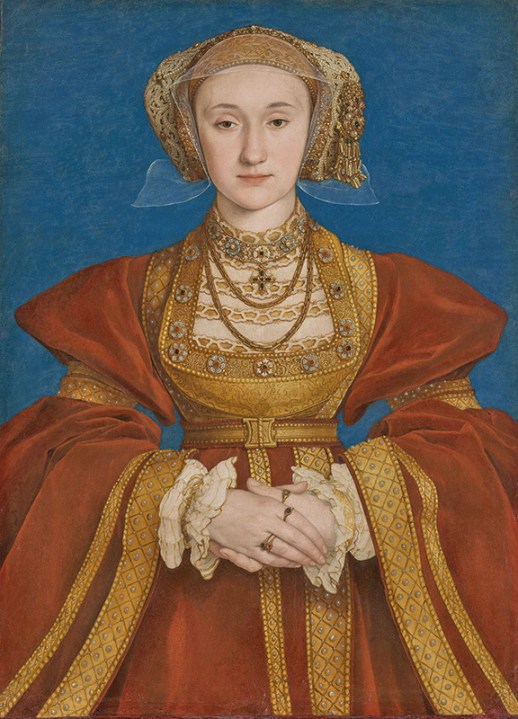
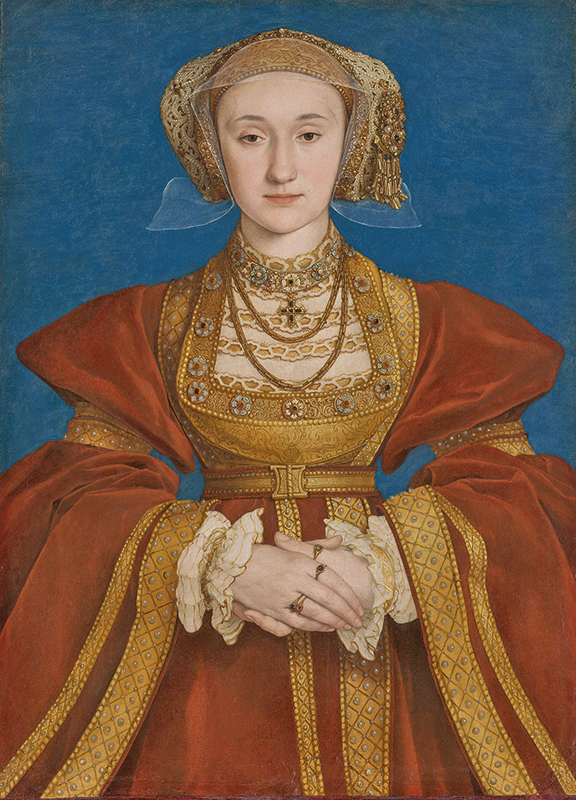
It is hard for us to imagine a world in which portraiture of such quality did not exist – and then suddenly arrived. The psychological shock of experiencing Holbein’s work ripples through Goldring’s account. ‘Death himself now seems a living being’, the French poet Nicolas Bourbon wrote after seeing the 41 woodcut images that comprise Holbein’s ‘Dance of Death’ sequence. Among the nearly 250 images reproduced in Goldring’s book are two chalk drawings Holbein made, on a brief 1524 visit to France, of funerary effigies. They are quite as astonishingly alive as his living subjects.
He returned to Basel in 1528. The following year, on Shrove Tuesday, a Reformation-fuelled riot saw hundreds of men smashing and burning much of the city’s sacred art, including an unknown number of Holbein’s works. The next year he could be found painting a wall of the now Protestant city’s Great Council Chamber with figures from the Old Testament. His gifts were many, and a talent for catching every rising tide was certainly one of them.
That was particularly evident in his work in England, where he returned in early 1532. Goldring traces Holbein’s portraits spreading through the country’s elites like an exquisite virus. More had fallen from favour, so the painter moved on to Thomas Cromwell, who brought him renewed proximity to the King and Anne Boleyn, and to the Protestant-minded Hanse merchants of London’s Steelyard. But the Catholic Thomas Howard, third duke of Norfolk, devoted to More and an enemy of Cromwell’s, was happy to commission a large portrait just a few years after More’s execution. Holbein’s contemporaries surely found him just as opaque as we do.
He was nothing if not adaptable. He abandoned the silverpoint technique that his father had taught him for ad vivum sketches in favour of chalk alone, a freer, more fluid medium. In France he learned some of Leonardo’s compositional and paint-handling secrets. In England he picked up the art of the miniature, which derives from manuscript illumination. More than 200 designs for plate and jewellery survive from his second spell in the country alone.
He had to adapt. When he first arrived in England, portraiture was little regarded – ‘a poor cousin,’ Goldring notes, ‘to tomb sculpture and heraldic painting.’ Inventories show that Cardinal Wolsey, then the greatest patron of the arts in England, owned hundreds of tapestries; but his few paintings were devotional aids, religious in nature.
Holbein’s arrival changed that. He created the market in which he prospered. Where previously an ambitious courtier might have signalled his loyalty by displaying the royal coat of arms, by the late 1530s a royal portrait was the fashionable choice. Holbein’s innovative business practices, which allowed him to produce multiple versions of a portrait for sale, independent of the original commission, kick-started the cultural transformation.
One reason we know so much about the work is the disciplined way in which Holbein preserved designs and drawings. As Goldring notes, it implies a powerful instinct for organisation. His private life, with a second illegitimate family in London alongside a wife and children in Basel, may have been messier. His will – brief, hurried and vague – suggests that death, when it came in London in October 1543, mostly likely from the plague, was a surprise.
But Holbein’s art continued to shape its own reception. In Basel, one collection of his works was purchased by the city in 1661 and put on display – the first private collection to be made available to the public. The following decade saw the compilation of a catalogue raisonné – of limited scope, but the first such publication for any artist. The closing chapter of Goldring’s biography traces these and other posthumous responses to Holbein. The book itself is now part of that long dialogue. Meticulously detailed, judicious and perceptive, it will surely prove the definitive account of Holbein’s life, and of the life and afterlife of his work, for many years to come.

Comments