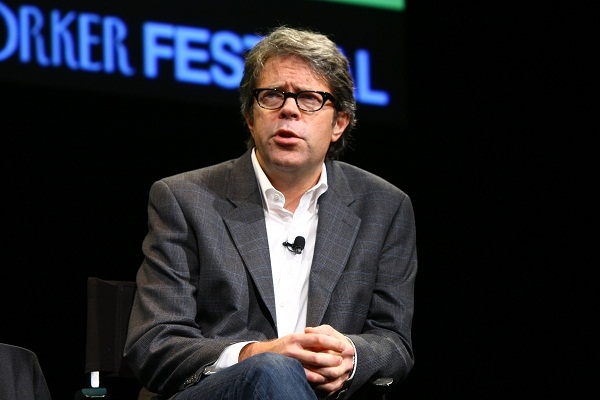
Do great novelists make great essayists? Not in the case of Jonathan Franzen, at least according to Phillip Lopate, who reviewed Franzen’s new essay collection Farther Away for the New York Times.
Lopate is a fan of Franzen’s but feels his non-fiction pieces – though entertaining and interesting – are ‘not nearly as strong as his novels’. He sets out some reasons why:
As a writer whose essays fail to hit the heights of his fiction, Franzen is in distinguished company: Lopate gives John Updike and Saul Bellow as other examples. He concedes there are exceptions, citing Virginia Woolf, D. H. Lawrence and J. M. Coetzee, but in general believes ‘Most dyed-in-the-wool novelists … do not excel at the essay, for good reason: they are wired otherwise.’‘While his prose is always cogent, he is not that consistently stylish a sentence writer. Essays put a different kind of pressure on the sentence, calling for more aphoristic compression and wit. His novels work best through patient accumulation of social detail and character development. By contrast, the I-character in his essays is not as strongly developed, nor as vivid. He is better able to convey moral irony by dramatizing a fictional conflict than by baldly stating his views. Finally, since, as he puts it, &”fiction is my religion,” he may simply be a literary monotheist who has never fully grasped the imaginative and expressive possibilities of nonfiction; he’s not trying to catch that fire. When he speaks of the authors who influenced him, they are all fiction writers.’
It is tempting to flip over Lopate’s analysis and ask: do great essayists make great novelists?
There is smaller pool of essayists-cum-novelists to choose from (the essay having been a ‘dying art’ since Montaigne, as we’re always reminded) but I can think of several writers whose essays are better than their fiction. For starters: George Orwell, Martin Amis, Geoff Dyer.
An eclectic trio, but all writers whose talents shine brighter in their shorter non-fiction pieces than their novels. That’s not to say their novels are bad (my judgment is reserved on Lionel Asbo, which I haven’t read) but that their defects are similar. They all place a higher value on ideas and prose than character development.
This could just be a matter of taste. Different people like different sorts of novels. Some of us get our kicks from a beautiful sentence, others from getting inside the mind of another human being. But ultimately, I think, it’s like cricket. Novelists and essayists are batters and bowlers. You get good all-rounders, sure, but outstanding all-rounders are rare. Different forms of writing demand different skills from the writer. Novelists look at things from the inside, essayists from the outside. Novelists must learn to suppress their ego; for an essayist, this is fatal. The great essayist is worldly; the great novelist otherworldly.




Comments