Bangkok
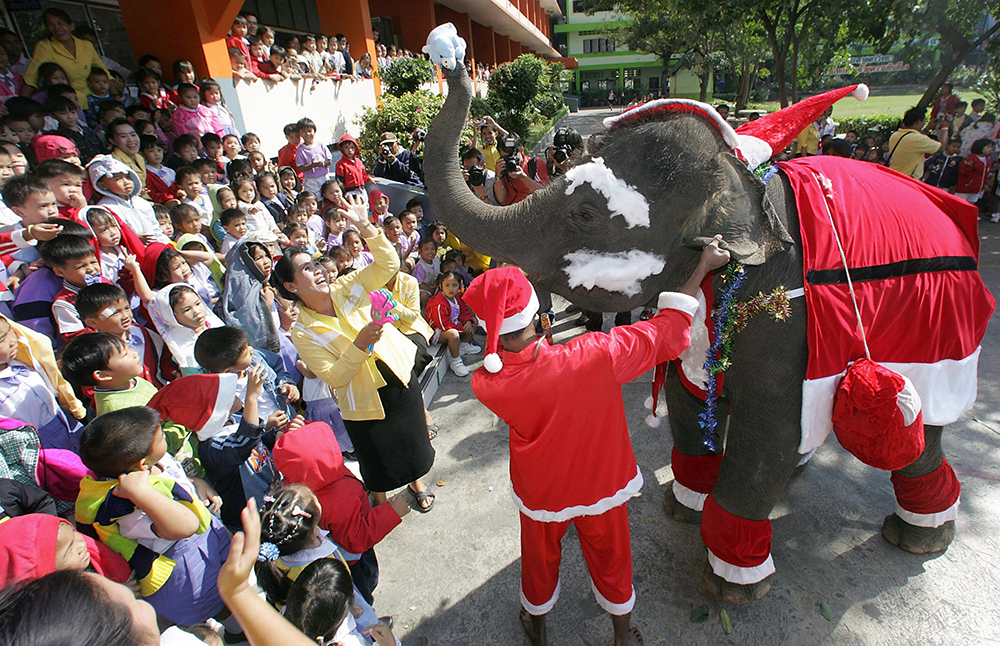
Christmas in Thailand is one of the strangest festivities of the modern world. A country that is almost entirely Buddhist, which does not recognise Christmas as a public holiday, whose people have almost no idea what the event means, nevertheless erects giant glittering Christmas trees in its malls and intersections. These are larger and more numerous than the ones you see in London. It’s not difficult to imagine a future where British tourists fly to Bangkok to rediscover the mood of Christmas, not in shopping but in pagan feeling.
December shoppers in the Bangkok mega-malls are greeted by choirs of small girls in Santa hats who ring bells and sing about the Wenceslas and the feast of Stephen. The eerie strains of ‘Silent Night’ echo down floors of office furniture and electronics. No one seems to ask why the night is silent or why a man named Wenceslas went out on the feast of Stephen. No one here knows why we farangs sing songs about him. But then does anyone in England? The words are lost, meaningless in both places, but here the overall mood is lighter. The fun is there. Perhaps because Christians are only 1 per cent of the population. An animist spirit prevails and the trashy, globalised, commercial holiday somehow, strangely, doesn’t feel as trashy, globalised or commercial as it does in many other places. Purists will argue that it’s all empty – a cynical misunderstanding. All right. But something else is there.

Those towering Germanic trees fill the tropical dusk with alternating lights and high-altitude silver angels, and around them on all of the central streets mango and frangipani trees light up with nets of fairy bulbs. Thais have unconsciously turned Christmas back into what it probably originally was: a pagan celebration of the solstice. I am frequently told by Thais that they are a ‘forest people’, that is, unconsciously close to the realm of trees and rivers. You cannot explain Christmas trees to them, any more than I can explain them to myself, but they seem to sense the pagan vitality of a 30ft tree covered with lights when they see one. Otherwise, why do they bother?
Some form of the celebration has existed since Jesuits appeared in the kingdom in the 16th century, but it’s true that today’s metropolitan orgy of lights and tinsel is a recent phenomenon. Is it driven purely by megamall marketing strategies? Perhaps. But I’ve noticed its quiet adoption by sundry levels of the society, especially by the educated upper classes. Some would say it has invaded the culture with the parallel invasion of the English language. This is probably true. Bangkok now has an entire elite social class that speaks English as I do. The proliferation of British and American schools has spearheaded the cultural imperialism of Santa hats.
Thais have turned Christmas back into what it probably originally was: a pagan celebration of the solstice
In fact, I live next to the Australian School on soi 31 and I hear the Thai tots below me all day screaming at each other in slangy social-media English. These are the future incubators of Christmases to come.
I once had to explain to my girlfriend why our tree had to be decorated with baubles, stars, candles and angelic figures. ‘I think,’ she said bluntly, ‘you don’t know why.’ Defeated by the enigmas of my culture. It was like her trying to explain why Thais put bottles of red Fanta and tiny figures of zebras in their spirit houses. Pressed on this matter she admitted she had no idea why they do that. Two religions – syncretic pagan-Christianity and syncretic pagan-Buddhism – both revel in images and symbols they don’t understand. It’s a perfect union. And has anyone else noticed how similar spirit shrines and Christmas mangers look?
Maybe these mixed signals are precisely what delight Thais, just as the most incomprehensible imagery in Christmas is precisely what makes me most nostalgic for it. Those choirs in the air-conditioned Bangkok malls make me remember the small English village of Lindfield in Sussex where I grew up and the intense emotion of Christmases in its 800-year-old Norman church. But grand hotels in Tokyo also have such choirs, and there they even sing ‘Silent Night’ in German. It’s as if one culture were calling faintly over the East-West abyss to another. Yesterday at a mall downtown in Bangkok I heard ‘God Rest Ye Merry Gentlemen’ and found myself stopping to listen to it. It had been years. What does it matter if the kids don’t understand the words? Maybe that’s not the point.
Back to the Fanta bottles and the mysteries of animist beliefs. I was recently in an ultra-modern MRI clinic where I found myself seated next to both a spirit house filled with those red bottles and to a small Christmas tree filled with miniature marzipan apples and tiny plastic sleighs covered with plastic snow. There were even some tiny camels in there, and they were just as weird as the tiny zebras in Thai shrines. When I asked a passing nurse about the Fanta bottles she had a perfectly reasonable explanation after all. Why, she said matter of factly, they’re there to fool demons who would otherwise be tempted to suck the blood of post-operative patients. But then she asked me, as if the question had been troubling her for some time: ‘So that’s the Fanta bottles. But what about the sleighs that fly?’



Comments