


I called on Hugo Wolf the other week, and he didn’t look too great. He wouldn’t, of course; he died in a mental asylum in 1903 after suicide attempts, professional disappointment and the slow poison of tertiary syphilis. His face gazes glumly out from his monument in Vienna: above him, a single laurel branch, beneath him an eternal flame. But at least he’s not alone. A muscular youth, semi-ripped, looks away at one side. And on the other, a naked couple clinch in a passionate embrace. Talk about rubbing it in.
It’s not that I make a habit of hanging around composers’ graves, you understand. But somewhere along the way I seem to have notched up an awful lot of these posthumous courtesy calls. With the big beasts – Beethoven, Mahler and co. – it’s more or less a professional obligation (if you’re a music writer, these chaps pay the mortgage). By the time I found myself thrashing through brambles looking for the eternal resting place of Johann Georg Albrechtsberger (1736-1809; wrote the world’s third-favourite trombone concerto) it was starting to feel more like an obsession.
Irrational? Maybe. The music is what matters; we all know that. Still, it’s consoling to acknowledge that famous names were once human beings – to share a patch of earth, however briefly, with their mortal remnants, and to know that others have done so before you. It sets you thinking – and you never quite know what you’ll find. ‘Many musicians will have wandered as I did out to the churchyard in Währing,’ wrote Robert Schumann in 1840, recalling his pilgrimage to the original burial sites of Schubert and Beethoven, where, he noted, someone had planted a wild rose. Later that day he rediscovered the manuscript of Schubert’s Great C major symphony.
Plus, it’s fun to have a bit of a mission when on holiday. Why follow the crowds in Venice when you could be scouring the Lido for the tomb of the English prima donna Catherine Tofts, who premièred Bononcini’s Camilla at Drury Lane in 1706? (Good luck with that, by the way. Mussolini built an airfield on top of Venice’s Protestant Cemetery in the 1920s.) There’s lower-hanging fruit on the graveyard island of San Michele where Stravinsky – master to the last of his own PR – was laid to rest after a funeral that was televised globally. That was in April 1971, and BBC2 broadcast a highlights package (it went out after Gardeners’ World).
It’s fascinating what these geniuses reveal of themselves – and of us, their admirers – in death
There were flowers on Stravinsky’s tombstone when we called, which isn’t uncommon. More of a surprise – and a touching one – was the nearby monument to Stravinsky’s patron Serge Diaghilev, who died (in impeccably Bohemian style) at the Grand Hotel des Bains in 1929. Visiting balletomanes had piled it high with faded ballet shoes – a dance lovers’ twist on the Jewish custom of placing stones and pebbles on memorials to the dead. (Mahler’s headstone, an austere-looking stela in the Viennese wine village of Grinzing, is covered in them.) It’s fascinating what these geniuses reveal of themselves – and of us, their admirers – in death. Like I say, you never quite know.
Mind you, in Elgar’s case it’s exactly as you’d expect. The spot, a leafy corner of the Catholic churchyard in Little Malvern, was chosen by his wife Alice prior to her death in 1920. Sir Edward joined her in 1934, and reduced himself to a footnote; a brief couple of lines at the bottom of Alice’s tombstone. Read what you like into that, but Elgar himself noted that ‘the blossoms are white all round and the illimitable plain, with all the hills and churches in the distance which were hers from childhood, looks just the same – inscrutable and unchanging’. Perhaps that was enough.
For maximum post-mortem impact, though, nothing tops a 19th-century civic Valhalla like the Czech national pantheon at Vysehrad in Prague, where Smetana lies flanked by quotes from Ma vlast and a bust of Antonin Dvorak basks amid gilded Jugendstil sunbeams. The motherlode is Vienna’s misleadingly named Zentralfriedhof (Central Cemetery), famous from The Third Man: a colossal suburban necropolis eight miles out along the number 71 tram line. Inaugurated in 1874, it’s practically a theme park of defunct musos. To help generate buzz, the planners got permission to exhume and reinter Beethoven and Schubert, who duly became the star attractions in the cemetery’s designated musicians’ zone.
They wanted Mozart, too, but they couldn’t find him. As fans of Amadeus will know, he was buried in an unmarked grave in the (only slightly more central) cemetery of St Marx. The approximate plot is known, but nothing more, and a modest Victorian memorial stands there now – completely deserted when we visited, apart from some beehives. St Marx has become an urban nature reserve, surrounded by motorway flyovers. You can just about glimpse it from the airport train, as you whizz past.
Undeterred, the management of the Zentralfriedhof erected a spurious Mozart grave regardless, and arranged the later burials – including Wolf, Brahms and almost the entire Strauss family – tastefully around him. It’s like a celebrity garden party of the deceased. Hey, there’s Johann Strauss I, right next to his old pal Joseph Lanner! Look, it’s Franz von Suppé! Around the peripheries hover the latecomers and B-listers: Robert Stolz, Hans Pfitzner, Emmerich Kalman and poor old Arnold Schoenberg, whose suitably avant-garde tomb (by the cubist sculptor Fritz Wotruba) was installed decades after his death in exile, and faces a windswept expanse of tarmac. I placed a piece of gravel on its base and a couple of ladies from a passing tour party followed suit.
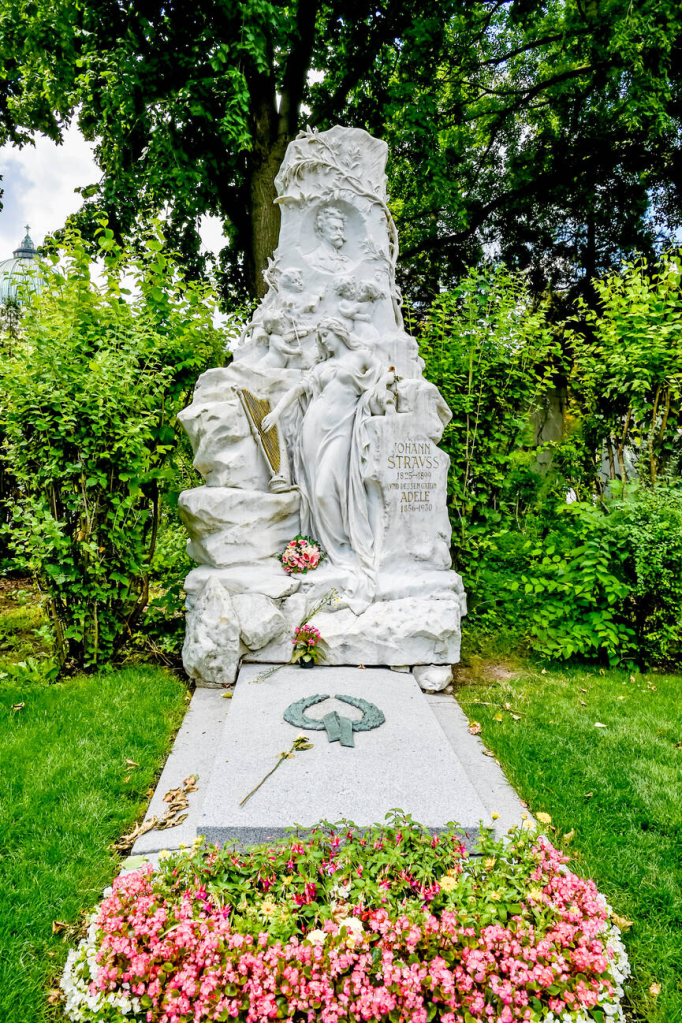
But many of the monuments are positively exuberant, and naturally, no one brings the party like Johann Strauss II. The Waltz King smiles down, moustache bristling and hair tousled as cherubs dance and play fiddles and a disconsolate Muse lets her gown slip fetchingly from her shoulder. Erotic gravestones are a bit of a theme in Vienna – that whole voluptuous Austrian memento mori thing carried to some startling extremes. It’s not just Wolf and his naked lovers. On Brahms’s memorial, a nude goddess tilts her shapely posterior at the viewer while the composer averts his eyes, bowed under the weight of tradition. For goodness’ sake, madam, put some clothes on! The 20th-century symphonist Franz Schmidt peers through his spectacles as a cute flapper girl wafts him to Parnassus wearing basically nothing. Mortality has its consolations.
And when all this sex and death starts to feel a bit much, how about some rock’n’roll? Seriously, tag along behind any local tour group, because in the Zentralfriedhof all roads lead to Falco (obit 1998). He’s so revered in these parts that the actual grave is obscured beneath floral tributes – freshly replenished, and clearly heartfelt. There’s a pink marble obelisk and a glass screen on which a life-size image of the Eurodisco legend hovers like Dracula amid the titles of his hits: ‘Rock Me Amadeus’, and – er, well, apparently there were others, and in Austria they still love them. That’s what matters, surely? On a nearby bench someone has left a testament in black marker: ‘FALCO LEBT’. Eternal flames and sexy angels are all very well, but immortality takes many forms. Er war Superstar, er war populär: we could all do worse, when the time comes.


Comments