
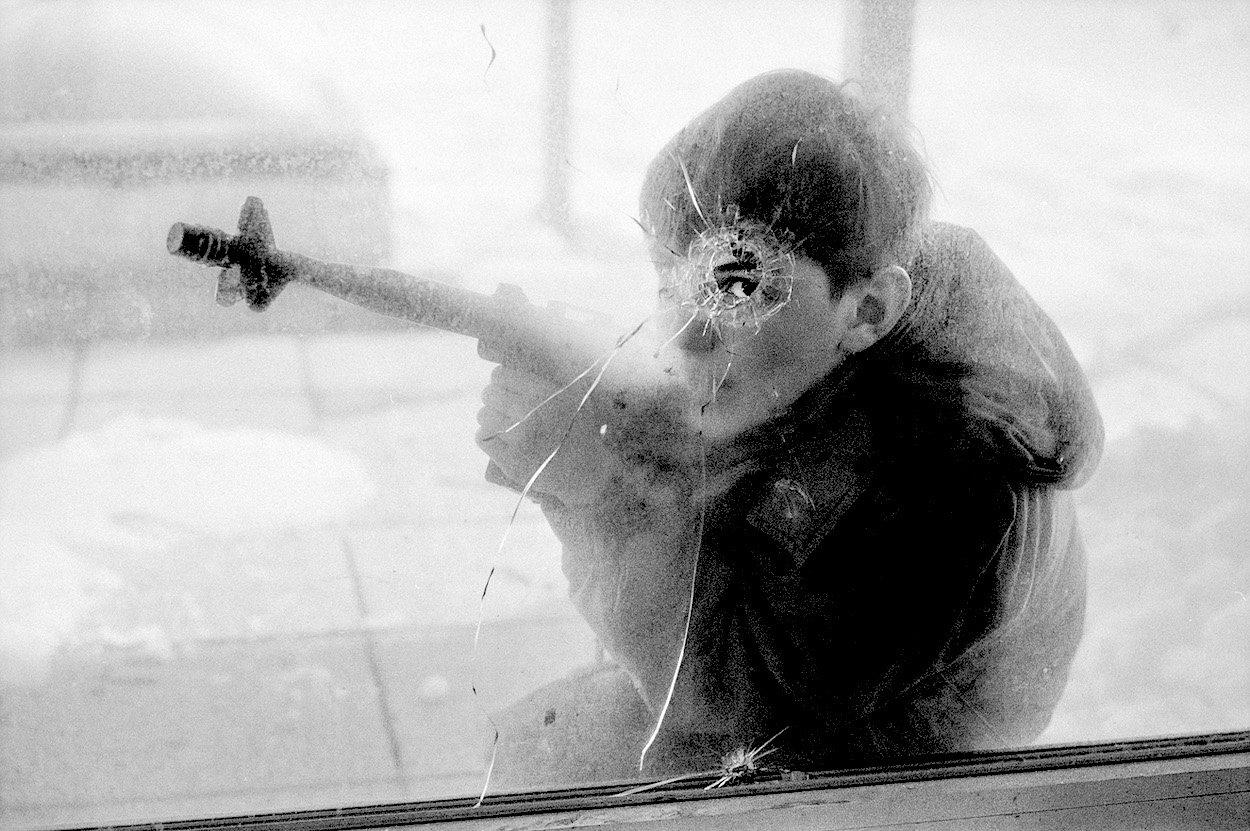
They call them the roses of Sarajevo: scars ripping through the concrete and painted red, marking where an artillery round claimed a life during the longest siege of modern history – a full three-and-a-half years, longer than even the siege of Leningrad.
From May 1992 until December 1995, an average of 329 shells struck the Bosnian capital each day, while snipers took aim at passers-by from vantage points on the mountains surrounding the city. More than 11,000 lives were lost in the siege, including 1,600 children, a memorial to whom now stands in a park. A closer look reveals some of the lost etched into the memorial are simply listed as NN – babies killed before they even had names.
Sarajevo might have been under siege, but it was not the worst place to be. It was not the concentration camps, where systematic rape, torture and starvation were daily routines, nor the east of the country, where the deadliest massacres took place. Life went on.
‘For me, war was, in a very strange and paradoxical or morbid way, fun,’ remembered Dzemil Hodzic, who was nine-years-old when the Bosnian war erupted in 1992, when I spoke to him in Sarajevo in October.

‘If we didn’t go to school, it was fun. If we had to hide, it was fun. I’m blessed that I was not a refugee, so my house was intact. None of my friends were killed during the war.’
His brother Amel was four years older.
‘Because he was older, he was in charge of the house when my parents were away,’ he reminisced. ‘So he was like a second father, like a boss. If some errands had to be done, I was the one doing it because he was giving the orders.’
On 3 May 1995, Dzemil’s mother, a nurse, returned from her night shift and served the boys their breakfast: scrambled eggs with milk and a pair of chocolates. ‘We shared the two chocolates, and I have the wrappers: I kept them as a memory,’ he continued. ‘I still remember the taste of those chocolates, funnily enough. And we went outside to play.’
There were ten or fifteen kids outside. Dzemil joined his friends to play marbles, while Amel and the older kids played tennis. It was a quiet, sunny Wednesday afternoon when suddenly, shots rang out. Dzemil saw his brother collapse, and ran to fetch his mother, instinctively taking his shoes off when he entered the house as if nothing had happened, before calling the ambulance. While everyone else was screaming and crying, the gravity of the situation hadn’t yet dawned on him. He took a blanket to wrap his brother in and stepped back outside, where his mother was desperately trying to perform CPR.
On the way to the hospital, Amel began gargling.
‘He’s alive!’ Dzemil beamed to his mother.
‘No, son, that’s air coming out of his lungs,’ she replied. At that moment, she knew.
When they reached the hospital, the other nurses took Dzemil to a waiting room. ‘I don’t know if I was there for five minutes or twenty minutes or one hour. I have no clue. Time passed really quickly. At some point they said, let’s go to the operating room. So when I entered the operating room, my father was already there. My brother was on the table. And my mom had that look on her face of a not happy person, but someone who is at peace. And she said, Dzemil, come kiss your brother.’
Several months after Amel’s death, in November 1995, a peace agreement was struck in Dayton, Ohio, then formally signed in Paris on this day 30 years ago. At the three-decade anniversary of the Dayton Accords, how far has Bosnia come?
From the end of the second world war until 1980, Yugoslavia was ruled by socialist dictator Josip Broz Tito, whose reign is remembered fondly even today, especially among older generations. But after his death, the void was filled by competing nationalisms. First to secede was Slovenia in 1991, to which the Yugoslav army retaliated with the Ten-Day War, followed by the considerably bloodier Croatian War of Independence.
The establishment of Bosnia, a multi-ethnic state of Bosniaks (Bosnian Muslims), Serbs and Croats, was the messiest. Serb nationalists boycotted the independence referendum of 1992, and with help from Slobodan Milosevic’s Serbia, formed paramilitary groups, reawakening centuries-old grievances.
‘Finally, after the rebellion against the dahis, the time has come to take revenge on the Turks in this region,’ vowed Serb warlord Ratko Mladic, referring to a 19th century revolt against the Ottoman Empire – as if anyone alive in the 1990s had anything to do with events almost 200 years ago.

An arms embargo was imposed on all sides by the UN, arguing – as we hear now about Ukraine – that more weapons would merely prolong the conflict, but the Serbs were already well-equipped from Yugoslav army stockpiles. In Sarajevo, the city’s defence was hastily organised by the ragtag Bosnian army wielding gun barrels fashioned from plumbing pipes.
Meanwhile on the Serb side, wealthy foreigners paid to hold a sniper rifle and gun down helpless civilians on human ‘safaris’ – a real-life version of The Most Dangerous Game.
Despite the ethnic hatred, Sarajevo was still a mixed city: Serbs suffered the same hardships as their Bosniak neighbours. Bosko Brkic, a Serb, and Admira Ismic, a Bosniak, Sarajevo’s Romeo and Juliet, died in each other’s arms after being shot by a sniper while trying to flee the city. And one of Sarajevo’s defenders, General Jovan Divjak, was an ethnic Serb.
‘I hate that term “all three sides” because in Sarajevo, there is no such thing; we are all Bosnians,’ said Dzemil. ‘I’m a Bosniak Muslim, but people who suffered with me during the war… We didn’t care who is who.’
Eventually, an intervention by Nato forced the Serbian, Croatian and Bosnian leaders to the negotiating table in 1995. The Dayton Agreement split the country in two: the Federation of Bosnia and Herzegovina, and the Serb-dominated Republika Srpska. With a total of three presidents and 13 prime ministers between the republic, the federation, and all its cantons, Bosnia’s politics can be aptly described as dysfunctional. Nothing ever gets done.
War criminals are still glorified, especially in the Serb republic. In the town of Foca – where almost the entire Bosniak community was violently expelled and ‘rape camps’ were set up for girls as young as twelve – I found a mural to Milorad Pelemis, whose men took part in massacres. (Pelemis died before he could be brought to trial.)
A new generation is growing up who’ve never heard a gunshot or an artillery blast
Division doesn’t end with the Serbs. Mostar, in the south, became the frontline between Bosnian and Croat forces when the alliance between them broke down, the Croats’ artillery destroying the city’s iconic Ottoman bridge. Today, suspicion lingers between the communities.
‘My son won’t grow up like that, because he’s always with me in the old town,’ said Marko, my tour guide. ‘But one day, he brought along one of his friends from school. He said it was his first time in the old town. When I brought him back to his parents, they said they simply never found time to take him there. You never found time to visit the other side of your own city? I couldn’t believe it.’
Still, despite the efforts of rabble-rousers like Milorad Dodik, until recently the secessionist Bosnian Serb leader, Bosnia persists. A new generation is growing up who’ve never heard a gunshot or an artillery blast in their lives, yet are stuck living in the same system. While Croatia, which also experienced war, prospers in the EU, Bosnia’s stuck in a deadlock.
‘We have peace, but we have a peace that was like a temporary solution, which became a permanent deal,’ reflected Dzemil, who now curates the Sniper Alley photo project.
‘They keep calling it “peace building”… We shouldn’t be calling 30 years later “peacebuilding”. So it’s frustrating. It’s not very promising that something will change if it hadn’t changed much in 30 years. But then, you never know. New people come, new administrations. We depend on foreign influence, including Britain, America, Germany, France. So we have to fight for the EU and fulfil these conditions [to join]. But sometimes it feels like they are set up there to fail in the first place, and it seems like we will never join the EU. So I don’t have a complete answer. The only thing I have to say we have to fight for the country, for our future, for our kids.’




Comments