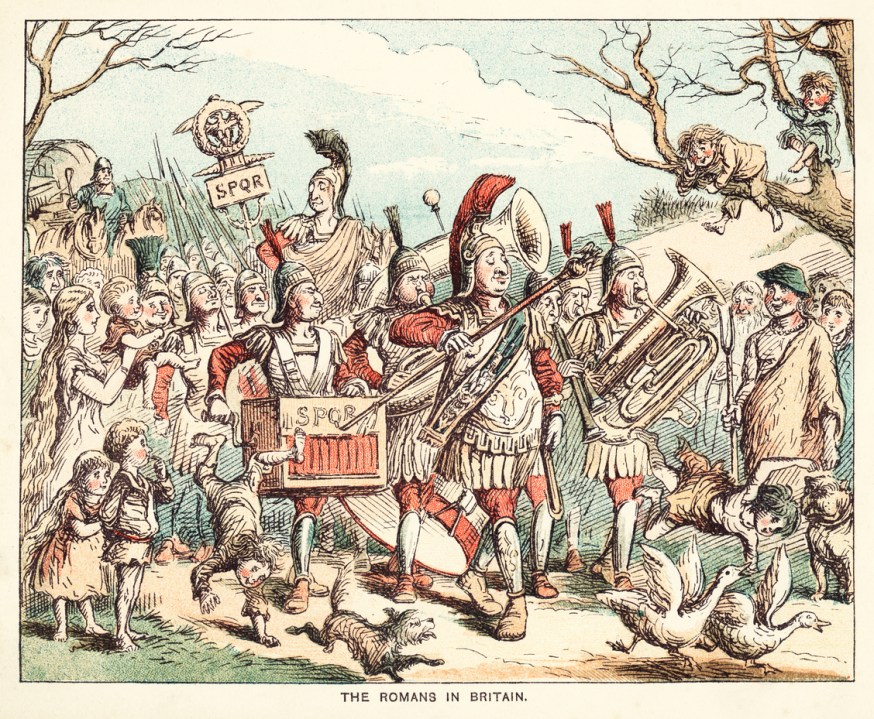

Since the Romans themselves wrote about the subject, we have a clear idea of the good things they did for Britain. Roads, towns, stone and brick buildings, plumbing, writing (IOUs), vineyards and leather bikinis were some of the many gifts of what used to be called Rome’s civilising power. Thanks to archaeology, we know some of these advances were less dramatic than thought – there were Iron Age towns and roads in Britain before the invaders arrived, for example. Now new evidence shows they had a clear negative impact on the native population. As happened centuries later during the Industrial Revolution, the Roman conquest led people to move into towns and their health deteriorated. And there’s another twist that questions just how deep the adoption of Roman culture in Britain really was.
For her doctoral research at the University of Reading, Rebecca Pitt looked at human remains dating from before and after the Roman Conquest in 43 AD. The success of her project, published in the journal Antiquity, owes much to new science. It also benefited from modern development. Many excavations, some very large, are now launched and funded by construction companies ahead of any building works. Traditional archaeology never approached the scale of this work, and often focused on places already known to contain ancient remains.
As a result of these new excavations, Pitt was able to study more than 600 skeletons, all of them infants, or women of child-bearing age. Many of these people suffered from poor health, apparently caused by poor diet, malnutrition, infections, physical trauma, pollution and poor living environments. More than a third of the infants displayed at least one such sign, as did more than two thirds of the women, who together suffered from stress, respiratory conditions and metabolic diseases. It’s when these figures are considered in more detail that it gets interesting.

First, there’s a clear distinction between Iron Age health and Roman: you were better off in the old days. Before Rome, about a quarter of infants showed signs of ill health in their bones; after, nearly half. Among women those statistics are nearly two thirds in the Iron Age, rising to three quarters in Roman times.
This builds on earlier studies conducted with smaller samples. ‘Life under Roman occupation,’ writes Pitt, ‘was less conducive to long-term health.’ Lead was probably a contributory factor, through plumbing, crockery, wine, medicines and toys. Infants would have been particularly vulnerable to its effects, which worked by disrupting metabolic pathways leading to nutritional deficiencies.
Previously it had been thought that any such fall in the quality of life would have occurred equally in towns and across the countryside. However, Pitt found this was not the case. You were as healthy in rural Roman Britain as you had been before. But things were worse in Roman towns: pathological changes visible in bones occurred in nearly two thirds of urban infants, and over 80 per cent of urban women. For Roman citizens, ingesting lead would have been but one of the cumulative impacts of living in polluted and overcrowded cities, exposed to pathogens introduced by passing traders and soldiers.
On the face of it, the new Roman lifestyle was as eagerly adopted in the countryside. Excavations have shown many instances in which Iron Age families appear to have continued living in the same place, be it in a farm or a village, through the tumultuous years of the first century AD. But they seem to have fallen wholesale for Roman styles. Thatched houses with round floor-plans were replaced with boxy rectangular buildings with tiled roofs. Industrialised Roman plates and bowls pushed out handmade crockery in local designs. Instead of funerary practices that differed from one tribe to another – to the extent that in much of the country archaeologists struggle to find anything we’d call a formal burial – people everywhere adopted the Roman practice of rectangular graves, one for each person, grouped together in cemeteries on the edges of settlements. And so on.
This apparent fondness for Roman culture, however, is challenged by the new evidence from the skeletons. If rural communities preserved their health, while their urban compatriots fell for more destructive lifeways, could that suggest a deeper rejection of Roman values concealed by the adoption of material conventions?
In Londinium, the Roman city of London, if you could afford them you could buy quality foods, from fruits and vegetables and freshwater fish, to imported lentils, dates and almonds. There are indications that London mothers followed the advice of Sonarus of Ephesus, a Greek physician, and weaned their children on a cereal-rich diet – not an ideal upbringing. For the great majority, urban living, in its Roman form with Roman values, brought an overall decline in health.
By contrast, out in the country, whatever people aspired to in the way of hot baths, mosaic floors decorated to illustrate Mediterranean mythology, and the occasional glass of wine, they retained their local ways of growing and processing food, and of living together. And so while some 20 per cent of city dwelling infants and 30 per cent of women suffered some form of metabolic condition, in rural Roman Britain, as in preceding centuries, those figures never reached 5 per cent. Caveat emptor, as the country visitors might have said to their urban cousins.



Comments