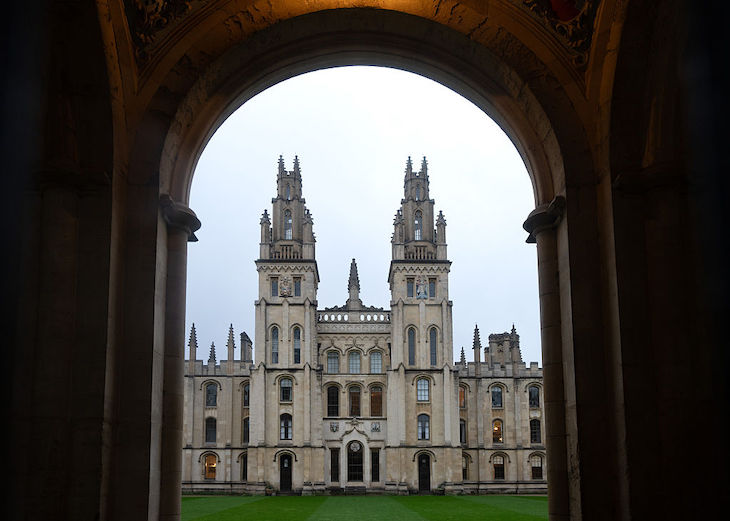
This week, there’s a strange absence in Oxford. For years, in December, you’d suddenly see a strange invasion of the streets of the university town. White-faced, terrified 17-and 18-year-olds, preparing for their university interviews. Colleges, tea rooms and restaurants were haunted by these poor, clever souls, mumbling equations and gerundives to themselves. Well, no more.
If candidates clam up on screen, it’s much harder to respond to even the kindest don, hundreds of miles away
The teenage geniuses are still applying to Oxford – but from the comfort of their bedrooms at home. In-person interview was temporarily halted, quite understandably, in 2020 because of Covid. But Covid came and went. And, in 2023, the Oxford colleges voted, by 24 to seven, to keep interviews online for another five years. Of course they did. How much easier for the colleges not to have to feed the applicants and put them up. How much easier for dons to sit at their screens at home – no need to go into college; no need to dress up below the waist.
It’s another example of Mount’s Rule of Laziness: Any Temporary Rule that Suits the Employee and Inconveniences the Public Becomes Permanent. For another example, see Litter Bins Temporarily Removed to Deter Terrorists.
Yes, you can argue a Zoom interview is more convenient and less terrifying for the young candidate. But – as we all know from our work interviews – Zoom is very different from real life. When you meet someone in the flesh, you take in a million things you can never intuit from a screen. It’s like the difference between a photograph and a Rembrandt.
The way people walk into a room. The way they hold themselves. Their posture. The minutiae of their expressions, tone, accent, volume…All lost in translation from real life to screen.

There is a greater ease and naturalness to conversation in the flesh. The polished performer can bang on at length on screen – remember how difficult it is to interrupt the office bore on Zoom? In person, he (and it usually is a he) can be more easily interrupted and interrogated.
The shy brainbox suffers the opposite effect. If they clam up on screen, it’s that much harder to respond to even the kindest don, hundreds of miles away. In the flesh, gentle encouragement is so much easier to discern and respond to.
Not all dons are pussycats. At my interview at Merton College in 1988, one tutor gave me a proper ruthless grilling on the subject of envy. Still, the other two dons in the room were comforting and considerate, perhaps in response to their icy colleague – good cops to his bad cop.
And it wasn’t my only chance. Then you went up to Oxford for the night, with a day either side – to give you a chance for long, rigorous interviews, in my case, at three colleges. At Christ Church and Magdalen (where I ended up), they couldn’t have been sweeter.
How good for my education, too, to be properly interviewed – even or especially by Professor Scary of Merton. To deal with disagreement and change your mind or stick to your guns according to your knowledge or lack of it – that’s a big part of being educated. Not least because that’s exactly what I’d spend the next four years at Oxford: learning how to learn and how to read people – not just dons.
Thirty-seven years on from those interviews, I remember them all in detail – the gentle ones and the scary one – because they were such a new departure in my life. I’d never been interrogated by clever, grown-up strangers before. Since then, I must have been cross-questioned like that a hundred times. Now it’s water off a duck’s back – but only because I started then, with no other option. You can’t build up that sort of tough shell by talking to scary people on Zoom from your bedroom cocoon.
How lovely to spend your life wrapped in cotton wool, never being confronted or taken on. Well, how lovely in theory. In practice, catastrophic!
At 17, I knew very little and it was important to realise that was the case. One of the wisest things I’ve ever heard was said by the late Professor Norman Stone (1941-2019), once I’d got into Oxford and was in my second year. I’d just said something naïve about the Second World War and he said, in an amused, friendly, utterly unaggressive way, ‘You only say that because you know so little.’
He was right – of course he was, as one of the world’s great experts on WWII. I was chastened – and found it very funny at the same time.
But I could only see that comment for its hidden kindness and helpfulness because, by then, I’d already had two years of meeting planet-brained dons, starting with Professor Scary and all the others at my Oxford interviews – in the flesh.



Comments