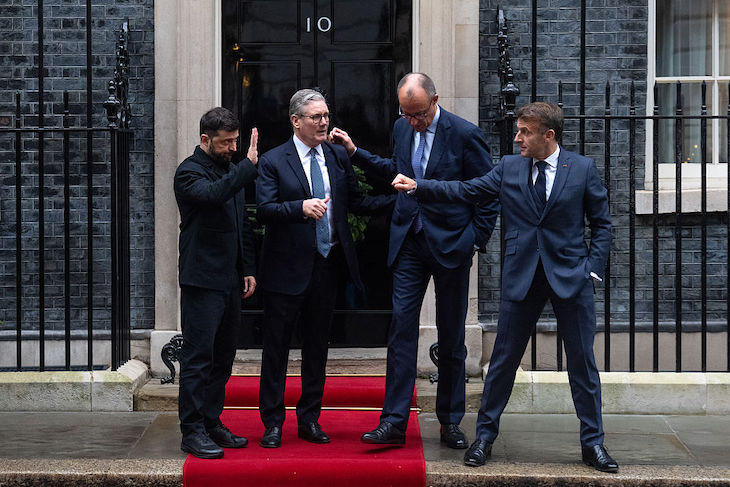
Europe’s leaders flocked to London this week, determined to show the world a united front. Like school boys at a bus stop, Ukraine’s president Zelensky stood beside Keir Starmer, German chancellor Friedrich Merz and French leader Emmanuel Macron in a carefully staged tableau of Western resolve. It was designed to send a message to Moscow: Europe is ready. Yet the spectacle only highlighted the uncomfortable truth: Europe talks like a military power, but behaves like a political debating society. The continent insists it has woken up to the new reality, yet it still refuses to build the armies required to confront it.
Europe talks like a military power, but behaves like a political debating society
For all the stirring rhetoric about stepping up, the hard numbers remain damning. If Europe truly intends to be taken seriously – by Russia or by the United States – it needs forces on a scale it has not contemplated since the Cold War. Not polite increases in defence budgets, not symbolic deployments, but vast armies capable of deterring a nuclear-armed imperial power.
Even Nato is stepping up its critique. Yesterday, the alliance’s chief Mark Rutte warned that too many on the continent were ‘quietly complacent, and too many don’t feel the urgency’. ‘Russia could be ready to use military force against Nato within five years.’ Instead, Europe’s leaders keep making grand speeches while their electorates stubbornly cling to the fantasy that the post-1991 holiday from history can continue indefinitely. Voters want safety without sacrifice, security without spending, deterrence without danger. And so Europe continues to bluff strategically, loudly asserting its intentions while hoping America will continue underwriting its defence.
Germany provides the most glaring example of this disconnect. The presence of Merz in London was meant to project seriousness and prepare the ground for a more assertive Berlin. Yet German politics is collapsing under him. His coalition is divided, chaotic, and teetering on the edge of fresh elections. And who stands to benefit? The far-right AfD – a party with elements that are openly sympathetic to Moscow and hostile to the very idea of a muscular pro-Ukraine European security posture. The Berlin political class keeps talking about the so-called Zeitenwende, but it can barely hold together a functioning government, let alone build the vast army required to defend Europe. Germany may speak the language of responsibility, but its politics, which is fragmented, fearful, suspicious of military power, make real leadership impossible.
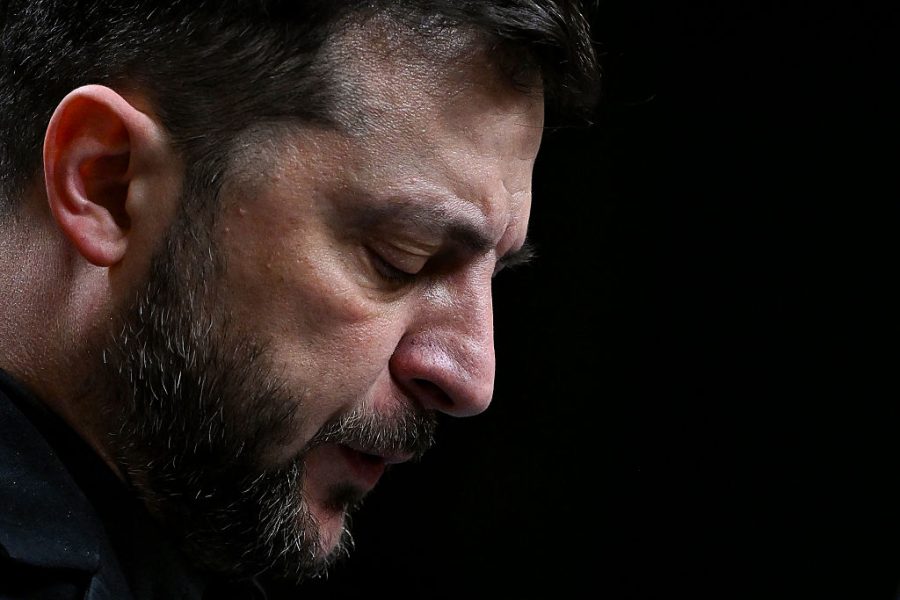
France is no better. Macron has spent years positioning himself as Europe’s only strategic thinker, the continent’s would-be commander-in-chief. Yet at home he is effectively toothless, unable even to form a government. Marine Le Pen and her Rassemblement National – which has been famously sympathetic to Russia’s worldview – is poised to take over the moment opportunity arises. Paris can barely govern itself; the idea that it will spearhead Europe’s rearmament verges on the absurd. The French president may enjoy giving bold speeches about Western resolve, but he leads a country exhausted by politics, reluctant to sacrifice, and staring down the barrel of a pro-Kremlin government.
Britain, for its part, talks a bolder game than either France of Germany. Starmer wants to convince the world that the UK remains Europe’s most reliable security actor. But he faces a party turning against him, a parliamentary caucus sharpening its knives, and the rise of Reform UK threatening to gut his electoral foundations. If an early exit becomes plausible, Britain will hardly be in a position to lead Europe militarily. Even if it were politically stable, its armed forces are simply too small to sustain any serious conflict without immediate American reinforcement. The country that once commanded an empire now struggles to field a single division.
Meanwhile, the United States – the guarantor of European peace for eight decades – is losing patience. Washington watches Europe posture without producing power, demand influence without committing resources, and insist on ‘co-leadership’ while remaining strategically dependent. Small wonder the Americans sidelined Europe almost entirely in the most recent peace plan discussions. The message could not have been clearer: if Europe wants a seat at the table, it must first bring something of value. In geopolitics, value means force.
Europe, in short, wants to be a geopolitical actor but refuses to accept the domestic costs. Its people are not prepared for conscription, expanded armies, industrial mobilisation, or the idea that peace in Europe may once again require serious, long-term military commitment. Until that changes, Putin will continue probing, testing and waiting. And Washington will continue treating Europe not as a partner, but as a dependent. It is now that Germany has to step up and use its full economic capabilities to lead in re-armament – and inspire Britain and France to join.
Which brings us back to the scene in London: four leaders standing proudly together, speaking of unity and resolve. It looked impressive – until one remembered that beneath the choreography lies a continent unwilling to build the power it claims to wield. Europe can stage all the summit photographs it wants, but unless it fundamentally changes, those images will remain what they were in London: a portrait of leaders who talk like generals but act like bystanders.


Comments