
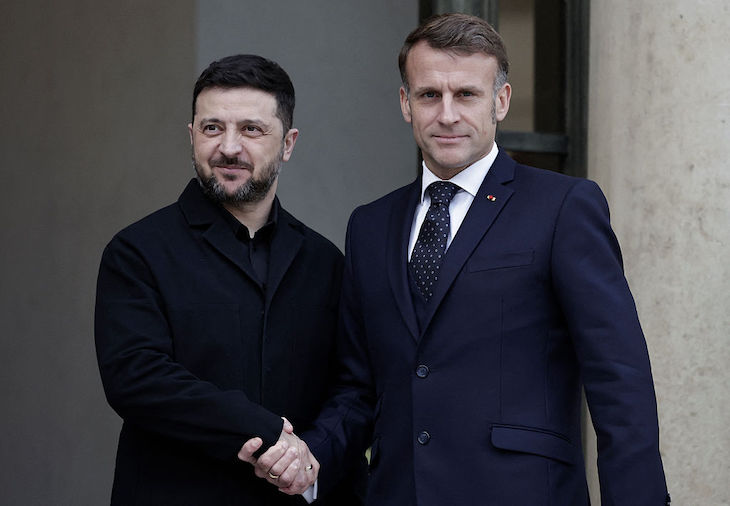
Emmanuel Macron welcomed Ukraine’s president Volodymyr Zelensky to Paris this morning to discuss ‘the conditions for a just and lasting peace’. But is the French leader nervous about what peace in Ukraine might mean for Europe – and for France?
There may be another reason why Macron is concerned at what peace in Ukraine might bring. It is an anxiety shared by others in Europe
In an interview with a Sunday newspaper, France’s foreign minister, Jean-Noël Barrot, declared that ‘peace is within reach, if Vladimir Putin abandons his delusional hope of reconstituting the Soviet Empire by first subjugating Ukraine’.
Macron showed little enthusiasm initially for the 28-point peace plan put forward by the USA and Russia, warning that Putin was not a man to be trusted. The plan has since been modified. And Macron appears more ready to accept a peace deal, particularly in light of the corruption scandal that has engulfed Ukraine in recent days.
Critics on the left and the right in France have accused Macron of exploiting the war in Ukraine for his own ends; first for electoral advantage in 2022 and 2024. And more recently to keep himself relevant. Since his centrist party was beaten into third place in last year’s parliamentary elections, Macron has scant domestic authority. Last week, a prominent conservative commentator labelled the president a ‘warmonger’.
There may be another reason why Macron is concerned at what peace in Ukraine might bring. It is an anxiety shared by others in Europe. In June 2022, four months after Russia had invaded Ukraine, Interpol Secretary General Jurgen Stock expressed his fear about the weapons being sent by Western governments to aid Ukraine’s defence. ‘The high availability of weapons during the current conflict will result in the proliferation in illicit arms in the post-conflict phase,’ said Stock.
Stock urged countries to scrutinise arms-tracking databases and ensure they wouldn’t end up in the wrong hands. ‘This will come, I have no doubts,’ said Stock. ‘Criminals are already now, here as we speak, focussing on that.’
The French, in particular, are fearful of a repeat of what happened after the war in the former Yugoslavia in the early 1990s. Towards the end of that decade, armed robbers in France began using Kalashnikovs, the assault rifle better known as the AK47.
Within a few years, they were the weapon of choice of the drug cartels, so prolific in western Europe that were exchanging hands for a few hundred euros. The weapons remain a threat: thirty of the 49 people shot dead in Marseille’s drug war in 2023 were killed by AK47s.
The Kalashnikov was also used by the Al-Qaeda cell which murdered the staff of Charlie Hebdo and four shoppers in a Jewish store in Paris in January 2015. The killers were also equipped with a rocket-launcher, which they didn’t use. The men who murdered 130 Parisians in November 2015 in the name of the Islamic State did so using Kalashnikov. A wounded survivor of that evening explained how ‘Kalashnikov bullets are very specific…they explode inside the body, which makes physical repair difficult and poses a real surgical challenge.’
France is more aware of the dangers now of black market weapons than it was 30 years ago. It is why the government lobbied hard to have their man elected as the new head of Interpol last week.
Lucas Philippe, a Frenchman with vast international experience in combatting anti-terrorism and drug trafficking, beat off challenges from Turkish and Ethiopian candidates to become the new chief. ‘Our enemy is organised crime and terrorism,’ declared the 53-year-old Philippe on winning the vote.
It hasn’t been an auspicious few years for Interpol. Philippe’s predecessor was an Emirati, Major General Ahmed Nasser Al-Raisi, who was accused of human rights abuses during his time as the UAE’s inspector general of the interior ministry. Raisi rejects the allegations against him. Responding to Al-Raisi’s election win in 2021, US senator Roger Wicker said Interpol had ‘become a tool in the hands of despots and crooks who seek to punish dissidents and political opponents’.
The man elected Interpol chief in 2016 was the Chinese, Meng Hongwei. But two years into his appointment, he was arrested by Beijing and charged with bribery. In 2020, Hongwei was sentenced to 13-and-a-half years in prison.
Philippe is the first European to lead Interpol since his compatriot, Mireille Ballestrazzi (who was the first woman in the post) headed up the organisation between 2012 and 2016.
Shortly before he was appointed Interpol chief, Philippe said that in the event he won the vote he would ‘strengthen operational coordination between the 196 member countries’. He also promised to enhance Interpol’s ‘capacity for anticipation’.
Anticipating what will happen to the military hardware currently in Ukraine post-conflict will be part of that challenge. But that will also require cooperation and determination from Brussels and European governments. The omens aren’t good. If Europe can’t defend its borders from people traffickers, then what chance have they got in defending them from arms traffickers?

Comments