Society

Priests and pagans

The Catholic tradition of priestly celibacy (Latin caelebs, ‘unmarried’), by which Cardinal O’Brien was bound, is not a dogma, but a discipline. In other words, it can be altered at the rotation of an encyclical. Like much else in the Catholic tradition, it has its roots in the pagan world. Asceticism derives from the Greek askêsis, ‘training, practice’. Pagans had long believed that humans could be transformed through mental and physical discipline. Pythagoras, for example, thought that the element of the divine in us could be brought out by fasting and contemplation. Diogenes in his clay wine jar rejected the whole concept of ‘society’; the millionaire Seneca, committed to the idea

Peter Archer — Notes from an Inland Sea

Peter Archer used to paint landscapes on the Cornish side of the Tamar river. Their most notable features were lovingly observed trees and the tall chimneys of abandoned tin mines. One might have expected that when he moved to a coalmining valley in South Wales, his landscapes would have become blacker and its main features hills and slag-heaps. Instead, he has gone to sea, not literally nor even as an observer from some visited shore, but in his imagination. The Welsh coal-mines may have had something to do with it, since these are predominantly grey paintings in which, like Conrad’s Thames Estuary, ‘the air was dark above Gravesend, and farther

Letters | 7 March 2013

Gove’s history lessons Sir: ‘The idea that there is a canonical body of knowledge that must be mastered,’ says Professor Jackie Eales, ‘but not questioned, is inconsistent with high standards of education in any age.’ This is not true. Primary education is, or should be, all about just such a body of knowledge. This gives children a foundation of fact, preferably facts learnt by heart. Without it, they cannot begin to reason, and develop valid ideas, in the secondary stage. It may be a tight squeeze to get them through English history up to 1700 by the age of 11, but it is better than not covering the ground at

Taking Olympic history to Manchester

To Manchester for an address to the Manchester Literary and Philosophical Society for the Kilburn Lecture on ‘The Future of the Olympic Games’. The learned society is Britain’s second oldest, after the Royal Society, having been instituted in 1781. John Dalton, the father of modern chemistry, was one of its important past members. My NBF Peter Barnes (I had to explain to him that the acronym meant new best friend) picked me up at the airport and whisked me to Manchester Metropolitan University, and within 45 minutes I had changed into evening clothes and was facing a jolly gathering of bearded professors, smiling ladies and an all-round appreciative audience who

A stable full of Germans

After a lot of false starts, I am now the proud occupant of a small weekend rental in the country. It is very exciting. No more commuting from Balham to Cobham to ride the horses. I wake up on Saturdays in a converted barn down a farm track and drive two minutes to the stable yard to see Tara, Grace and Darcy. The three mares have now moved from their expensive livery yard to what we horse-owners rather disingenuously call a DIY yard. I say disingenuous because it’s not really DIY. A nice lady called Sue looks after them on weekdays and I ‘do them myself’ at weekends. Somehow, it

Edinburgh Zoo and the great panda racket

If you have nothing to do, are suffering from stress, and wish to be rendered comatose, I recommend that you get interested in the efforts being made by Edinburgh Zoo to mate its two giant pandas. The zoo has thoughtfully installed video cameras in the pandas’ enclosure so that we can constantly watch them online and marvel at their sloth. I had my laptop tuned to the ‘Panda Cam’ throughout the weekend and checked it from time to time to see what the pandas were up to. The answer was never anything at all except for sleeping or eating. Often there was no panda in camera shot; but when there

Bridge | 7 March 2013

Terry Hewett’s annual charity bonanza, Night of the Stars, has become THE charity event of the year and has made Terry the true star. This year she auctioned off 43 bridge stars, raising well over £40,000 for four charities, and gave us all a fabulous evening to boot! This year’s tournament was won by Jeremy Dhondy playing with the outgoing Chairman of the EBU, Sally Bugden. Look at the formidable Jeremy in action here: Maybe Sally overbid with 3♦ (I would have done the same) but if she hadn’t there wouldn’t be a story to tell. West led the ♠10 and declarer had a lot to do. It’s usually right

Witschcraft | 7 March 2013

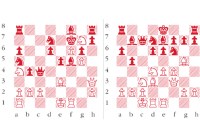
There are two new books about Aron Nimzowitsch, chess strategist and author of My System. Aron Nimzowitsch on the Road to Chess Mastery 1886-1924 by Per Skjoldager and Jorn Erik Nielsen is published by McFarland, while Aron Nimzowitsch 1928-1935 by Rudolf Reinhardt (on which the notes to today’s game are based) is shortly to be published. This week, a game and puzzle by the crown prince of chess, as he was sometimes known. Nimzowitsch-Asztalos: Bled 1931; English Opening 1 c4 Nf6 2 Nc3 c5 3 g3 Nc6 4 Bg2 e6 5 Nh3 Nimzowitsch tries something unusual instead of the normal 5 Nf3. 5 … Be7 6 d3 d6 7 0-0

no. 256

White to play. This position is from Nimzowitsch-Alapin, Vilnius 1912. How did White swiftly conclude his sacrificial attack? Answers to me at The Spectator by Tuesday 12 March or via email to victoria@spectator.co.uk or by fax on 020 7681 3773. The winner will be the first correct answer out of a hat, and each week I shall be offering a prize of £20. Please include a postal address and allow six weeks for prize delivery. Last week’s solution 1 … Rxg2 Last week’s winner Peter J. Skelly, Bedford

Portrait of the week | 7 March 2013

Home George Osborne, the Chancellor of the Exchequer failed to dissuade EU finance minsters in Brussels from endorsing a plan to cap bankers’ pay bonuses. City banks contemplated taking the EU to court over it. HSBC’s annual profits fell by 6 per cent to £14 billion, including a loss of £700 million made in Britain. The Royal Bank of Scotland, 81 per cent of which is owned by the government, made its fifth annual loss in a row, of £5.17 billion. Sir Mervyn King, the governor of the Bank of England, suggested it should be split up and sold. Lloyds Banking Group, 40 per cent of which is owned by

Toby Young

Memo for Prince Alwaweed bin Talal – here’s how you handle Forbes

I feel a twinge of pity for Prince Alwaleed bin Talal — and it’s not often you can say that about a billionaire Saudi businessman. According to Forbes, he’s worth $20 billion, making him the 26th richest man in the world. But is he? The prince has disputed this estimate of his net worth, claiming the true figure is $29.6 billion. That would place him in the world’s top ten. The reason I feel sorry for him is not because his wealth may have been underestimated, obviously. Rather, it’s because Forbes has made him the subject of a pitiless hatchet job in the current issue, ridiculing him for trying to

Dear Mary | 7 March 2013

Q. Every morning I walk to work and stop to pick up a cappuccino from a local café outside which is invariably sitting a (handsome) man, alone apart from his dog, having breakfast. We always say hello and I sense that he likes at least the look of me, but there is no opportunity to say anything else. He must live locally but I don’t know who he is, and I can’t ask the people who run the café as they don’t speak English. I can’t sit down with him at the one table outside as that would be far too obvious (and too cold). I can tell he is

Tanya Gold

Tanya Gold reviews Balthazar

Balthazar is a golden cave in Covent Garden, in the old Theatre (Luvvie) Museum, home to dead pantomime horses and Christopher Biggins’s regrets. It is a copy of a New York restaurant, which was itself a copy of a Parisian brasserie, and it is the first big London opening of the year. This means diary stories and reviews and profiles of the co-owner (with Richard Caring), Keith McNally, the most ludicrous of which was in the FT, and was an interview with his house, which is in Notting Hill. It wasn’t quite as ridiculous as: F.T. What are you proudest of, Keith McNally’s House? Keith McNally’s house Guttering. But it

Lurch

My husband made a little joke. ‘There’s no such thing as a free lurch,’ he said, looking up from his Sunday Telegraph. In it, David Cameron had declared: ‘The battle for Britain’s future will not be won in lurching to the right.’ Lurching is a nicely pejorative word. A lurch could only be welcome accidentally. The word suddenly popped up in the 19th century. No one is known to have used it earlier than Byron in 1819, in Don Juan, where he contrives a Byronic rhyme: ‘A mind diseased no remedy can physic/ (Here the ship gave a lurch, and he grew sea-sick).’ Its origins are mysterious but nautical. A clue may

2103: Rime

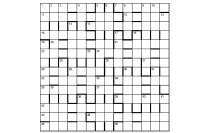
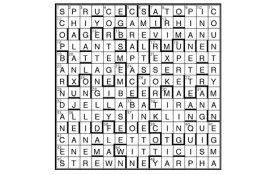
Unclued entries are words or phrases whose meanings are not connected, but they are determined by the appearance in the grid of the last two lines of a poem, one word to each row. The first two lines of the poem appear in fourteen clues, whose answers do not touch the quotation in the grid, as extra words which must be removed before solving the clues.  The four lines of verse, read together, could form a succinct summary of the poem. Across 1 Company lacking new economic revenue (6) 7 To wit, two who? (6) 11 Weed to plant in tree (or to plant around vegetable) (9, three words) 12

2100: Mask | 7 March 2013

Corrections of misprints in clues give PAPER OVER THE CRACKS, indicating the position of 12 in relation to the other unclued lights. First prize Kenneth M. Robb, Linlithgow Runners-up Alexander Caldin, Salford, Oxfordshire; Ben Stephenson, London SW12