Biography

‘Too bohemian for Bournemouth’: the young Lawrence Durrell

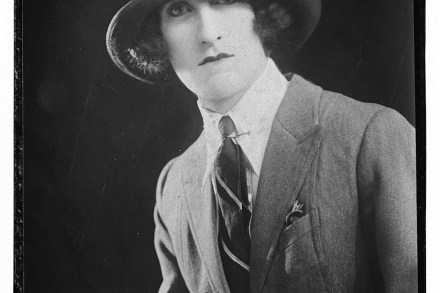
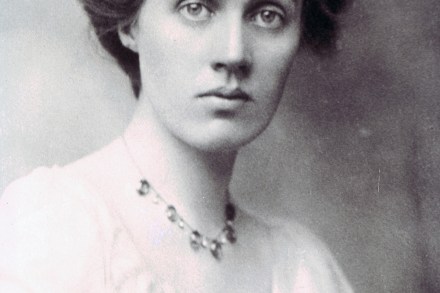
These legendary lives need the clutter cleared away from them occasionally. Lawrence Durrell and his brother Gerald turned their family’s prewar escape to an untouched Corfu into a myth that supplied millions of fantasies. It still bore retelling and extravagant expansion recently, if the success of ITV’s series The Durrells is any sign. (One indication of that pleasant teatime diversion’s accuracy: the actor playing Larry, Josh O’Connor, is 6ft 2in. Larry himself was a whole foot shorter.) How Louisa Durrell, struggling with life in Britain after returning from India, went in a bundle with her children to a Greek island of cheap Venetian mansions, heat and innocent adventure is always
The Spectator letter that marked a turning point in gay history

On 3 June 1960, a letter appeared in The Spectator which began: Sir, We are homosexuals and we are writing because we feel strongly that insufficient is being done to enlighten public opinion on a topic which has for too long been shunned. The letter was prompted by the government’s failure to act upon the recommendation of the 1957 Wolfenden Report that homosexual acts between consenting adults in private should no longer be a criminal offence. This had led to the founding of the Homosexual Law Reform Society (HLRS) in 1958, and it was for this organisation that the letter’s three signatories worked as volunteers. The letter was both unusual

Admirable in their awfulness – the siblings Gus and Gwen John

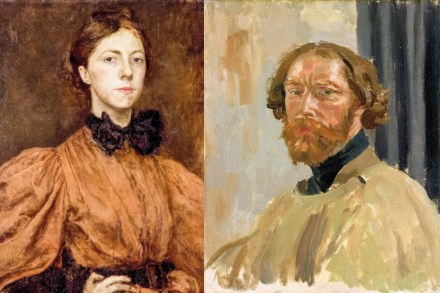
‘In 50 years’ time,’ Augustus John gloomily reflected following his sister’s death on 18 September 1939, ‘I will be known as the brother of Gwen John.’ He was right. In 2004, when the Tate mounted a joint retrospective of Augustus and Gwen John, it was Gwen who had become the major artist. The ‘variable strident chords’ of the self-styled Gypsy King, likened in his youth to Michelangelo, Rembrandt and Raphael, had been supplanted by the ‘sustained minor key’ of the nunlike recluse.  The first decades of the 20th century were what Virginia Woolf described as ‘the Age of Augustus John’; but the praise lathered on him after his own death,

Nunc est bibendum – to Horace, the lusty rebel

Horace suffers from a reputation as an old man’s poet. Classicists often joke that Catullus and Martial are for the young, and Horace for those of a certain vintage – wine being a favourite Horatian theme. Many lose their thirst for his Odes at school, only to realise their brilliance decades later. Classroom Horace is just a bit too bombastic and patriotic to be cool. The Horace of Peter Stothard’s beautifully written new biography surprises with his sexiness. Not many pages in we find him poring over scurrilous papyri in the libraries of Athens. A verse by the Archaic-era poet Archilochus has caught his eye. It describes a woman with

Everyone who was anyone in Russia was spied on – including Stalin

Vasili Mitrokhin was a KGB colonel smuggled out of Russia by MI6 in the early 1990s with a treasure trove of notes from the KGB’s archive. The resulting 3,500 CI reports (CI meaning counter-intelligence – information about hostile spies) identified 1,000 KGB agents around the world and were shared with 36 countries. The CIA rated it ‘the biggest CI bonanza of the post-war period’, while the FBI described as ‘the most detailed and extensive pool of CI ever received’. The story behind it was as remarkable as the haul itself. Gordon Corera’s fluent narrative draws on many sources, including the magisterial two-volume Mitrokhin Archive compiled by the historian Christopher Andrew

What Mark Twain owed to Charles Dickens

You know Mark Twain’s story. You’ve got no excuse not to; there have been so many biographies. Starting in the American South as Samuel Clemens, he took his pen name from the call of the Mississippi boatmen on reaching two fathoms. His lectures, followed by his travel pieces and novels, enchanted America and then the world. As a southerner, his principled stance against slavery gave him moral authority. The famous ‘Notice’ to The Adventures of Huckleberry Finn – ‘Persons attempting to find a motive in this narrative will be prosecuted; persons attempting to find a moral in it will be banished’ – was swept aside, so that persons like H.L.

Douglas Cooper – a complex character with a passion for Cubism

The collector, art historian and critic Douglas Cooper (1911-84) relished conflict. He was a formidable man, loud in speech and dress, with forceful views and a taste for ridicule. He could also be very funny. John Richardson, Picasso’s biographer, who knew Cooper better than most, said it was as though an angel and a demon child were perpetually fighting for control of his personality. Physically robust, Cooper survived being stabbed in the stomach when he was 50 after unwisely propositioning a French soldier. He is remembered today, if at all, for his legendary collection of Cubist art, focusing on the four greats of the movement: Picasso, Braque, Léger and Gris.

‘I secreted a venom which spurted out indiscriminately’ – Muriel Spark

In 1995, Dame Muriel Spark, then one of Britain’s most distinguished living writers, was interviewed for a BBC documentary. During filming, the show’s editor commented that ‘her biographer must be the most depressed man in England’. Three years earlier, Spark had personally anointed Martin Stannard as the writer of what she intended to be the authorised version of her life, presenting him with the vast archive of documentation – spanning 50 years and 50 metres – gathered at her home in Arezzo. ‘Treat me as if I were dead,’ she instructed him. Stannard understood this to mean that he should proceed as a traditional historian; by the time his hag-ridden

The mystifying cult status of Gertrude Stein

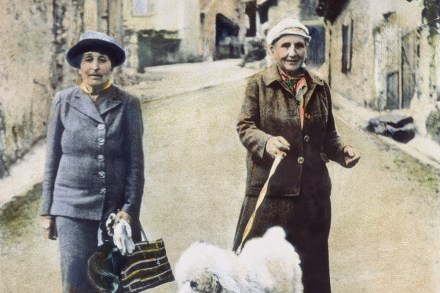
To most people, the salient qualities of Gertrude Stein are unreadability combined with monumental self-belief. This is the woman who once remarked that ‘the Jews have produced only three original geniuses – Christ, Spinoza and myself’. Of the reading aloud of her works, Harold Acton complained: ‘It was difficult not to fall into a trance.’ Even if you are as good a writer as Francesca Wade, it is still difficult to avoid the influence of what she herself calls Stein’s ‘haze of words’. So the first half of this impressively researched biography is cerebral rather than colourful. Stein’s writing career really began when, aged 28 (she was born in 1874),

Thomas More’s courage is an inspiration for all time

Three years ago, when memories of the final series of HBO’s Game of Thrones were still fresh, Joanne Paul published The House of Dudley, a gripping account of three generations of the Dudley family, whose efforts to seize the crown from the Tudors, as I noted in these pages, made the machinations of the Lannisters and the Starks look tame. Now, hard on the heels of the final instalment of the BBC’s adaptation of Hilary Mantel’s Wolf Hall trilogy – and with a revival of Robert Bolt’s A Man for All Seasons opening in the West End in August – Paul has published another book equally attuned to the zeitgeist.

Richard Ellmann: the man and his masks

Richard Ellmann’s acclaimed life of James Joyce was published in 1959, with a revised and expanded edition appearing in 1982. The first edition, the work of an ambitious young American academic, received what Ellmann’s editor at Oxford University Press described as ‘the most ecstatic reaction I have seen to any book I have known anything about’. Ellmann’s work would ‘fix Joyce’s image for a generation’ wrote Frank Kermode in The Spectator, a prediction described by Zachary Leader as ‘if anything, too cautious’. By the time of the second edition, Ellmann had become a lionised Oxford don and the image of Joyce he had fixed was starting to chafe. Post-structuralism was

The problem with Pascal’s wager

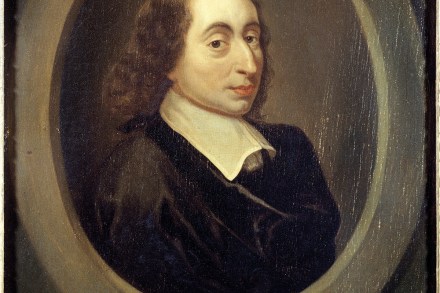
Blaise Pascal resists definition. During a short life (he died in 1662, aged 39) he invented the calculator, laid the foundations for probability theory and created the first public transport system. He was also an austere Catholic, whose call for a return to strict Augustinian doctrines put him outside the religious mainstream. As a philosopher, he is remembered today for his ‘wager’ argument – a challenge to atheists, framed as a cosmic gamble. As Graham Tomlin shows in this lively, conversational biography, Pascal worked in threes, often steering a course between extremes. As a Catholic, he refused to commit to the new sect of Jansenism, but also abhorred the Jesuits’

Rafael Nadal: king of the orange brick court

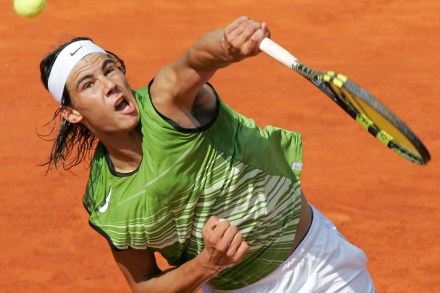
Even the greatest have setbacks. It is how they respond that makes them great. Take your chances, forget the lapses. The triumvirate who ruled men’s tennis this century – Novak Djokovic, Rafael Nadal and Roger Federer – each won just 54 per cent of the points they played. It was about turning it on when it counted. No one could turn it on like Nadal on Parisian clay. The orange brick dust of Roland Garros on which he slid and scampered so well seemed to inspire the Spaniard with magical powers. From 19 visits to the French Open, he returned to Mallorca only five times without the Coupe des Mousquetaires

The love that conquered every barrier – including the Iron Curtain

In our age of cosmetic fantasy, a dramatic love story between two bespectacled art historians sounds implausible. But add in the Montague-Capulet effect of the Iron Curtain, along with a fearless Russian heroine who proved that love can conquer every barrier, and you have an enchanting tale: a completely true one, beautifully written by the art historian and novelist Iain Pears, the author of An Instance of the Fingerpost among many other books. Pears, who had been a pupil of Francis Haskell, began to visit his former tutor’s widow Larissa Salmina on a regular basis after 2000. He soon realised from odd remarks just how extraordinary their lives had been.

The psychiatrist obsessed with ‘reprogramming’ minds

When the actress Celia Imrie was 14, she was admitted to an NHS hospital where she was given medication intended for delusional, hallucinating, agitated schizophrenics. Though not diabetic, she was regularly injected with insulin, which lowered her blood sugar so that she became shaky, anxious, ravenously hungry and so confused she couldn’t recognise her own family. Yet she was one of the luckier ones. Other patients were given enough insulin to induce a coma caused by dangerously low glucose levels, and some even died.  Why was Imrie subjected to this? Because she was anorexic and had been placed in the care of a notorious psychiatrist who believed in aggressive physical

William Blake still weaves his mystic spell

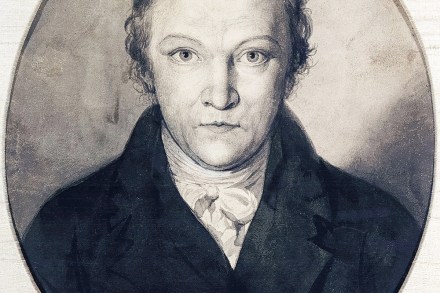
Everyone has their own William Blake and each age finds something new in the ocean of his work: revolutionary Blake, Christian Blake, humanist Blake, Jungian Blake, Freudian Blake, free-love Blake, hippy Blake, occult Blake, eco-Blake. The only time that missed out was his own – then he was mad, delusional and ignored Blake. Philip Hoare brings the fizz of his own sensibility to bear on the work of a man whose progeny of artistic spin-offs multiply with each passing generation. The result is a book that is neither Blake biography nor critical analysis nor legacy-tracing nor personal odyssey but a capacious mixing of them all. As the author of Leviathan

Across the universe – John and Paul are in each other’s songs forever

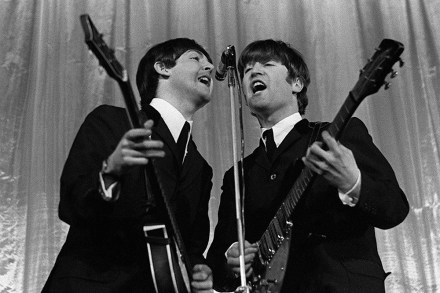
The world’s love affair with the Beatles began, arguably, with the release in October 1962 of the group’s first single ‘Love Me Do’, full-blown Beatlemania following hard on its Cuban heels. Will we still need them, will we still feed them, when they’re 64? The answer appears to be a resounding and remunerative yes. Beatlemania is for life, not just for Christmas. Beatles books increasingly obtain to the condition of poetry, in that more people want to write them than read them. Yet still they keep appearing in bookshops. And every time a new volume about the group is published – like all those of sound mind, I have loved

How Anne Frank’s photograph became as recognisable as the Mona Lisa

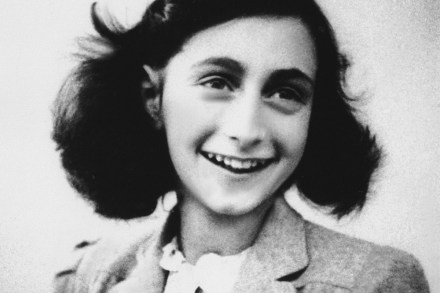
Anne Frank died of typhus in Bergen-Belsen in late February 1945. Her last days were spent in the sick barracks caring for her sister Margot, who had a high fever and smiled contentedly, her mind already wandering. Anne, too, had been feverish, but ‘friendly and sweet’, according to witnesses. Her last recorded words were: ‘Margot will sleep well, and when she sleeps I won’t need to get up again.’  Ruth Franklin’s superb and subtle book pivots around this moment, which is described in a starkly titled central chapter, ‘Corpse’. Half her study tells Anne’s story up to the tragedy of her death. It traces her parents’ backgrounds and characters, her

The adventures of the indomitable Dorothy Mills

When Dorothy Mills disappeared to Haiti to research a travel book, the British press led with the headline: EARL’S DAUGHTER GOES TO SEE BABIES EATEN IN BUSH. Mills was never out of the news in the interwar years. She wrote nine novels as well as six travel books, all of which sold briskly, and in 1928 she was the only woman in the starry line-up at London’s Explorer’s Week (Ernest Shackleton’s skipper, Frank Worsley, spoke alongside her). She was born Dorothy Walpole, in 1889.Her father, Robert, became the fifth Earl of Orford when she was five. Her ancestors included Britain’s first prime minister, another Robert. The young Dolly travelled widely

The Bloomsbury Group’s precarious paradise

The artist Vanessa Bell, née Stephen, the wife of Clive Bell, is enjoying the limelight this year as an exhibition of her work travels the country. Hot on its coat-tails comes Wendy Hitchmough’s beautifully illustrated new study of Bell’s life and art. As the former curator of the painter’s home at Charleston, Hitchmough writes with insider knowledge, supported by an armoury of scholarship: the bibliography alone stretches to 14 pages and the notes to 45. Somewhere within this carapace is a uniquely original and talented artist struggling to get out – a true radical whose story was one long, rolling sequence of experiments in leading as creative a life as