Eu

How Vladimir Putin is waging war on the West – and winning

Last month, the speaker of the Russian parliament solemnly instructed his foreign affairs committee to launch a historical investigation: was West Germany’s ‘annexation’ of East Germany really legal? Should it be condemned? Ought it to be reversed? Last week, the Russian foreign minister, speaking at a security conference in Munich, hinted that he might have similar doubts. ‘Germany’s reunification was conducted without any referendum,’ he declared, ominously. At this, the normally staid audience burst out laughing. The Germans in the room found the Russian statements particularly hilarious. Undo German unification? Why, that would require undoing the whole post-Cold War settlement! Which is indeed a very amusing notion — unless you

Emir Kusturica interview: why Slavoj Žižek is a fraud

Last month I was invited on a press trip to Serbia. The whole thing sounded great; free accommodation, free food, free travel. I said yes, obviously. But there was a catch; it involved an interview with the film director Emir Kusturica. Now, the first thing you should know about Emir Kusturica is that he’s huge, a proper man-mountain. His hands look like they could do more damage than your average battle tank, and at 6’3″, he must be at least a head taller than me. Not that I’m thinking this lucidly when finally the interview moment comes. Before I begin my questions, I’m more than a little scared that, at any

Martin Vander Weyer

Bet on a swift Grexit

‘Will Greece exit the eurozone in 2015?’ Paddy Power was pricing ‘yes’ at 3-to-1 on Tuesday, with 5-to-2 on another Greek general election within the year and 6-to-4 on the more cautious ‘Greece to adopt an official currency other than the euro by the end of 2017.’ I’m no betting man — as I reminded myself after backing a parade of point-to-point losers on Sunday — and I defer to our in-house speculator Freddy Gray, who will offer a wider guide to political bets worth having in the forthcoming Spectator Money (7 March). But on the Greek card I’m tempted by the longer odds on the shorter timeframe, because this

The Eurozone crisis is as much a political problem as it is an economic one

Veterans of Eurozone crisis summits, hoping for another nail-biting drama, had queued to get ringside seats. But yesterday’s meeting over Greece with Eurozone Finance Ministers ended without result. And you shouldn’t be surprised. We’ve been here many times before – Eurozone committees keep minutes but lose hours – and this was not a meeting during which decisions were to be taken. While some Eurozone watchers have convinced themselves that there is now a new script for Greece’s relation with its Eurozone creditors, no Eurozone government but the Greek share that view. It’s not just that other capitals are hostile to Greece’s own game plan of forcing other governments to make a new

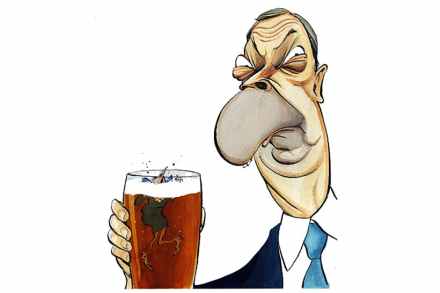
Kindred spirits? Nigel Farage wants Jean-Claude Juncker as his drinking buddy

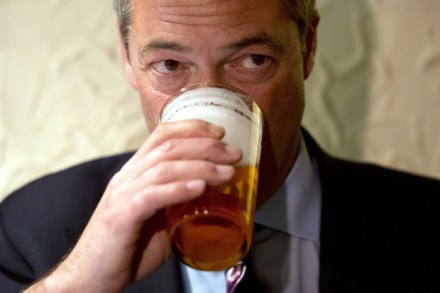
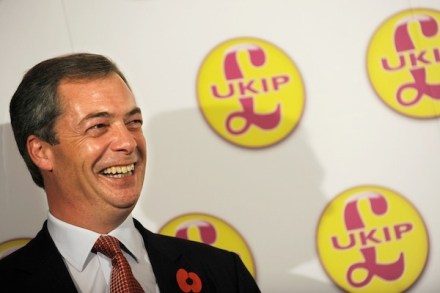
Nigel Farage wrote in the Spectator of his struggle to complete Dry January, while Jean-Claude Juncker is reported to be partial to a glass of cognac to kick start the day. So it came as little surprise to Mr Steerpike that the leader of Ukip named the President of the European Commission as his preferred drinking partner. Asked by Jim Mellon of Master Investor who out of David Cameron, Nick Clegg, Ed Miliband, Jean-Claude Juncker, Hilary Clinton and Jeb Bush, he would most like to go for a pint with, Farage opted for Juncker. ‘Oh Juncker every time, top man . I don’t agree with him politically, but I tell you something, he’s got a

Worry about the eurozone crisis if you like. But profit, too

If you want something to worry about, you need only cast your eye across the channel to find yourself spoilt for choice. There is the background noise of massive unrepayable sovereign debt levels. There’s huge youth unemployment. There are angry minority political parties — note the rise of Spain’s anti-austerity party Podemos. There is the battle between those who think the eurozone can survive as just a monetary union and those who know that it will only survive if it gives into political union. There is the threat of deflation (nice when you aren’t in debt, crippling when you are). There is the new phenomenon of negative yields, whereby desperate

Taki’s recipe for the survival of the Greek nation

The good news is that a Greek suppository is about to relieve the EU’s economic constipation. The bad is that there’s a Castro in our midst posing — just as Fidel did 56 years ago — as a democratically elected populist. Back then it was Uncle Sam who was the bogyman. Now it’s the EU. Back then the Soviet Bear came to Fidel’s rescue. Now it’s Putin. Personally, I’d take Vlad over the faceless unelected Brussels gang anytime. The problem is Tsipras, a vulgar-sounding name if ever there was one. Add to it the fact that he has two sons, one named after Che Guevara, the other after Carlos, the

This time next year Greece will be out of the euro or Syriza will be out of power

There has been much interest in the European Central Bank making a new call on Greek government bonds, saying that ‘it is currently not possible to assume’ the bonds to be safe assets once the bailout programme expires. This is as you might expect: after all Yanis Varoufakis, the new Greek Finance Minister, has been touring European capitals this week to remind creditors that Greece is bankrupt. Yet markets and Twitter – our two modern messengers of truth – ‘spooked’, along, of course, with the poor souls who thought Greece’s Attica or Piraeus banks to be worthy an embrace by their savings. Loans to the Greek government fetch a 9.7

Why France so worries European policy makers

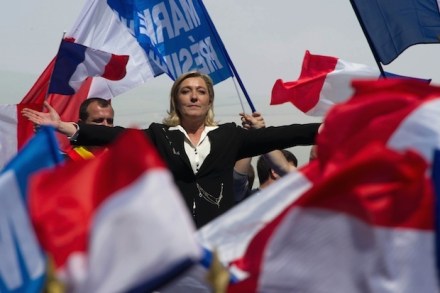
Today’s huge Podemos rally in Madrid is a reminder that Syriza’s victory in Greece has emboldened the anti-austerity left across the Eurozone. What worries Angela Merkel and other northern European leaders is, as I say in the magazine this week, that any concessions to the new government in Athens, will lead to Podemos—a party which was founded less than 12 months ago—wining the Spanish elections later this year. But the country that most worries European policymakers isn’t Greece or Spain but France. Its economy is showing no signs of recovering and its politics are threatening to become very ugly indeed. A new poll published this week shows the Front National’s

Nigel Farage’s diary: How I survived Dry January

Dry January is tougher than it sounds. Well, for me anyway. It’s now been some 28 days since I’ve had a drink, and you should see what that means for my campaigning strategy. ‘Ginger beer? Lemonade?’ Pub-goers around the country can’t believe it when I walk in and whisper my order over the bar. The fact is they don’t believe I’m really doing it. ‘I’m not all spin and bluster like those other lads,’ I usually reply. ‘If I promise I’m going to do something, I’ll bloody well do it.’ Still, I can’t say it’s never going to tempt me again. Especially not given the week I’ve had. It all

James Forsyth

Europe’s crisis is Cameron’s opportunity

Napoleon notoriously preferred his generals to be lucky — and on that score at least, he would have approved of David Cameron. The triumph of the Syriza party in Greece presents him with a glorious opportunity to solve the European question that has bedevilled the Tories for so long. Europe’s difficulty is Cameron’s opportunity. The European elite has been shaken by the scale of Syriza’s victory. Just a few weeks ago, Cameron was arguing in private that Greek voters, who remain overwhelmingly pro-EU, would ultimately not back a party that was intent on a confrontation with the eurozone authorities. European diplomats stressed that even if Syriza won it wouldn’t get

Martin Vander Weyer

What’s good about austerity (whatever the Greeks think)

The only question I remember from my Oxford moral philosophy paper was ‘What is integrity and is it a virtue?’ In the margins of all the politicking that follows the victory of Syriza in the Greek election, I hope someone asks: ‘What is austerity, is it a virtue, and why has it worked in the UK and Ireland but failed in Greece?’ My own definition of austerity in the context of financial crisis, when I debated it with former Greek finance minister George Papaconstantinou, was ‘a synonym for frugal, uncorrupt government supported by willing taxpayers of the sort that has been largely absent in southern Europe’, at which George got

The benefits of breeding like a rabbit

Let’s face it. Whatever Pope Francis actually means when his head is in the clouds during those in-flight press conferences of his, we Europeans need to breed like rabbits if we want to preserve Europe. That is not why I have bred like a rabbit, but it is the brutal truth. I have five children aged 11 down to three — because until the age of 40 I thought I was infertile and did not think I could breed at all, let alone like a rabbit; and because though I am a devout agnostic, I am married to Carla, a devout Catholic, who is much younger than me and refuses

Revealed: Nigel Farage once voted for the Green Party

Nigel Farage’s secret is out. In an interview with the Mail on Sunday, the leader of Ukip let slip that he once voted for the Green Party. ‘I voted Green in 1989 in the European elections,’ Farage admits. While he fails to give any further explanation of why he supported a party that appears to be at loggerheads with his own views, Farage does go on to reveal the most insulting names he has been called. ‘I was called a football hooligan once in public and I didn’t like that. I am many things but a hooligan I am not. I have been called everything this year, absolutely everything, racist, xenophobe – there’s

Greece lightning: six things you need to know about Syriza's victory

It’s official: Syriza, the Greek anti-austerity leftist party, has won the general election. With 98pc of the votes counted it is looks to have taken 149 out of 300 seats, just two short of an overall majority but still in a very strong position. Syriza is pro-EU but anti-austerity – so will soon face a confrontation with the Troika (the European Commission, the European Central Bank and the International Monetary Fund). Germany has indicated that it’s less worried about Greece leaving the EU, so won’t bend over backwards to accommodate demands. The brinkmanship will now begin. 1. Background – the Greek economy Over the last four years Greece has suffered from a depression comparable to 1930s America, resulting in

Syriza's rule will be short-lived: the EU will never give what it wants

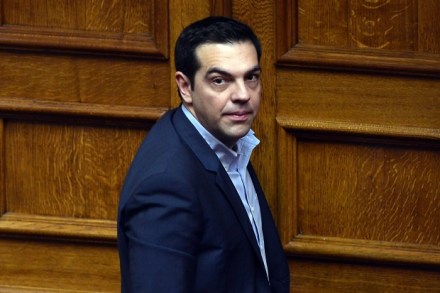
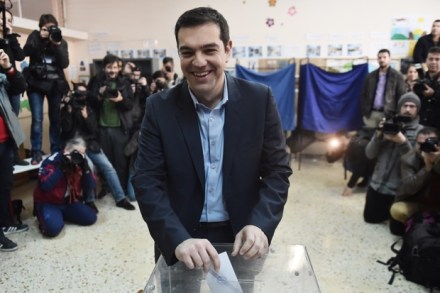
So Alexis Tsipras is Greece’s new Prime Minister. Syriza, the extreme-left party he leads, may end up (just) short of an overall majority. But it won a landslide today – and no one will stand in the way for making government policy of its party programme. This means we’re guaranteed turbulence ahead, both in Greek and Eurozone politics. Syriza is no club for chic leftist posturing, nor is it a discussion circle for grey-haired Marxist academics. It is a coalition of hard and soft communists, violent and peaceful revolutionaries, eco-warriors, radical socialists and a hotchpotch of lefties that think it is an act of fascism to take away bonuses to public servants for washing

James Forsyth

A Syriza majority will put Athens and Berlin on a collision course

The next set of exit polls are now out from Greece and they, again, show Syriza pulling off a spectacular victory. Their lead might even be just enough to see them win an overall majority; the poll estimates that they will win between 148 and 154 seats in the 300 seat parliament. If Syriza do win outright, they will have no justification to voters for watering down their demands to the rest of the Eurozone. They will have a clear mandate to push for the debt restructuring that they want. But Berlin is not going to be in any mood to grant concessions. Angela Merkel is already deeply unhappy about

James Forsyth

Greece votes, Europe waits

Greek voters are currently going to the polls in an election that will have profound consequences for the Eurozone. If the anti-austerity Syriza party wins, as the polls suggest it will—and its lead has actually been increasing in the past few days, the Eurozone crisis will enter a new and more acute phase. Syriza will demand a softening of the terms of the Greek bailout. But the Merkel government, the European Central Bank and the European Commission are adamant that they’ll be no leeway given. With Merkel already deeply unhappy about the ECB’s quantitative easing programme, she isn’t going to sign off on any concessions to Athens. Another reason why

How will the British public take to Rubens’s fatties?

This week a monumental exhibition, Rubens and His Legacy, is opening at the Royal Academy. It makes the case — surely correct — that the Flemish master was among the most influential figures in European art. There are few painters of the 18th or 19th century — from Joshua Reynolds to Cézanne, Watteau to Constable — who were not affected by his work. It will be interesting, however, to discover what the London art public feel about Rubens himself. The British have had a complicated relationship with the great man. Its apex is represented by his residence in London — admittedly for a brief nine months in 1629–30 — his