Watching David Dimbleby watching the royal family, I am instantly reminded of the BBC’s other royal David. It is pure Attenborough as he examines the exotic plumage and rituals of rex Windsorianus in its natural habitat.
In this week’s first episode of What’s the Monarchy For?, a three-part study of the sovereign for BBC1, Dimbleby examines royal power, engagingly prodding and poking fun at both sides. However, it ends as it starts, with our host still scratching his head.
The monarchy is the first thing much of the world thinks about when it thinks about Britain
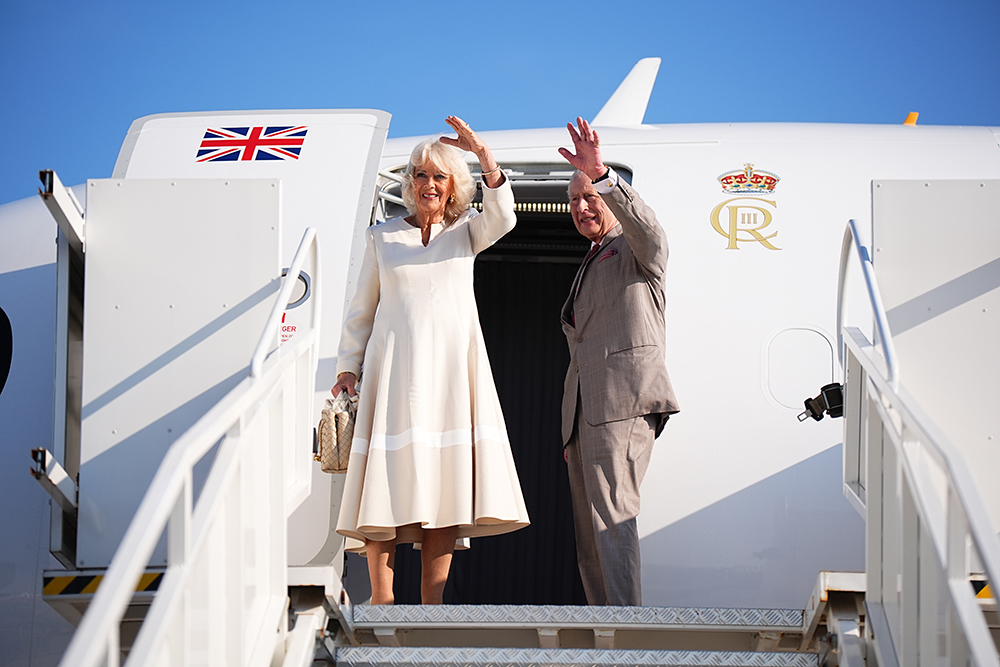
Perhaps we will have an answer by the end of the final episode. For those who do not have three hours to spare, however, I would point to the scene on Windsor high street this week as a very simple answer to Dimbleby’s question. I happened to be there, talking to another arm of the BBC, as we watched the monarchy doing what it does best. The whole town was flying British and German flags. A respectable crowd had turned out to watch the Household Cavalry escorting the royal procession through the town and up to the castle. There was the King, accompanied by Queen Camilla plus the Prince and Princess of Wales. But who was that sitting next to him?
A random straw poll of members of the public revealed a recognition factor of precisely zero. None of those I met in the crowd was able to identify the jovial, bespectacled 69-year-old figure as Frank-Walter Steinmeier, a former foreign minister who has been head of state for more than twice as long as Charles III. To which my German friends might well observe that Mr Steinmeier is a very well-respected Bundespraesident. That is true but it is not the point. Two years ago, I was in Berlin for the reverse exercise as the King paid a state visit (the first of his reign) to Germany. On that occasion, every single person in the – substantially larger – crowds knew exactly who the state visitor was.
Britain is a nation undergoing a slow but steady diminution of its economic, military and geopolitical significance, yet it has one unarguable diplomatic asset. That is not my diagnosis but that of the man who invented and defined soft power, Professor Joseph Nye of Harvard University. I interviewed him for my biography of the late Queen and he told me that Britain will always be at or near the top in soft power terms for two reasons: the English language and the monarchy. In short, the world would rather meet British royalty than anyone else we might park on a red carpet. More than that, repeated international surveys show that the monarchy is the first thing much of the world thinks about when it thinks about Britain.
Dimbleby accepts that this can be of immense value, pointing to the late Queen’s 2011 state visit to Ireland and her subsequent handshake with ex-IRA capo Martin McGuinness as ‘a masterstroke of soft power’. But Dimbleby also suggests that this soft power is shamelessly transactional. He links the current government’s use of the monarchy to schmooze Donald Trump – ‘laying it on with a trowel’ – to the way in which previous governments used the Windsors to seal deals with ‘tyrants’ such as Robert Mugabe and Nicolae Ceausescu. Isn’t that rather the point, though?
The programme is less clear when it seeks to define the domestic power of the monarchy. At times, we are watching a subjective personal appraisal by D. Dimbleby (‘I seem to have been reporting on the monarchy for ever’). At others, it feels like Panorama as former politicians, courtiers and commentators are grilled on the extent to which the King may have overstepped the constitutional mark in comparison with his neutral late mother. Her role in Boris Johnson’s subsequently unlawful 2019 prorogation gets some flak – even if the arch-Remainer Dominic Grieve accepts she had no choice. The shouty fringe group Republic also has its moment, claiming that the royals are ‘intrinsically harmful’ and ‘symbolise feudalism’.
The main charge is that Prince Charles indulged in ‘industrial-level lobbying’ of ministers many years ago. We see plenty of old Charles speeches and Dimbleby reads out a princely letter to then-prime minister Tony Blair nudging him on everything from beef farming to helicopters and signed ‘Yours ever, Charles’ (he can’t resist a dig at the royal signature – ‘It looks like “Mary”’).
At one point, I heard my own voice. It was a clip from a BBC film for Prince Charles’s 60th, when I asked him if he could still champion big causes once he was King. ‘I don’t know. Probably not,’ he replied.

Dimbleby then fast-forwards 17 years and points sternly at shots of the King escorting Sir Keir Starmer and Angela Rayner, around the Duchy of Cornwall’s Nansledan new town near Newquay. This moment is painted as both back-tracking and regal arm-twisting. We are told no one can find ‘any other instance where a reigning monarch has actually been on an official visit with a Prime Minister’. He adds: ‘This is unprecedented.’ It feels a bit of a stretch. Aside from the fact that the King has handed on the duchy to his son and that Starmer and Rayner are not fools, I seem to recall that Downing Street had expressed an interest in a trip at a time when Labour was making a lot of noise about housing. Who was using whom? As for the idea that PMs don’t go on official trips with monarchs, I can think of a few, not least David Cameron hitching a ride on the late Queen’s state visits to Ireland and Germany.
The programme seems surprised that each monarch is different. Yet the King, unlike his mother, came to the throne with a 50-year track record as a charitable entrepreneur, a reservoir of experience which politicians can tap into or ignore.
Asked at one point if he himself is pro-monarchy, Dimbleby replies: ‘I am pro–television series about the monarchy.’ Amen to that. Yet the main challenge to any series with a title like this one is best summed in the words of former Labour special adviser Paul Richards: ‘There’s something deeply irrational about our constitution.’ Until a majority of the UK would prefer to have someone like nice Frank-Walter Steinmeier in charge, that’s just the way it should be.



Comments