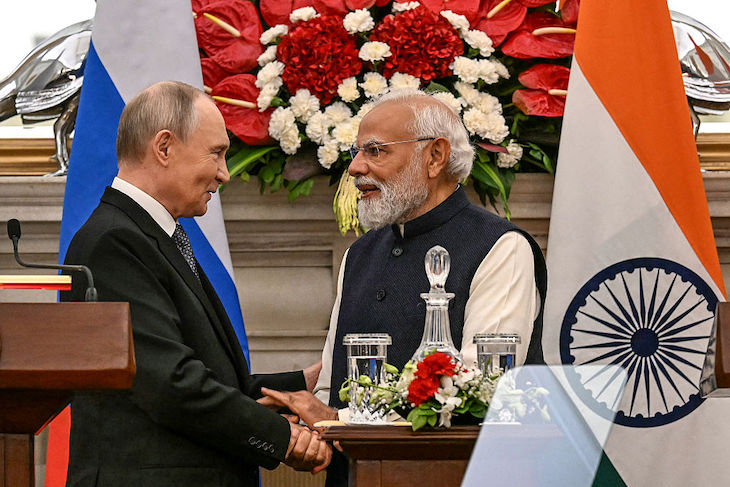
Vladimir Putin lands in Delhi, steps off the plane and instantly gets what he came for: the pictures. The handshake with Narendra Modi, the red carpet, the talk of a ‘special and privileged strategic partnership’. For the Kremlin, this week’s summit in India is mainly a PR exercise: proof to Russians that their country is still received as a great power, while the West tries isolation. But don’t be deceived if it appears that two equal giants are meeting. They are not.
India, the land of the future, has surged to become the world’s fifth-largest economy and is on course to overtake Germany and Japan. Russia, the land of the past, now hovers at the fringes of the global top ten and is likely to also fall behind faster-growing economies such as South Korea and Australia.
India, the land of the future, has surged to become the world’s fifth-largest economy. Russia, the land of the past, now hovers at the fringes
Behind the toasts and communiques, the relationship is brutally transactional. Russia needs buyers for its oil, customers for its weapons and legitimacy. India wants ‘energy security’ – in plain English: cheap oil – and ‘strategic autonomy’: the freedom to do deals with everyone, on its own terms. Putin came for optics. Modi took the meeting for discounts.
The joint press appearance made this clear. Modi slightly sharpened India’s line on the Ukraine war: ‘India is not neutral; India is on the side of peace.’ But the substance has not changed. Delhi still avoids blaming Russia and refuses to join sanctions. Modi has given himself a better soundbite, not a different policy.
Putin, for his part, thanked Modi for ‘peace efforts’ and claimed Russia was working towards a settlement. Both leaders stressed that Indo-Russian ties are ‘not directed against any third country’. Translation: Delhi will not be dragooned into a Russian camp; Moscow will not publicly take sides against India’s other partners.
The defence relationship is shifting in ways that matter more than the rhetoric. For decades, Russia was the backbone of India’s arsenal. Today its share of Indian arms imports has dropped to just over a third as India both buys more from the United States, France and Israel and pours money into ‘Make in India’ defence projects. At this summit, the central Indian message to Moscow was not ‘we want more’ but ‘we expect performance’: faster S-400 deliveries, proper upgrades for existing Su-30 fighters, and fewer excuses. India is not signing up for fresh dependency; it is demanding that Russia honour past promises, while Delhi quietly widens its options.
One much-reported submarine ‘deal’ captured Putin’s problem. Reported as ‘breaking news’ as Putin landed in Delhi, the supposedly new leasing agreement for a Russian nuclear submarine turned out to rest on a contract signed in 2019, dusted off in time for the trip and mis-sold as fresh billions. Classic Putin theatre: repackage old stock as a breakthrough, inflate every remaining ounce of leverage into maximum symbolism.
On paper, Delhi remains non-aligned, fond of talk about friendship with all and enmity with none. In practice, this is old-fashioned realpolitik: a constant calculation about which line best serves Indian interests. Delhi says outright that it will keep buying Russian oil if the price is right – while simultaneously deepening security cooperation with the United States, Japan and Europe. It will also, like recently, quietly trim volumes when sanctions risk biting and insurance problems become too costly. Modi’s transactional score is much closer to Trump’s than to that of any European technocrat still trying to pretend their foreign policy is little more than a series of deals.
It would be misleading to portray the Modi-Putin summit as some great ’tilt’ towards Moscow. India is not drifting into Russia’s camp. It is demonstrating, quite calmly, that it will put Indian interests first, every time.
In the long run this is an opportunity from a Western perspective. Free economies will always offer better technology, more capital and more attractive partnerships than Russia can – as long as Russia remains a petro-kleptocracy. Even more so, of course, while Russia labours under sanctions. So, yes, Putin can keep peddling marked-down oil and yesterday’s weapons, but even the discounts are starting to look like a clearance sale.
Then there is China. For India, Beijing is the primary adversary. The more Moscow leans on Beijing for markets, components and diplomatic cover, the less useful it becomes to India as a ‘balancing’ power.
So India does not have to love the West to see where the better long-term bets lie (and lots of resentment lingers). Its interests are still nudging it towards deeper integration with the democratic, market-driven world. Certainly not as a junior follower, but as one of its key players.
Trump may finally have met his match. Modi is just as deal-driven, but his time horizon appears longer.
Putin still struts loudest on the stage. The numbers, however, say something else: Russia only plays big. India is big.


Comments