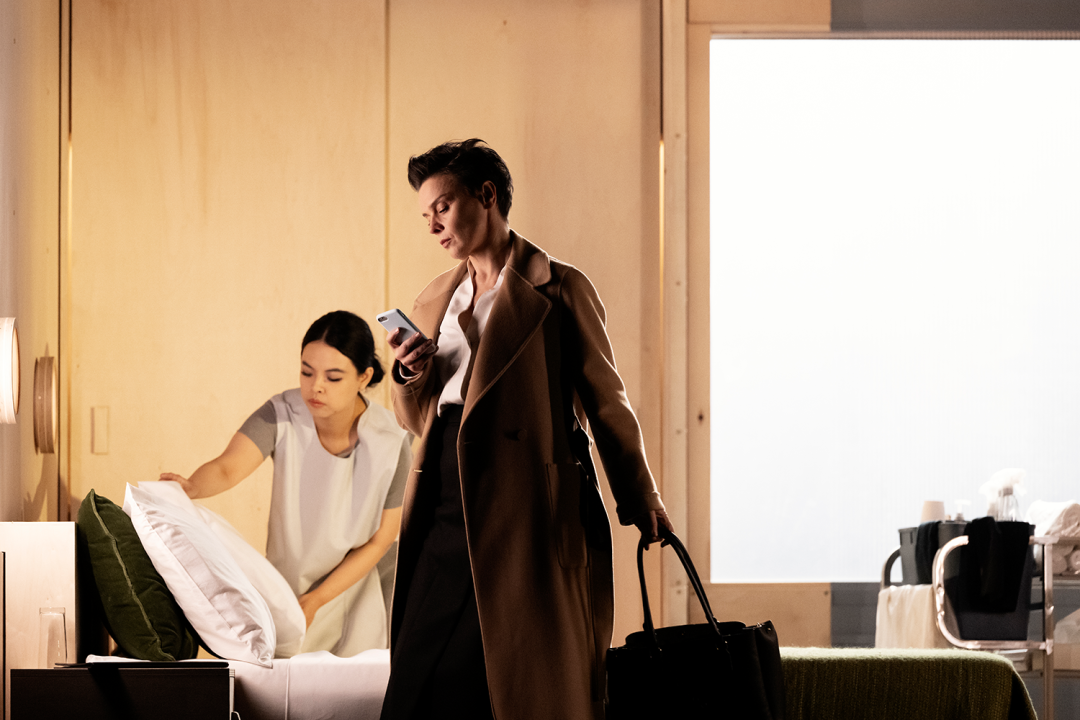
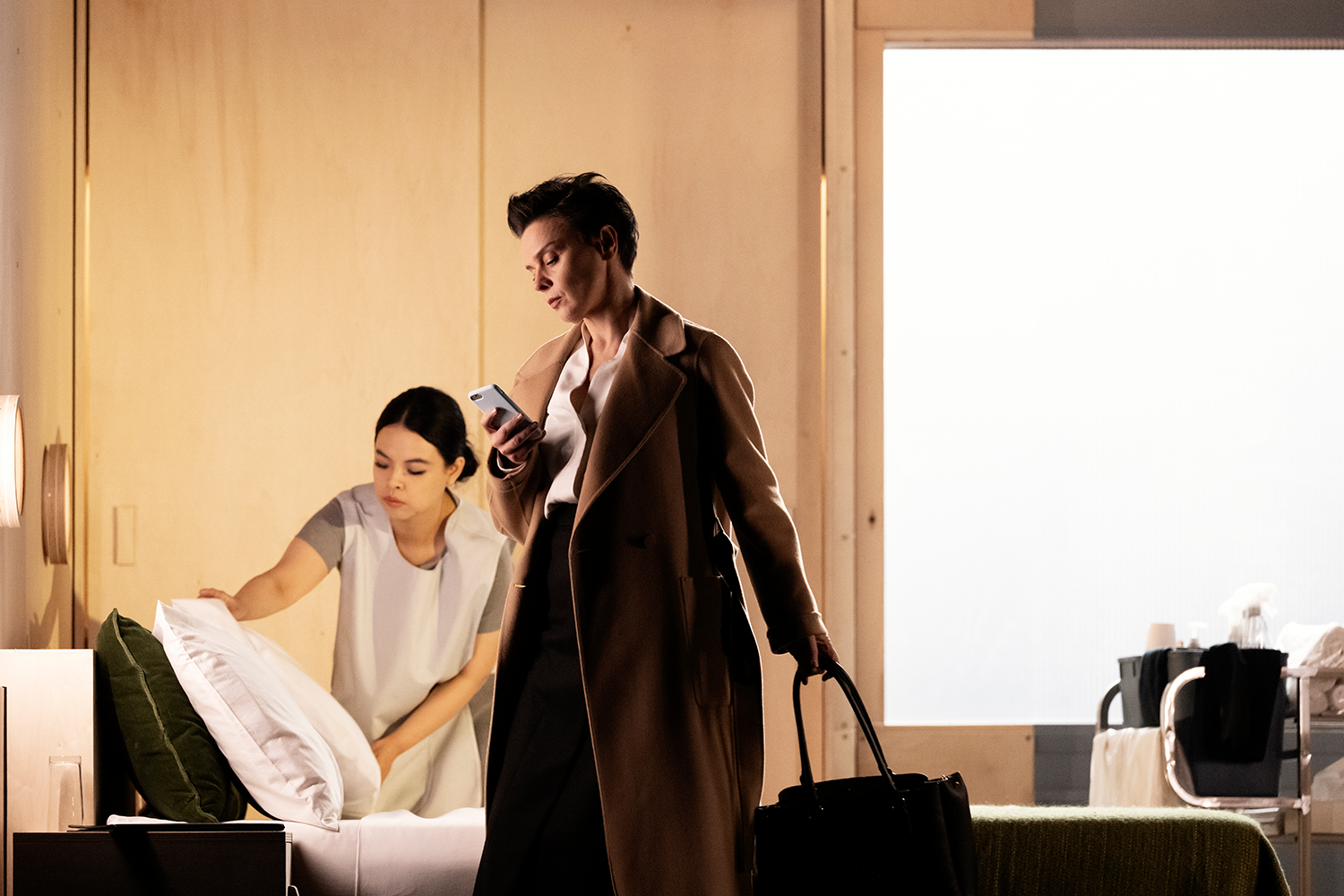
Janacek’s The Makropulos Case is a weird and very wonderful opera, but its basic plot isn’t hard to follow. Still, it seems to send directors into a tailspin. One recent production (since revised) had a cast member break character and pull out a flipchart to recap the story so far. Katie Mitchell’s new staging for the Royal Opera takes the more familiar route of updating the action to the present, and it’s always fascinating to see what opera directors think we’ll find relatable. Luxury hotels, recreational heroin use, Tinder hookups with locally sourced hotties: no, me neither. How the other half live, eh?
In short, it’s a bit like Mitchell’s 2022 re-imagining of Handel’s Theodora. Once again, Mitchell has converted the original drama into a sort of Netflix crime thriller. And once again, she goes in feet-first, grafting on an invented subplot in which the young lovers Janek (Daniel Matousek) and Krista (Heather Engebretson) are criminals involved in a honey-trap heist directed at the opera’s central character, the charismatic (and in this production, predatory) diva Emilia Marty (Ausrine Stundyte).

So a lot of things happen that do not happen in Janacek’s opera, up to and including an (apparently consequence-free) murder. It means that Engebretson has relatively little to sing but a great deal to do, and she does it magnetically, even during the embarrassing slow-motion mime sequences when Marty gazes at her like a female Aschenbach in Death in Venice. The biggest problem – something that badly needs fixing for any future revival – is Mitchell’s decision to spell out her new storyline in a string of rapid-fire WhatsApp messages, projected above the stage throughout Act One.
It’s ingenious, but massively distracting. The action is already split between two separate rooms on stage. With a further stream of visual information to process, on top of the surtitles, it’s an all-out war for your attention. And because this is 2025 and we’ve all had our brains rewired, it can only end one way. The Covent Garden audience duly chuckled at the stream of emojis and LOLspeak while beneath it, the actual opera bustled along; a secondary concern.
But after Act One (the three acts are played without an interval) the updating works well. If you’re coming to The Makropulos Case without any previous knowledge – definitely the best way, so no spoilers here – you’ll see a slick, modern and superbly performed musical drama. In the manner of a Guardian columnist quitting X for Bluesky, Mitchell has announced her intention to retire from opera, which is a pity, because however questionable her production concepts, few directors are better at drawing characters from life, and persuading singers to inhabit them.
She’s phenomenally observant. A sideways glance, a swig from a water bottle, the precise angle at which a character sits; it’s all so human, and seems so natural – a masterly complement to Janacek’s photo-realistic word-setting. Everyone on stage has their own motivations, from Sean Panikkar’s volatile, hormone-crazed Albert to Peter Hoare as the well-meaning dad Vitek, and Alan Oke’s decrepit Hauk-Sendorf; here, an object of pity and dismay rather than the more usual laughter.
Then there’s Marty herself: the way moods flash and ripple across Stundyte’s soigné exterior – imperious, jaded, suddenly impulsive – but also what her voice reveals, particularly in the closing fall of a phrase. Fierce sunlight cools to ice in the course of a few syllables, or simply floats away, soft and desperately sad. There’s an inner glow to Stundyte’s singing that powers through Jakub Hrusa’s firm, translucent account of the score, with its feral trumpets and tear-stained strings. Outstanding performances in a flawed production? Despite everything, it felt better than that, and perhaps The Makropulos Case should always leave you feeling conflicted. See it and decide for yourself.
And keep a look out next Halloween for Gothic Opera, a newish small-scale company that specialises in 19th-century rarities with a supernatural theme. This year they did Offenbach’s Die Rheinnixen, performed in the round and directed by Max Hoehn, who updated a medieval tale of peasants and woodland spirits to early Weimar Germany.
Twenties propaganda posters glowered ominously in the mist, and Hannah von Wiehler conducted a reduced seven-piece orchestra which – if we’re splitting hairs – could probably have used a double bass, for added German romantic darkness.
Because that, remarkably, is what Die Rheinnixen is – an unexpected venture into the territory of Weber and Marschner by the king of French operetta, who later recycled several of its melodies (including the famous Barcarolle) in The Tales of Hoffmann. It was well cast and juicily sung; Katie Stevenson and Hannah O’Brien, in particular, were forceful and wholly compelling as a Rhineland mother and her doomed, lovelorn daughter. Nirvana for Offenbach completists (hands up), and the rest of the audience seemed enthusiastic too.



Comments