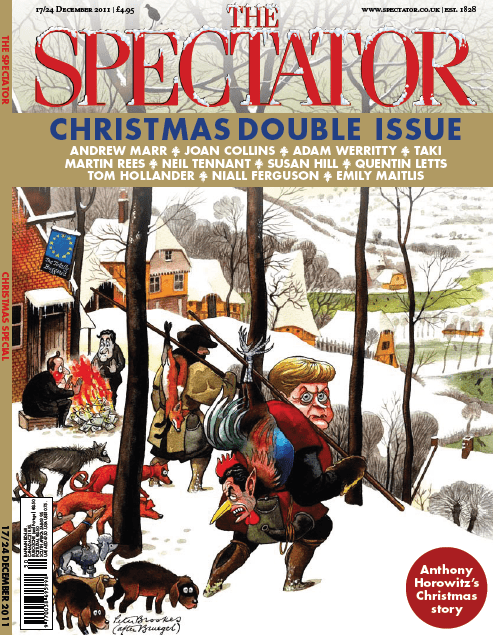
 Look slightly to the left, CoffeeHousers, and what you’ll see is the cover image to this
week’s Christmas double issue of The Spectator — a brilliant send-up of Bruegel’s ‘The Hunters in the Snow’ by Peter Brookes. You’re now able to buy your own copy, but we thought we’d pull out an intriguing little snippet from James Forsyth’s interview with
Andrew Lansley, by way of a taster. The Health Secretary, it seems, isn’t just determined to see health spending rise in real terms in this parliament, but beyond that too:
Look slightly to the left, CoffeeHousers, and what you’ll see is the cover image to this
week’s Christmas double issue of The Spectator — a brilliant send-up of Bruegel’s ‘The Hunters in the Snow’ by Peter Brookes. You’re now able to buy your own copy, but we thought we’d pull out an intriguing little snippet from James Forsyth’s interview with
Andrew Lansley, by way of a taster. The Health Secretary, it seems, isn’t just determined to see health spending rise in real terms in this parliament, but beyond that too:
On its own, this might be reminiscent of how, pre-election, Lansley tried to steer George Osborne’s Budgets in advance. But, as James reveals, Downing St are actually of the same mind as the Health Secretary:‘I ask him whether, despite the ramifications of the autumn statement, the NHS budget will still be immune from cuts. His reply is unequivocal: “We have been very clear that the NHS is going to have real terms increases year on year. I mean clearly what we’ve said in terms of the coalition agreement is an agreement for a parliament. From our point of view, I would say yes is the answer to that because exactly the same principles apply. We have a profile of rising demographics and demand and cost pressures and technology in the NHS, so it is inconceivable that we can sustain the quality of services that we are looking for without the basis of real terms increases.” Does this mean that spending on the NHS will have to rise in real terms every year from now until kingdom come? “I believe so.”’
This may not be too surprising, given how much stock the Tories currently place in increasing spending on the health service. But it does augur a repeat of the last election’s dividing line on the NHS, and of the arguments that surrounded it at the time (such as when the head of the the Audit Commission described the ringfence as ‘insane’). It also makes me wonder whether — now that, with the Autumn Statement, George Osborne has extended his fiscal horizon well beyond 2015 — other ministers might embark upon their own landgrabs for future spending.‘One senior figure at No. 10 tells me that “Dave, George and Steve”, the holy trinity of Cameron, Osborne and Hilton, “all believe that the pressures on the Health Service are such that you are always going to have to increase spending on it”. Lansley is keen to stress that when the economy starts growing at a reasonable rate, you’ll be able to put more money into the Health Service without increasing the share of GDP that it swallows up. For this reason, he thinks that the commitment to ever-rising spending is sustainable.’

Comments