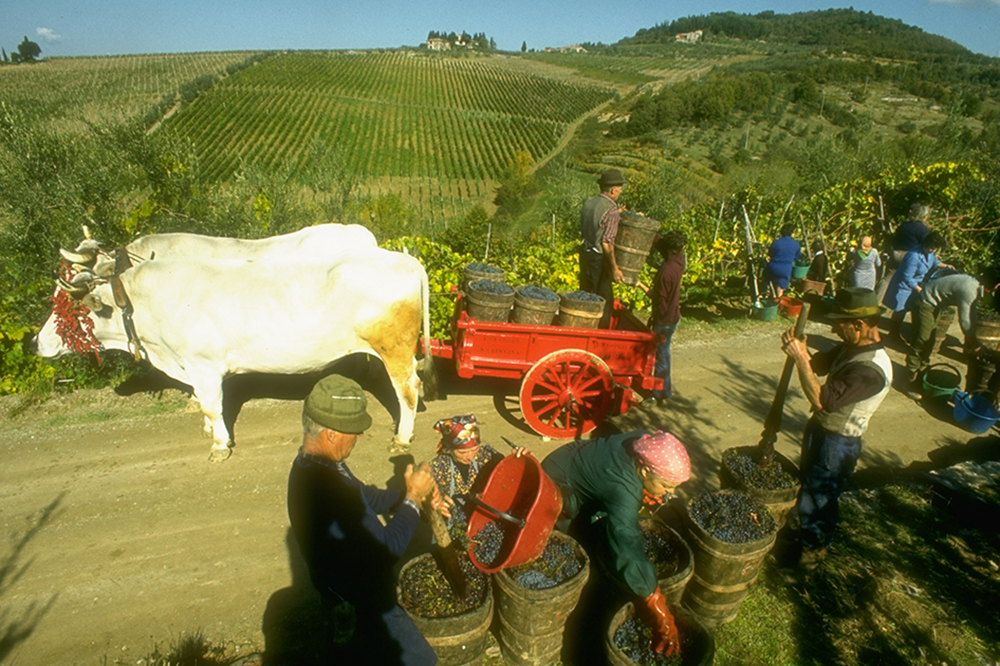

Towards the end of the war, a young Guards officer met some Italian aristocrats. They had much in common. Robert Cecil was the heir to a marquessate. The Principe di Venosa’s daughter was married to an Italian marchese. Lifelong friendships have ensued down the recent generations.

Nevertheless, the English family would be the first to concede that when it comes to generations, the Italians are a couple of centuries ahead. In 1385, Giovanni di Piero joined the Florentine winemakers’ guild. The easy movement between the Florentine bourgeoisie and the aristocracy helps to explain that great city’s long success: the Medici are the obvious example, as are the Antinori, who have been making wine for 26 generations, and are still gaining momentum.
There is a remarkable girl called Alessia Antinori, one of the most energetic people on the planet, who, unusually for an Italian, insists that she does not drink coffee. The Antinori family were always comfortably placed as winemakers but the recent family members were not interested in inherited laurels. Along with their aristocratic friends and friendly rivals the Frescobaldi and the Rocchetta, they were part of a movement to enhance the quality and reputation of Italian wine. This has been an unqualified success. The Antinoris have several vineyards in Tuscany and Umbria. They make Chianti Classico, Brunello and Vino Nobile di Montepulciano.
Anything with the Antinori label guarantees quality but they have gone further. Traditionally, Italian winemakers concentrated on Sangiovese. But the Antinoris experimented with foreign varietals, especially Cabernet Sauvignon. In some quarters, this radicalism produced a sucking of teeth. It was not long before any sucking noises came from appreciative palates.
One of the joys of wine is the people who make it. Those who nurture it always seem life-enhanced, but the Antinori clan stand out
The Antinoris led the onward march of the super-Tuscans: Solaia, Tignanello and Guado al Tasso, not yet as well-known as the others – but the stress is on ‘yet’. One cannot expect bargains with wine of this quality, but Guado al Tasso is – still – excellent value.
That is not all. Alessia loved visiting Puglia, which has been a wine-growing region since time immemorial. Under the brand name Tormaresca, she produces Negroamaro, Primitivo, chardonnay and also some rosés. This is part of a drive – the Il Vicolo restaurant in London is a leader of the British end – to publicise Puglian wines, which have indeed improved greatly since I first came across them 50 years ago.
Yet Italy is not enough. The Antinoris have holdings in Hungary, Malta and Romania: small as yet but watch this space. There is a rather larger property in Chile, but the jewel of the non-Italian crown is in the Napa Valley, above all Stags’ Leap, one of the finest Californian wines.

In total, the Antinoris have about 6,000 acres of vines, and this takes no account of olive plantations, woodlands and other agricultural holdings. That might suggest that Alessia and her two sisters have a full work-load, but they are constantly trying to increase it. As a youngster, Alessia spent four years in Hong Kong; from then on she was determined to open up the Far East markets to Antinori bottles, and has enjoyed considerable success. As part of the ambassadorial drive, she decided to open restaurants which would serve Italian produce and Antinori wines. The Cantinetta Antinori in Belgravia does just that and the food is excellent. The French produce the very grandest food but the Italians know how to make ingredients sing.
So: wine, food, international marketing. That is not nearly enough to keep this human dynamo occupied. Someone once commented that Alessia cannot visit any country without either wanting to buy a vineyard, establish a new wine market or open a restaurant; at moments, all three – but there is even more. Since the early 16th century, the Antinoris have owned a Palazzo in Florence. Alessia is a collector of art, constantly searching for rising talent, encouraging artists and trying to spread the gospel of art as widely as possible.
There is also her farm, not far from Rome, and run on strictly organic principles. Needless to say, it has vines and Fioranello will be a label to conjure with. Alessia is also helping to fill a gap in Italian cuisine. I have always been surprised at how little cheese Italy produces. Gorgonzola made with raw milk is as good as cheese gets, but beneath that, the French are the masters – with increasing competition from the UK. Alessia’s farm produces goat’s milk and sheep’s milk cheeses. They will be winning awards before you know it.
One of the joys of wine, second only to drinking, is the people who make it. Wine is life-enhancing. Those who nurture it always seem life-enhanced.
Even by those exalted standards, the Antinori clan is special. Their story and their history express Italian civilisation. It is not surprising that they emerged from Tuscany. The French may have invented the concept of douceur de vie, but the Tuscans practise it almost effortlessly. That might, in this context, seem a paradox, but it is surmountable. Alessia Antinori and her family prove that you can be as energetic as any mercantile professional anywhere in the world, but still spread delight in the Tuscan way of life.
Italy in general is also flourishing. There was a time when we Brits felt able to patronise Italian politics, but forget dispensing patronage: we are more likely to be in receipt of pity. It is not so very long since Signora Giorgia Meloni was sneered at by the international bien-pensant-ry, derided as a neo-fascist, with sometimes the ‘neo’ omitted. Not these days. It could easily be argued that the Italian Premier is the most impressive leader in Europe: possibly in the entire West. Friedrich Merz? A candidate certainly, but what about the German economy?
Italy benefits from a benign climate, abundant agricultural riches and a biddable population. The Italians have never expected much from their governors, and are always pleasantly surprised when things are better than they feared. We British must console ourselves – and the house of Antinori helps.



Comments